Choosing the right steel tube specifications is about more than size alone. Buyers comparing galvanized pipe specifications, carbon seamless pipe options, or high carbon steel pipe often overlook tolerances, coatings, standards, and delivery requirements that directly affect cost, safety, and project performance. This guide explains the critical details most orders miss, helping engineers, purchasers, and project teams make more accurate and cost-effective decisions.
In steel sourcing, a tube that looks correct on paper can still create welding problems, fit-up delays, coating failures, or non-compliance at the project site. That risk grows when orders move across regions and must align with ASTM, EN, JIS, or GB requirements. For importers, fabricators, distributors, and project managers, a good specification sheet is not a formality; it is a cost-control tool.
As a structural steel manufacturer and exporter from China, Hongteng Fengda supports global buyers with standard and customized steel solutions for construction, industrial, and manufacturing applications. While the company is widely known for angle steel, channel steel, steel beams, cold formed profiles, and OEM structural components, the same sourcing discipline applies to steel tubes: details decided before production often determine whether a shipment performs as expected over the next 5, 10, or 20 years.
Why Steel Tube Specifications Fail at the Ordering Stage
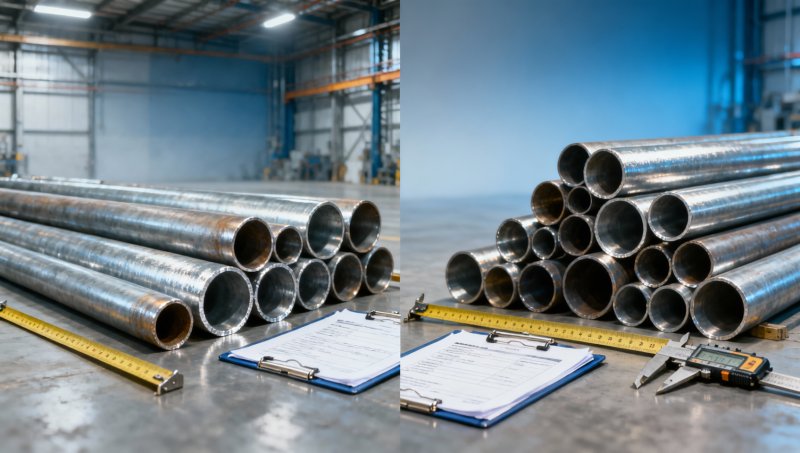
Many orders begin with only three data points: outer diameter, wall thickness, and length. That is not enough. Two tubes with the same nominal size can differ in steel grade, tolerance range, galvanizing thickness, end finish, straightness, hydrostatic testing, and mill documentation. These differences directly affect total installed cost, even when the unit price difference is only 3% to 8%.
A common issue appears when buyers request “galvanized pipe” without defining whether the requirement is pre-galvanized, hot-dip galvanized after fabrication, or zinc-coated to a specific mass such as 275 g/m². In outdoor or humid service, coating ambiguity can shorten maintenance intervals from 8–12 years to only 2–5 years, depending on the environment and exposure level.
Another mistake is mixing commercial terms with engineering terms. For example, a purchaser may ask for carbon seamless pipe, while the project drawing actually requires a pressure-grade seamless tube with testing and traceability. The product may still be “carbon steel,” but if the standard, inspection method, or heat treatment is wrong, the shipment can be rejected before installation.
Specification failure also happens when procurement and technical teams work separately. The engineering team focuses on load, pressure, or weldability, while the sourcing team focuses on lead time, MOQ, packing, and shipping efficiency. Without a shared checklist of 6 to 10 key items, the order often leaves out the details that matter most at delivery.
The most frequently missed specification points
- Dimensional tolerance, including OD, wall thickness, and cut length tolerance such as ±0.5 mm or ±1.0 mm
- Steel grade equivalency between ASTM, EN, JIS, and GB when projects involve multiple countries
- Coating type and coating mass, especially for galvanized or corrosion-resistant tube applications
- Required testing, such as hydrostatic test, eddy current test, flattening test, or tensile verification
- Surface condition, end treatment, bundle weight, and packaging for sea shipment or distributor stock
The table below shows how seemingly small omissions lead to larger project consequences.
For most B2B buyers, the lesson is simple: a complete steel tube specification reduces hidden costs better than aggressive price negotiation alone. A lower ex-works price can quickly become the more expensive option once field modification, delay penalties, or inspection failures are included.
The Core Technical Details Buyers Should Confirm Before Production
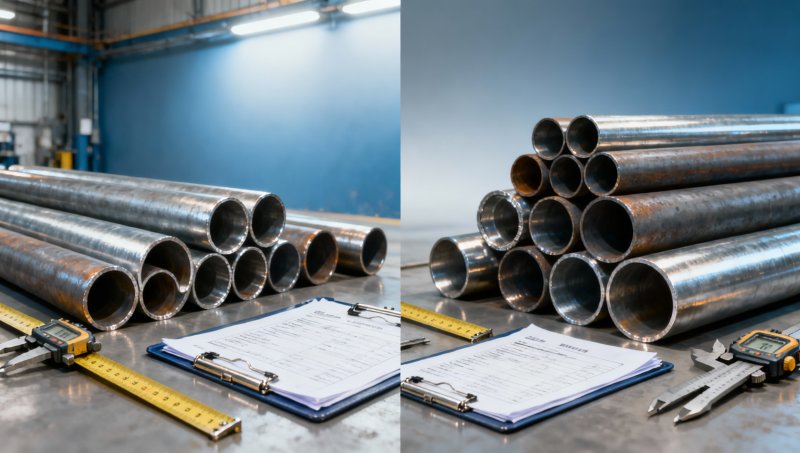
Before issuing a purchase order, buyers should confirm at least 8 technical dimensions of the steel tube requirement. The first group includes basic geometry: outer diameter, wall thickness, random or fixed length, and permissible tolerance. For fabricated structures, cut length accuracy such as 0 to +5 mm can matter more than nominal size because it affects assembly sequence and waste control.
The second group includes material and process data. This means steel grade, manufacturing route, and condition: ERW, seamless, cold formed, hot finished, normalized, or as-rolled. Carbon seamless pipe used in mechanical applications may need a different surface finish and dimensional consistency than tube used in general structural supports. High carbon steel pipe, when specified, also requires closer review of machinability, brittleness risk, and forming limitations.
The third group covers compliance and inspection. Buyers should list the governing standard, required test items, document type, and acceptance criteria. If the project is for infrastructure, industrial plants, or export distribution, the order should state whether third-party inspection is needed and whether marking must include heat number, standard, size, and batch identity.
The fourth group includes practical delivery details. These are often ignored until shipment is ready: bundle size, maximum bundle weight, end caps, anti-rust oil, seaworthy packing, container loading method, and destination labeling. For 20 ft and 40 ft containers, loading plan decisions can affect freight utilization by 5% to 12%, especially for mixed sizes.
A practical specification checklist
The table below can be used by engineers, procurement teams, and quality staff as a shared control list before final order approval.
When this checklist is completed before production starts, buyers usually gain better control over lead time, documentation readiness, and after-sales communication. In export projects, this preparation is often more valuable than requesting a rushed change after the mill schedule is locked.
Three questions that save time and money
- Is the tube selected by nominal size only, or by actual application load, pressure, and connection method?
- Does the coating or surface condition match inland dry storage, marine exposure, or long transit of 30–45 days?
- Are the standards and documents defined clearly enough for customs, site QA, and final client approval?
Coatings, Corrosion Resistance, and the Link to Total Lifecycle Cost
Corrosion protection is one of the most underestimated parts of steel tube specifications. Buyers often compare only the base steel price, but the coating system can determine whether the product requires early maintenance, repainting, or replacement. Galvanized pipe specifications should therefore include not only the word “galvanized,” but also coating method, coating weight, surface treatment, and expected service environment.
In many projects, the steel tube is only one part of a larger structural package that includes profiles, beams, channels, support brackets, and formed parts. For this reason, corrosion strategy should be coordinated across the entire steel package rather than chosen item by item. A mismatch between tube coating and adjacent structural members can create uneven service life and maintenance planning.
This is also where coated flat steel products can support a better overall solution. For roof systems, cladding supports, fabricated enclosures, and cold formed accessories used near tube assemblies, AZ150 Galvalume Steel Coil offers a practical corrosion-resistant option. Available in AZ30–AZ275 coating ranges, widths from 30–1500 mm, and thicknesses from 0.125–2.0 mm, it supports fabrication needs where paintability, workability, and surface protection must be balanced.
For buyers evaluating full-package sourcing, that matters because coated tube and coated sheet components often work in the same environment. Material options such as SGCC, DC51D, DX52D, and S250GD–S550GD allow different strength levels, while surface conditions including chromated, skin pass, oiled, dry, AFP, and non-AFP give more flexibility for downstream processing. The goal is not to replace tube selection with coil selection, but to align the whole steel package to one service-life plan.
How coating choice changes project economics
The following comparison shows why corrosion protection should be treated as a specification decision, not an afterthought.
A buyer looking only at unit price may miss the larger cost picture. If the environment includes coastal air, chemical exposure, or frequent wet-dry cycles, the correct coating choice can reduce maintenance interventions over a 10-year period and improve asset reliability. That is particularly relevant for distributors and project owners who must control both procurement cost and service-life risk.
How to Evaluate Suppliers, Standards, and Delivery Commitments
A steel tube order is not complete when the technical specification is correct. Supplier capability must also match the order complexity. For international projects, buyers should confirm whether the supplier can work with multi-standard requirements, mixed product packages, OEM processing, and export documentation. A vendor that handles only one domestic grade may not be the right fit for a project requiring ASTM plus EN comparison or custom marking.
Lead time should be reviewed in production terms, not only in sales terms. Ask how many stages are involved from order confirmation to shipment. A typical export cycle may include 4 to 6 stages: drawing or specification review, raw material allocation, rolling or forming, inspection, packing, and container loading. If one stage is unclear, promised delivery dates can become unreliable.
Quality control is equally important. Buyers should ask what is inspected in-process and what is checked before shipment. For example, does the mill verify dimensions by batch or by piece? Is coating visually inspected only, or measured? Are mechanical properties taken from the parent coil, from the finished tube, or from test coupons? The answer affects how much confidence a buyer can place in the final documents.
Hongteng Fengda’s export-oriented model is relevant here because many global buyers prefer one supplier that can coordinate structural steel products under recognized international standards. Stable production capacity, consistent quality control, and dependable lead times help reduce sourcing risk when projects combine standard items with custom steel components.
Supplier evaluation points for procurement and project teams
- Can the supplier produce to ASTM, EN, JIS, or GB and explain grade equivalence clearly?
- Can they support OEM requirements such as cut-to-length, punching, surface condition control, or mixed packing?
- Do they provide clear inspection records, MTCs, and shipment marking for traceability?
- Can they maintain lead times across repeat orders of 2–4 weeks or larger scheduled deliveries?
- Do they understand container optimization, export packing, and destination-specific labeling needs?
A realistic delivery planning approach
For distributors, EPC buyers, and industrial users, a practical approach is to divide purchasing into three checkpoints. First, confirm the final specification and documents before production. Second, verify in-process status at around 30% to 50% completion for large orders. Third, review packing lists, labels, and test documents before loading. This three-checkpoint process usually prevents the most expensive cross-border errors.
It is also wise to align lead time with shipping reality. A mill completion time of 15 days does not mean material arrives in 15 days. Port booking, customs, and ocean transit may add another 10–40 days depending on destination. Procurement teams that separate production lead time from logistics lead time make better budgeting and installation decisions.
Common Buyer Mistakes, FAQ, and a Smarter Ordering Process
Even experienced buyers can repeat the same mistakes when steel tube orders become urgent. The most common error is assuming that a previous order can be copied without checking whether the new project uses the same exposure conditions, same welding process, same code requirements, or same packing rules. A tube suitable for warehouse interiors may not be suitable for a coastal platform or outdoor support frame.
Another frequent mistake is approving a quotation that uses general descriptions instead of measurable criteria. Terms like “standard quality,” “export package,” or “galvanized finish” are too broad. Measurable terms such as 6 m fixed length, ±1% wall tolerance, coating mass range, bundle weight limit, or specific standard reference give both buyer and supplier a shared technical language.
The most effective ordering process is usually a 5-step workflow: requirement review, specification confirmation, sample or document validation, production control, and pre-shipment check. This process is especially valuable for decision-makers and finance approvers because it lowers claim risk and makes pricing easier to evaluate against actual project value.
Below are common search-driven questions that often come up during steel tube procurement and project evaluation.
How do I choose between galvanized pipe and carbon seamless pipe?
Choose based on service condition and performance need, not on habit. Galvanized pipe is often preferred for atmospheric corrosion resistance in outdoor or humid settings. Carbon seamless pipe is often selected where pressure performance, uniform structure, or tighter mechanical expectations are more important. In some projects, both are used in different parts of the same system.
What documents should be required with an export steel tube order?
At minimum, buyers often request commercial invoice, packing list, mill test certificate, and marking identification. Depending on project type, additional inspection reports, coating verification, or third-party witness records may be required. If these are needed, they should be written into the PO before production begins.
What are the main warning signs in a quotation?
- The standard or grade is missing, replaced only by a trade description.
- The quotation lists nominal size but no tolerance or test requirement.
- Coating is mentioned without method or coating mass.
- Lead time is promised without defining production and shipping stages.
- Documents and packing are treated as optional instead of controlled deliverables.
Steel tube specifications influence much more than purchase price. They affect compliance, fabrication efficiency, corrosion performance, lead time predictability, and long-term maintenance cost. Buyers who define tolerance, standard, coating, inspection, and delivery conditions clearly are far more likely to receive material that performs correctly the first time.
For global projects that also require structural profiles, cold formed sections, or customized steel components, working with an experienced Chinese manufacturer and exporter can simplify coordination and reduce sourcing risk. If you need help comparing steel tube specifications, aligning standards, or building a more complete steel package, contact Hongteng Fengda to get a tailored solution, discuss product details, and plan a more reliable order.
Please give us a message


Please enter what you want to find