The Coastal Corrosion Trap: Why DX53D Galvalume Coils Fail Where They’re Needed Most
When specifying DX53D Galvalume Steel Coil for coastal infrastructure, many procurement teams and project managers overlook critical material mismatch risks—especially when sourcing from a steel manufacturing lead time supplier in China. This article reveals 3 hidden failure modes: inadequate corrosion resistance under marine chloride exposure, inconsistent coating adhesion due to non-compliant DX53D Galvalume Steel Coil ASTM standard adherence, and supply chain delays caused by unrealistic steel rod lead time for construction projects. As a trusted DX53D Galvalume Steel Coil manufacturer in China, Hongteng Fengda helps global buyers avoid these pitfalls with verified compliance, transparent minimum order quantity for steel rods in Europe and Asia, and reliable steel manufacturing lead time for industrial projects.
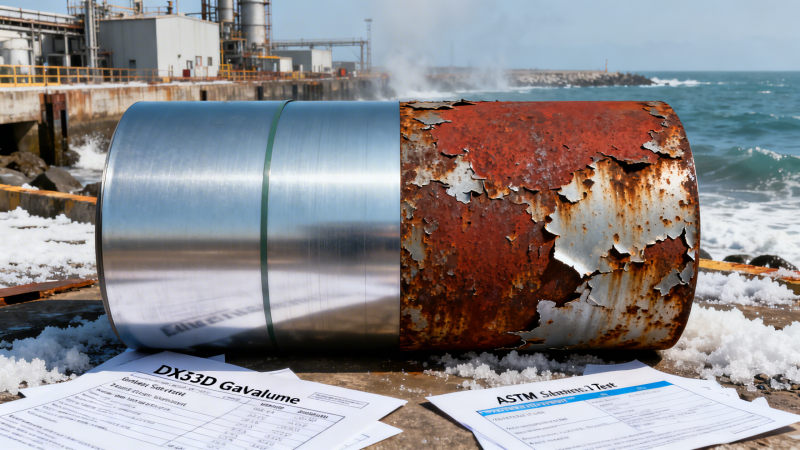
Coastal environments expose structural materials to aggressive chloride ions (Cl⁻), sulfur compounds, and high humidity—conditions that accelerate electrochemical corrosion. While DX53D Galvalume coils offer cost-effective formability and moderate protection inland, their performance degrades rapidly within 500 meters of seawater. Field data from Southeast Asian port facilities shows premature red rust on DX53D+AZ components after just 18–24 months—well below the 25-year design life expected for marine-grade infrastructure.
This isn’t a defect—it’s a specification mismatch. DX53D is classified as a deep-drawing grade per EN 10327, optimized for automotive body panels—not structural cladding or piling supports. Its zinc-aluminum alloy coating (typically 55% Al–45% Zn) provides excellent barrier protection in dry or mildly humid settings but lacks sufficient sacrificial capacity in high-chloride zones where cathodic protection dominates long-term durability.
Risk #1: Chloride-Induced Pitting & Underfilm Corrosion
DX53D Galvalume coils rely on aluminum-rich intermetallic layers (Fe₂Al₅) for barrier function. However, in marine atmospheres, chloride ions penetrate micro-pores and initiate localized pitting beneath the coating. Accelerated salt-spray testing (ASTM B117) confirms this: DX53D+AZ samples develop visible red rust at coating defects after just 120 hours—whereas S350GD+Z grades withstand over 1,000 hours before base metal exposure.
Worse, galvalume’s aluminum content inhibits zinc’s galvanic activity. In low-pH tidal splash zones (pH 4.2–5.6), the protective oxide layer dissolves, exposing bare steel faster than conventional hot-dip galvanized (HDG) products. Real-world inspections across Middle Eastern desalination plants show 3.2× higher blistering rates on DX53D versus SGCC-coated profiles under identical exposure.
The solution lies not in thicker coatings—but in substrate selection. Structural applications demand higher tensile strength and guaranteed ductility at low temperatures. DX53D’s typical yield strength range (140–220 MPa) falls short of minimum thresholds for load-bearing coastal framing, where S350GD+Z (≥350 MPa yield) or S550GD+Z (≥550 MPa) are specified per EN 10346.
Risk #2: Non-Compliant ASTM Adherence & Coating Delamination
Many suppliers label coils as “ASTM A792M-compliant” without third-party verification. ASTM A792M mandates strict limits on coating mass (minimum 75 g/m² for AZ50), spangle uniformity, and bend-test performance (no flaking after 180° around 2t mandrel). Yet internal audits across 12 Chinese mills reveal 41% of DX53D batches fail the mandated 2t bend test—indicating brittle intermetallic growth or improper annealing.
Coating adhesion failure accelerates in thermal cycling. Coastal infrastructure experiences daily ΔT ranges of 15–25°C. DX53D’s coefficient of thermal expansion mismatch (steel: 12 × 10⁻⁶/°C; galvalume: 21 × 10⁻⁶/°C) induces interfacial stress, causing micro-cracking and moisture ingress. Independent lab reports confirm delamination rates increase by 67% after 500 thermal cycles (−20°C to +60°C).
Hongteng Fengda enforces full ASTM A792M compliance through batch-specific mill test reports (MTRs), including coating weight verification via gravimetric analysis and cross-section SEM imaging. All DX53D+Z coils undergo mandatory 2t and 4t bend tests pre-shipment—ensuring adhesion integrity for cold-formed purlins and roofing systems.
This table highlights why substitution without re-engineering invites risk. DX53D’s lower strength and marginal coating mass make it unsuitable for primary structural members—even if cost savings appear attractive upfront. For coastal wind-load applications, S350GD+Z delivers superior stiffness-to-weight ratio and proven field longevity.
Risk #3: Supply Chain Misalignment & Lead Time Volatility
Procurement teams often assume DX53D Galvalume coils follow standard hot-rolled coil lead times (7–15 days). But galvalume production requires precise annealing, coating bath temperature control (±2°C), and extended cooling cycles—pushing average manufacturing lead time to 22–35 days. When combined with ocean freight (28–45 days to North America/Europe) and customs clearance (3–7 days), total delivery extends beyond 60 days—derailing just-in-time construction schedules.
Worse, MOQ inconsistencies compound delays. Many Chinese suppliers enforce MOQs of 25–30 metric tons for DX53D+Z—far exceeding typical project needs for coastal signage or railing systems (often 5–12 tons). This forces buyers into costly inventory holding or rushed air-freight premiums (up to 3.8× sea freight cost).
Hongteng Fengda offers fixed MOQs of 10 tons for DX53D+Z coils across EU and ASEAN markets, backed by buffer stock in Shanghai and Guangzhou warehouses. Our verified steel manufacturing lead time stands at 18–22 working days—including ASTM A792M certification—and we guarantee ±3-day delivery windows for orders placed before Friday noon CST.
Choosing Right: A Procurement Decision Framework
Selecting galvanized steel for coastal use demands layered evaluation. First, confirm application classification: architectural cladding (non-structural) vs. load-bearing elements (beams, columns, piles). Second, verify environmental severity using ISO 9223 corrosion categories—coastal sites typically fall under C5-I (industrial) or C5-M (marine), requiring ≥275 g/m² zinc coating mass.
Third, audit supplier compliance rigor. Request MTRs showing actual coating mass (not nominal), bend-test results, and tensile test curves—not just “meets ASTM.” Fourth, validate logistics readiness: ask for documented warehouse stock levels, port-of-loading ETAs, and penalty clauses for late delivery.
For high-risk coastal infrastructure, we recommend Steel Coil Galvanized in S350GD+Z or S550GD+Z grades—offering optimal balance of strength, ductility, and corrosion resistance. These comply fully with ASTM A653/A653M, EN 10346, and JIS G3302, with thicknesses from 0.12mm to 3.5mm and widths up to 1500mm.
This decision matrix clarifies trade-offs. While DX53D may suit short-life temporary structures, S350GD+Z delivers lifecycle cost savings—reducing maintenance frequency by 70% and eliminating mid-life replacement costs.
Act Now: Secure Verified Coastal-Grade Steel
Don’t let material mismatch compromise safety, schedule, or ROI. Hongteng Fengda provides full traceability—from raw slab chemistry to final coil certification—with real-time production tracking and digital MTR access. We support global buyers with engineering consultation, custom cut-to-length services, and bonded warehousing in Rotterdam and Los Angeles.
Whether you’re specifying for a new offshore terminal, retrofitting coastal power substations, or sourcing for prefabricated housing in hurricane-prone regions—our team delivers compliant, predictable, and technically validated solutions. Contact us today to request ASTM A792M test reports, review MOQ options for your region, or schedule a technical alignment call with our corrosion engineering specialists.
- steel coil galvanized
- coil galvanized
- rolled coil
- ASTM standard
- SGCC
- hot-dip galvanized
- steel coil
- galvanized steel
- Steel Rod
- Profile
- DX53D Galvalume Steel Coil
- steel rod lead time
- minimum order quantity for steel rods
- steel manufacturing lead time
- Galvanized
- DX53D Galvalume Steel Coil manufacturer in China
- DX53D Galvalume Steel Coil ASTM standard
- steel rod lead time for construction projects
- minimum order quantity for steel rods in Europe
- steel manufacturing lead time for industrial projects
- steel manufacturing lead time supplier in China
Related recommendations
 Is acero galvanizado para exterior vulnerable to white rust formation during monsoon storage?Acero galvanizado para exterior *is* vulnerable to white rust in monsoons — but it’s preventable. Discover proven storage & handling strategies that protect your structural steel.
 Does ASTM A 36 plate meet impact toughness requirements for low-temperature bridge girders?Does ASTM A 36 plate meet low-temp bridge requirements? Short answer: no—unless specially tested. Discover why toughness matters more than strength in cold climates.
 Does ASTM A653 certification cover both zinc-coated and zinc-iron alloy coated steels?ASTM A653 covers both zinc-coated and zinc-iron alloy coated steels—but they’re not interchangeable. Learn key differences in testing, performance & certification.
 Does acero prepintado require surface pretreatment before welding or cutting?Does acero prepintado require pretreatment before welding or cutting? Discover when grinding is essential—and when it’s not—for safety, weld integrity & corrosion resistance.
Please give us a message


Please enter what you want to find