Flexible steel wire is valued for its strength, bendability, and wide use in construction, manufacturing, and industrial support systems. But it does not perform equally well in every environment or application. Understanding what flexible steel wire does best—and where its limits appear—helps buyers, engineers, and project planners make better material decisions, control costs, and avoid performance risks.
What does flexible steel wire actually mean in steel industry use?
In practical steel sourcing, flexible steel wire usually refers to steel wire that can bend repeatedly or conform to routing, binding, suspension, reinforcement, or support needs without cracking under normal working conditions. The word “flexible” does not mean soft in an absolute sense. It usually points to a combination of tensile strength, ductility, diameter control, and surface condition. In many industrial applications, the useful diameter range may start below 1 mm and extend to several millimeters, depending on whether the wire is used for tying, weaving, filtering, guarding, or load transfer.
Buyers often search for flexible steel wire when they are really comparing several categories at once: stainless steel wire, galvanized carbon steel wire, spring wire, annealed binding wire, and wire used inside woven or welded steel products. The right choice depends on three basic factors: how much bending is required, what environment the wire will face, and whether the wire works alone or as part of a larger steel assembly. In construction and industrial procurement, those three questions usually determine 70% to 80% of the selection outcome.
This matters because a wire that performs well in indoor bundling may fail in marine exposure, chemical processing, or vibration-heavy equipment. A flexible steel wire that bends easily may also sacrifice some stiffness or abrasion resistance, while a high-strength wire may become less forgiving during installation. For information-stage buyers, the goal is not to find the “best” wire in general, but the best-performing wire for a specific service window, installation method, and lifecycle expectation.
How is it different from rigid or high-tension wire?
The difference is usually functional, not just visual. A more flexible product is easier to coil, route, and install in tight spaces, and it is often preferred where repeated shaping or moderate movement occurs. A more rigid or high-tension wire may carry higher loads or hold its shape better, but it can be less tolerant of sharp bends, repeated handling, or field adjustments. In steel processing, this trade-off is common across cables, mesh systems, tie wire, and wire-reinforced components.
When evaluating flexibility, engineers generally look beyond simple material labels. They consider wire diameter, grade, processing method, and expected bend radius. For example, a thinner stainless wire may feel more flexible than a thicker low-carbon wire, even though stainless steel is often associated with higher strength and corrosion resistance. That is why practical specification review should include at least 4 checkpoints: material grade, diameter, operating environment, and expected mechanical movement.
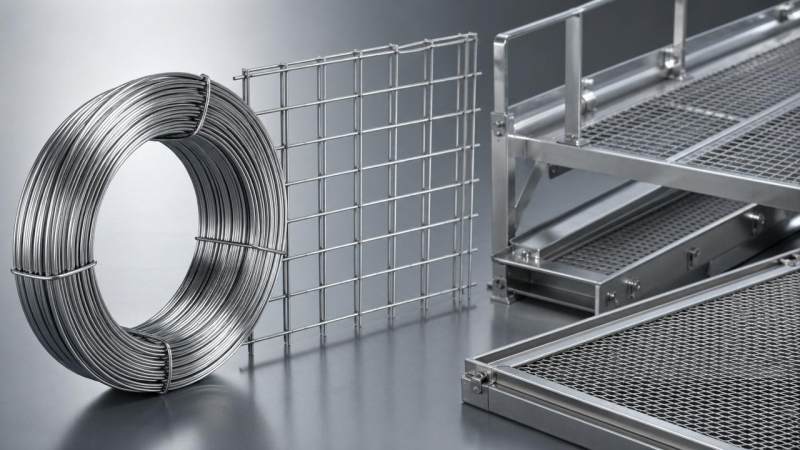
Quick evaluation points
- Check whether the application requires one-time bending or repeated flexing over months or years.
- Confirm if the wire is exposed to moisture, chlorides, acids, alkalis, or elevated temperatures above common indoor service conditions.
- Review whether the wire is load-bearing, positioning-only, or used as part of mesh, filtration, or protective assemblies.
- Compare installation constraints such as routing space, fastening speed, and minimum bend radius.
Where is flexible steel wire genuinely useful?
Flexible steel wire is genuinely useful where a steel component must combine manageable handling with dependable mechanical performance. In construction, it is commonly used for tying reinforcement, supporting temporary positioning, securing insulation or ancillary materials, and integrating into mesh-based solutions. In manufacturing, it is used for guides, screens, separators, hanging supports, and protective barriers. In industrial systems, it appears in filtration, guarding, packaging, vibration control accessories, and wire-based reinforcement structures.
One reason the keyword flexible steel wire receives attention is that many buyers are not sourcing loose wire alone. They are often evaluating a downstream fabricated form such as woven mesh, welded mesh, filter media, cages, screens, or formed steel wire parts. In these cases, flexibility affects fabrication efficiency, weld consistency, shape retention, and service durability. A procurement team may start with wire properties, but the final decision is often tied to assembly performance over a 6-month, 12-month, or multi-year operating cycle.
For global buyers in construction and industrial supply chains, flexibility also helps with transport and installation efficiency. Coiled or rolled materials are easier to pack, ship, and deploy across projects in North America, Europe, the Middle East, and Southeast Asia. However, the value comes only when flexibility is matched with correct grade selection and stable production quality. If either is wrong, field failures can show up as distortion, corrosion, broken joints, or early wear.
Which applications benefit most?
The most suitable applications usually fall into three groups. First are fastening and support uses, where the wire must be easy to bend and quick to install. Second are mesh and screening uses, where flexibility helps fabrication but finished structure must still remain stable. Third are corrosion-sensitive environments, where stainless wire is selected because flexibility alone is not enough; resistance to rust, chemicals, and moisture becomes equally important.
The table below helps information-stage buyers quickly map common uses of flexible steel wire to the performance feature that matters most.
A useful takeaway is that flexible steel wire performs best when the task requires controlled bending, moderate strength, and shape adaptability. It becomes less suitable when the same wire is expected to replace rigid bars, thick structural members, or heavily tensioned components without design adjustment.
What about mesh and filtration products made from flexible wire?
This is where flexible steel wire becomes especially practical. Many filtration and screening systems rely on fine stainless steel wire that can be woven or welded into stable openings. For buyers comparing finished products, one relevant example is Stainless Steel Welded Mesh, which combines stainless steel wire with controlled mesh geometry for filters, sieve applications, the chemical industry, mine industry, architecture, residences, and other industrial uses.
Its available stainless models include SS 201, 304, 304L, 316, 316L, and 430, with diameter ranges from 0.0008″ to 0.12″ and mesh options from 2 mesh to 635 mesh. Open area can range from 25 to 84.6, while roll width can reach up to 240″ and roll length up to 2000′. Those figures matter because in filtration and screening, flexible steel wire is not judged only by bendability; buyers also look at aperture consistency, retention range, chemical resistance, and handling efficiency during fabrication and installation.
For projects involving rust exposure, chemical media, or cleaning cycles, stainless wire-based mesh often offers better durability than ordinary carbon steel wire. Depending on the process, plain weave or twill weave structures may also be considered alongside welded formats. This is a good reminder that the “best” flexible steel wire solution may not be loose wire at all, but a finished wire product engineered for a specific industrial result.
Where does flexible steel wire fail or become a poor choice?
Flexible steel wire becomes a poor choice when buyers expect it to do the job of a rigid structural member, a high-load cable, or a corrosion-proof material without proper grade selection. Failure usually does not happen because the wire is “bad.” It happens because the application demands exceed what the chosen diameter, alloy, or fabrication method can handle. In many projects, the problem appears after installation, when repeated load cycles, abrasion, vibration, or aggressive chemicals reveal the mismatch.
One common limit is fatigue. A wire that bends well during installation may still fail if it is flexed continuously at the same point thousands of times. Another limit is surface attack. In coastal or chemical environments, untreated or low-grade wire can corrode quickly, reducing cross-section and strength. Heat is another concern. At elevated temperatures, some wire grades lose performance or scale more rapidly, especially if they were chosen for cost rather than environment.
A third limit is dimensional stability. Fine flexible steel wire can drift out of shape under impact, sustained tension, or point loading if the design does not support it well. This is critical in mesh, guard, and filtration use, where small deformation can change opening size, flow rate, or screening precision. In many industrial systems, even a 5% to 10% change in opening behavior can affect downstream process consistency.
What are the most common failure scenarios?
The table below summarizes common situations where flexible steel wire underperforms and what buyers should review before ordering.
For information researchers, this comparison helps separate material failure from selection failure. In many cases, flexible steel wire is still the right category, but not in the originally assumed grade, finish, or geometry.
Warning signs before purchase
- The supplier quote lists wire diameter but does not clearly describe material grade or operating environment.
- The application includes vibration, repeated opening and closing, or continuous movement more than several hundred cycles per month.
- The project expects exposure to salt spray, acidic washdown, alkali cleaning, or process heat without confirming corrosion resistance.
- The wire is being considered as a cost-saving substitute for a structural steel profile without engineering review.
How should buyers judge the right type of flexible steel wire?
A practical buying decision starts with application logic rather than catalog browsing. Buyers should first define the job in measurable terms: load level, movement frequency, installation method, environment, target service life, and whether the wire will be used alone or in a fabricated product. These six points are often enough to eliminate unsuitable options before price comparison begins. Without them, a lower-cost wire may create higher replacement, maintenance, or downtime costs later.
Next, compare material families. Carbon steel may be sufficient for dry, low-corrosion, short-cycle applications. Galvanized wire may fit moderate atmospheric exposure. Stainless grades such as 304 or 316 are commonly evaluated for moisture, chemical, hygiene, or outdoor conditions. The decision is rarely only about initial cost per kilogram. It often depends on the full-use cost over 12 to 36 months, especially when access for replacement is difficult.
Finally, check fabrication compatibility. If the wire must be welded, woven, formed, or integrated with mesh, cages, guards, or filters, the manufacturing process matters as much as raw material grade. A stable supplier should be able to discuss standard specifications, customized dimensions, and the practical difference between standard material supply and OEM-oriented production.
What questions should be asked before ordering?
The list below can help procurement teams and engineers avoid common mistakes when evaluating flexible steel wire or related fabricated steel wire products.
- What is the exact working environment: indoor, outdoor, marine, chemical, high-humidity, or heated?
- Is the wire bent once during installation, or flexed repeatedly over weeks, months, or years?
- What diameter range and tolerance are acceptable for the application?
- Does the project require compliance with ASTM, EN, JIS, GB, or another standard framework?
- Will the wire be used loose, or converted into mesh, screen, filter, support part, or customized component?
- What delivery timeline is realistic: stock supply, batch production, or customized lead time of several weeks?
These questions are especially useful for global sourcing, where buyers must balance specification fit, production stability, and logistics timing. For many projects, the right supplier is not the one offering the lowest unit price, but the one reducing sourcing risk through clear technical confirmation and consistent production control.
What are the biggest misconceptions about flexible steel wire?
A common misconception is that more flexibility is always better. In reality, too much flexibility can reduce shape stability, increase deformation risk, or make the wire unsuitable for precise spacing and load positioning. Another misconception is that all stainless wire behaves the same. Grades such as 201, 304, and 316 differ in corrosion resistance, cost, and suitability for chemical or chloride-heavy environments. Choosing only by the word “stainless” can lead to overbuying or underperforming.
Another frequent mistake is assuming that flexible steel wire automatically means low strength. Some wire products combine significant tensile capability with useful bendability, especially when diameter and grade are properly matched. At the same time, buyers should not confuse temporary installation convenience with long-term structural reliability. A wire that is excellent for fastening or filtration may not be the correct choice for primary load-bearing duty.
There is also a sourcing misconception: buyers sometimes compare only raw material cost, ignoring downstream fabrication and service life. In practice, a wire product that lowers replacement frequency from every 6 months to every 18 months can create meaningful operational savings, even if the initial purchase price is higher. This is particularly relevant in industrial plants where shutdown windows are limited.
FAQ summary for quick judgment
If you need a fast reference, the following FAQ-style table summarizes how to think about flexible steel wire in real project screening.
The practical lesson is simple: flexible steel wire is highly useful when matched to bending, environment, and service function, but it is not a universal answer for every steel task.
If you are evaluating supply options, what should you discuss first?
If your team is still in the research stage, start with the parameters that most directly affect performance and procurement risk. These include wire material, diameter range, final application, corrosion exposure, expected service period, and whether you need standard supply or a custom-made fabricated product. Discussing these points early can shorten sampling and quotation cycles by 1 to 2 rounds and reduce avoidable specification changes later.
As a structural steel manufacturer and exporter from China, Hongteng Fengda supports global buyers with reliable steel products and customized solutions for construction, industrial, and manufacturing projects. Beyond angle steel, channel steel, steel beams, cold formed steel profiles, and custom structural steel components, project communication often includes how wire-based or mesh-related steel products fit into broader assemblies, site conditions, and sourcing plans. Stable production capacity, clear specification review, and dependable lead times are often just as important as unit price.
Why choose us for the next discussion? Because many buyers do not only need material; they need a practical confirmation process. You can contact us to discuss parameter verification, product selection, delivery schedule, customized solutions, applicable standards such as ASTM, EN, JIS, or GB, sample support, and quotation details. If you are comparing flexible steel wire options or related steel products for construction, industrial screening, filtration, or fabricated applications, a clear technical conversation is the fastest way to identify what will work well, what may fail early, and what can be optimized for cost and reliability.
Please give us a message


Please enter what you want to find