Structural steel welding defects often stay hidden until erection, inspection, or even service conditions expose them—causing delays, added costs, and safety concerns. For buyers, engineers, and project managers working with structural steel components, understanding common structural steel welding issues is essential to controlling quality, evaluating suppliers, and ensuring reliable performance from fabrication to final installation.
Why do structural steel welding defects show up so late?
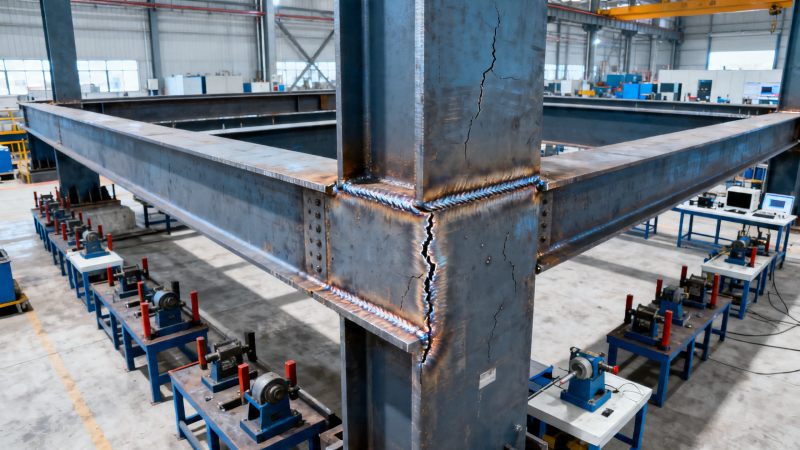
Late-appearing welding defects in structural steel are rarely random. In most projects, they originate during fit-up, welding sequence control, heat input management, or surface preparation, but they remain invisible until a later stage. A beam may pass visual review in the workshop, then fail dimensional checks during assembly 2–4 weeks later. A column splice may look acceptable before coating, yet reveal porosity, undercut, or cracking after blasting, galvanizing, or load transfer during installation.
For technical evaluators and quality managers, the real issue is not only defect presence but defect timing. Defects discovered after shop release can trigger rework, repeated NDT, schedule interruption, crane idle time, and site coordination problems. For procurement and finance teams, late defect detection directly affects landed cost, not just unit price. A lower purchase price can quickly become a higher total project cost when 3 key stages—fabrication, transport, and erection—are disrupted.
Structural steel welding defects also appear late because weld quality is influenced by multiple variables acting together. Joint design, base material thickness, welder qualification, consumable condition, ambient humidity, and inspection timing all matter. In medium to large projects, hidden defects often emerge where tolerances stack up: root passes, restrained joints, thick-to-thin transitions, field splice areas, and highly loaded connection zones.
This is why buyers sourcing from international suppliers should look beyond basic mill documentation. A reliable structural steel manufacturer should show process discipline from incoming material control to final inspection. Hongteng Fengda, as a structural steel manufacturer and exporter from China, supports global projects with standardized production control, compliance with ASTM, EN, JIS, and GB requirements, and practical coordination for standard and customized structural steel components.
The most common reasons hidden weld issues escape early detection
- Inspection is limited to surface appearance, while internal discontinuities such as slag inclusion or lack of fusion require UT or RT at the correct project stage.
- Residual stress and restraint do not immediately produce visible cracks; they may become detectable only after cooling cycles, transport vibration, or erection loading.
- Coatings, primer layers, or galvanizing can either reveal or amplify underlying weld quality problems that were not obvious in as-welded condition.
- Dimensional distortion from welding may remain acceptable in the shop but exceed fit-up tolerance once multiple members are assembled on site.
Which structural steel welding defects matter most in fabrication and erection?
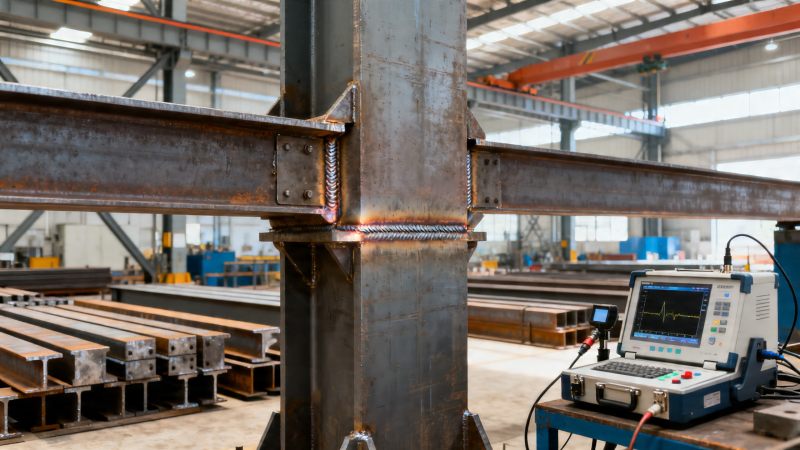
Not every weld imperfection has the same consequence. Some defects mainly affect appearance or coating adhesion, while others reduce load-carrying reliability, fatigue resistance, or connection integrity. For project managers and safety personnel, the priority is to identify defects that can delay acceptance, reduce structural performance, or cause repetitive field repair. In structural steel fabrication, 5 categories deserve the closest control: cracks, porosity, lack of fusion, undercut, and distortion.
Cracks are usually the most critical because they can propagate under stress and are often unacceptable in primary structural connections. Porosity may seem minor when scattered, but clustered porosity can indicate process instability, poor shielding, contamination, or improper consumable handling. Lack of fusion and incomplete penetration are particularly serious in thick sections and load-bearing joints, where the weld may look continuous but fail to transfer force as designed.
Undercut, overlap, and excessive reinforcement can also create long-term issues. These surface profile defects may increase stress concentration, complicate coating coverage, or trigger rejection during inspection. Distortion, meanwhile, is not always listed as a classic welding defect, yet for operators and installers it is one of the most expensive problems. Even a deviation of a few millimeters across repeated members can create alignment problems across a full frame or platform system.
The table below summarizes common structural steel welding defects, where they usually appear, and why they are often discovered late instead of during the first visual check.
For steel buyers, this table shows why weld quality should be reviewed as a system rather than a single pass/fail point. A supplier that can explain where defects originate, how they are inspected, and at which stage they are most likely to be found is usually better prepared to protect schedule and total project cost.
Where these defects commonly occur
High-risk joint areas
High-risk locations include beam-to-column joints, stiffener terminations, thick base plates, flange-to-web transitions, and field splices. These areas typically carry higher restraint, greater thickness variation, or tighter erection tolerance. In projects with repeated modules, one small welding parameter drift can affect 20, 50, or even 100 similar parts before the issue is fully detected.
This is also why structural steel components for export must be prepared for transport and installation, not only workshop acceptance. A weld that survives shop handling may still face stress from packing, loading, sea freight vibration, and site lifting. Good suppliers account for this full chain when setting inspection hold points and release criteria.
How should buyers and engineers evaluate welding quality before defects become costly?
Procurement teams often focus first on price, tonnage, and lead time, but structural steel welding quality should be assessed through a broader 6-point evaluation framework. This is especially important for OEM components, heavy sections, galvanized steel parts, and projects with cross-border approval requirements. The right supplier conversation should cover welding procedure qualification, welder qualification, dimensional control, traceability, NDT planning, and packaging protection.
For projects that combine welded assemblies with corrosion-resistant raw materials or downstream machining, material consistency also matters. In some applications such as towers, ancillary facilities, marine-related parts, street light poles, and building steel structure components, customers may also specify galvanized round steel as part of the overall sourcing package. In such cases, material quality, surface condition, and downstream fabrication compatibility should be reviewed together rather than separately.
One practical example is Galvanized Round Steel, which can be used across electric power tower, communication tower, highway protection, marine components, and building steel structure components. With diameter ranges such as 16–250 mm, customized lengths, tensile strength of 570–820 MPa, and compliance options aligned with AiSi, ASTM, BS, GB, JIS, EN, and AS, it is important to confirm whether subsequent welding, heat treatment, machining, or peeling requirements are part of the supply scope.
When galvanized or cold-drawn steel products are integrated into structural projects, engineers should ask 4 direct questions: Will the item be welded before or after galvanizing? What tolerance class is required, such as ISO h8 or ISO h9? Is ultrasonic or surface control necessary? And how will marking and packaging prevent mixing during multi-batch delivery? These checks reduce the risk of quality disputes later in fabrication or installation.
A practical procurement checklist for structural steel welding quality
Before releasing a purchase order, many buyers benefit from a structured comparison rather than a general supplier promise. The table below can be used by procurement, QC, and project teams to compare suppliers on the factors that most often influence hidden welding defects and late-stage rework.
The strongest procurement outcome usually comes from combining technical review with commercial review. A supplier with stable production capacity, clear quality control, and export documentation discipline can help reduce sourcing risk more effectively than one offering a shorter quote sheet but weaker process visibility.
What project teams should verify in 4 stages
- Before order: confirm standards, welding scope, coating scope, and acceptance level.
- Before production: review drawings, joint details, tolerances, and inspection hold points.
- Before shipment: check final dimensions, NDT reports where required, marking, and packing condition.
- Before erection: verify unloading, storage, lifting points, and any site repair procedure limits.
What standards, process controls, and shop practices reduce late weld failures?
Good structural steel welding quality does not come from inspection alone. It comes from process control before, during, and after welding. For most export-oriented steel projects, buyers commonly ask suppliers to work in line with major standards such as ASTM, EN, JIS, and GB, depending on project location and contract requirements. What matters in practice is whether the shop translates those requirements into measurable work instructions, inspection checkpoints, and records.
A disciplined fabrication shop usually controls at least 5 operational areas: material receiving, joint preparation, consumable handling, welding sequence, and post-weld inspection. For moisture-sensitive consumables, storage condition and issue timing are especially important. For restrained or thicker joints, preheat and interpass control may be required. Even when exact values depend on grade and procedure, the principle is consistent: process windows must be controlled before defects become hidden inside the weld.
In structural steel projects involving galvanizing, machining, or cold-formed profiles, the interface between processes is often where problems start. A component may be welded correctly but then mishandled during straightening, drilling, or surface treatment, leading to later rejection. This is one reason integrated manufacturers are often better positioned to coordinate quality than fragmented supply chains where each party only controls one segment.
Hongteng Fengda supports global buyers with modern manufacturing facilities, strict quality control, and supply capability across angle steel, channel steel, steel beams, cold formed steel profiles, and customized structural steel components. For customers in North America, Europe, the Middle East, and Southeast Asia, this matters because consistency across production batches and dependable lead times are often just as valuable as base material price.
Common control points that reduce welding defects
- Check fit-up gap, bevel angle, and surface cleanliness before arc start, especially on multi-pass welds and thicker sections.
- Monitor heat input and weld sequence to limit distortion across repeated members and long seams.
- Apply staged inspection: visual during fabrication, dimensional check after welding, and NDT at specified hold points.
- Protect finished components during transport so a compliant weld is not damaged before site acceptance.
A note on timing and rework
Repair is always more expensive when the defect is found later. Shop repair may add 1–3 days to a batch schedule. If the same defect is found after coating or after delivery to site, the impact can extend to 1–2 weeks once logistics, inspection rebooking, and erection resequencing are included. For this reason, suppliers and buyers should define hold points early instead of treating quality review as a final paperwork task.
FAQ: what do buyers, QC teams, and project managers ask most often?
Structural steel welding defects are a technical topic, but the most common questions are usually practical: how to detect risk early, what to ask a supplier, and how to avoid field delay. The answers below focus on decisions that influence fabrication quality, procurement control, and installation reliability.
How can I reduce the chance of hidden welding defects when sourcing structural steel?
Ask for more than material grade and drawing confirmation. Review the welding scope, joint types, inspection plan, and dimensional tolerances before production starts. For projects with critical connections, request defined hold points for visual inspection and NDT where applicable. A 4-stage review process—order, pre-production, pre-shipment, and pre-erection—usually reduces surprises much more effectively than relying on final documents alone.
Which defects are most likely to delay installation?
Distortion, lack of fusion in critical joints, and cracking are among the most disruptive. Distortion creates immediate fit-up issues on site. Cracks and internal fusion defects can stop acceptance until repair and reinspection are complete. In many projects, these problems are more costly than visible surface porosity because they affect both structural performance and erection sequence.
Is visual inspection enough for structural steel weld quality?
No, not always. Visual inspection is essential, but it mainly covers surface condition, profile, and obvious discontinuities. Internal defects such as incomplete penetration or lack of fusion may require ultrasonic or radiographic examination depending on the joint, thickness, and project specification. The key is to define the inspection method according to risk level, not to apply the same check to every weld.
How long is a typical lead time for structural steel with quality review and export packing?
Lead time depends on quantity, complexity, coating, and inspection scope. For standard structural steel items, many projects work within a 2–6 week production window. Customized assemblies, multi-batch schedules, or additional testing can extend that period. Buyers should also allow time for drawing confirmation, packing preparation, and freight planning rather than counting production days only.
Why choose a supplier that understands both welding risk and procurement reality?
In structural steel sourcing, the best outcome is not simply buying material at the lowest initial price. It is securing components that arrive on time, fit on site, meet required standards, and do not create hidden costs through weld defects, rework, or schedule disruption. That is why engineers, purchasers, QC managers, and decision-makers need a supplier that can support both technical details and commercial execution.
Hongteng Fengda provides structural steel products and customized solutions for global construction, industrial, and manufacturing projects. Our scope covers standard specifications and OEM supply, supported by stable production capacity, quality control discipline, and export service for international buyers. Whether you need angle steel, channel steel, steel beams, cold formed profiles, or customized structural components, the goal is the same: reduce sourcing risk and improve project predictability.
If you are evaluating a new supplier or troubleshooting recurring structural steel welding defects, you can discuss practical topics before ordering: parameter confirmation, drawing and joint review, product selection, delivery schedule, customization options, standard compliance, sample support, inspection scope, and quotation planning. Early alignment on these points often saves far more than late-stage repair.
Contact us to review your structural steel requirements, compare fabrication options, and confirm the right supply plan for your project. If your inquiry includes mixed product categories, customized components, or corrosion-resistant materials such as galvanized round steel, we can help you clarify specifications, processing sequence, and delivery expectations before production begins.
Please give us a message


Please enter what you want to find