Stainless steel sheet for kitchen applications is valued for durability and hygiene, yet surface stains can still appear under daily use. From water spots and grease buildup to cleaning mistakes and material grade differences, understanding the real causes helps users choose, maintain, and source better products. This guide explains why staining happens and how reliable steel suppliers support long-term performance.
For kitchen equipment users, fabricators, procurement teams, quality inspectors, and project managers, surface staining is not only a visual issue. In commercial kitchens, food processing rooms, and residential installations, stains can affect cleaning efficiency, inspection results, and even buying confidence. In many cases, the metal is not “rusting” in the traditional sense; instead, the surface is reacting to water chemistry, airborne contaminants, heat exposure, or poor maintenance routines.
In the steel industry, especially for global sourcing, the discussion should go beyond appearance. Buyers need to understand grade selection, sheet finish, fabrication practices, passivation quality, and supplier consistency. A reliable Chinese steel manufacturer with stable production, ASTM/EN/JIS/GB compliance, and strict quality control can reduce long-term risks far more effectively than choosing only on initial price.
Why Kitchen Stainless Steel Sheets Develop Surface Stains
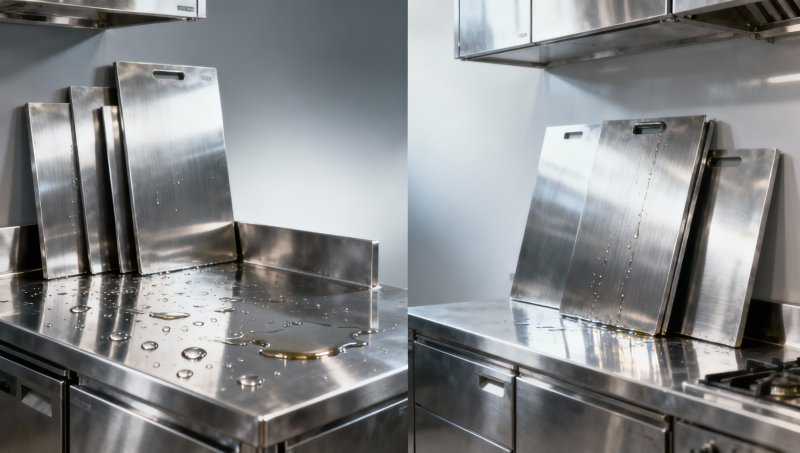
Stainless steel does not mean stain-proof under every condition. Its corrosion resistance depends on a thin passive chromium oxide film that reforms naturally in oxygen-rich environments. When this film is disturbed by chlorides, acids, iron contamination, or aggressive cleaners, the surface can show tea staining, water spotting, rainbow discoloration, or localized rust-like marks within weeks or months.
In kitchen environments, 4 common triggers account for most visible staining. First, hard water leaves mineral deposits after repeated drying cycles. Second, grease and food residues trap moisture and salt. Third, chlorine-based cleaners attack the passive layer, especially if left on the surface for more than 5–10 minutes. Fourth, contamination from carbon steel tools during fabrication can embed free iron particles into the sheet.
Temperature also matters. Around cooktops, ovens, and steam zones, repeated heating and cooling can accelerate discoloration. At temperatures above 60°C in wet conditions, residues dry faster and adhere more strongly. In busy commercial kitchens operating 8–16 hours per day, this cycle becomes much more severe than in low-use residential settings.
Another overlooked reason is material mismatch. A buyer may specify “stainless steel sheet” without defining grade, finish, or thickness. In practice, 201, 304, and 316 grades can behave very differently when exposed to chlorides, detergents, and humid air. Surface finish also changes stain visibility: a mirror finish highlights water spots, while a brushed finish may hide minor marks but trap contaminants in deeper grain lines if cleaning is poor.
Typical stain types seen on kitchen stainless steel
The following table helps distinguish cosmetic staining from early corrosion risk. This is useful for maintenance staff, quality teams, and procurement evaluators comparing root causes before replacing panels or changing suppliers.
A key conclusion is that not every stain means the sheet quality is defective. However, recurring brown specks, weld discoloration that is not treated, or stains concentrated in specific use zones often indicate a controllable technical issue. This is why stain analysis should involve both maintenance review and sourcing review.
How Grade, Finish, and Fabrication Affect Stain Resistance
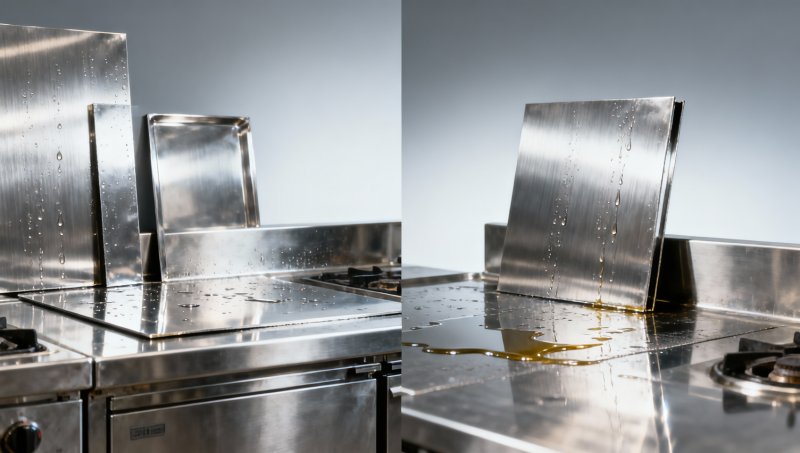
Grade selection is the first technical filter. In many budget-focused projects, buyers choose lower-cost stainless steel without fully considering chloride exposure, cleaning chemistry, or service frequency. For light-duty dry kitchens, 304 is commonly sufficient. For coastal kitchens, central kitchens, seafood preparation zones, or chlorine-heavy cleaning routines, 316 often performs better because of its higher molybdenum content.
Finish selection also changes long-term appearance. Common finishes include 2B, BA, No.4, and mirror-polished surfaces. A No.4 brushed finish is widely used for kitchen equipment because it balances appearance and cleanability. Yet the grain direction should be consistent, and cleaning should follow the grain. Cross-grain scrubbing with abrasive pads can create micro-scratches that collect residue after only 2–3 weeks of heavy use.
Fabrication quality is equally important. If welding is performed without proper post-treatment, heat tint can reduce local corrosion resistance. If carbon steel brushes, grinding discs, or contaminated worktables are used, embedded iron may trigger rust-colored spots. In OEM fabrication, separate tooling for stainless steel and carbon steel is a practical quality control measure that many serious manufacturers adopt.
Thickness and flatness matter more than many users expect. Thin sheet can distort under heat, creating low points where water and chemicals remain longer. For countertops, splashbacks, cabinets, and equipment cladding, choosing the correct thickness range for the load and fabrication method improves both durability and stain control over a 3–10 year service cycle.
Common selection benchmarks for kitchen stainless steel sheet
The table below provides a practical comparison for technical evaluators and purchasers. Exact specification depends on application, but these ranges reflect common market logic in kitchen-related stainless steel sheet sourcing.
For most B2B buyers, the best decision is not the cheapest grade per ton, but the best total-life-cost combination. A sheet that costs 8%–18% more upfront may reduce replacement, complaint, and maintenance costs over several years, especially when installed across large kitchen projects.
A note on broader steel sourcing capability
For buyers working with infrastructure, industrial plants, or mixed-project procurement, supplier capability across multiple steel categories can improve consistency and logistics planning. For example, some contractors sourcing stainless materials for facilities also source structural solutions such as Steel Sheet Piles for deep water construction and cofferdams. Products in this category may be supplied in grades such as S275, S355, S390, S430, SY295, SY390, and ASTM A690, with standards including EN10248, EN10249, JIS5528, JIS5523, and ASTM, plus single lengths of over 80 m where required.
Although kitchen stainless steel sheet and structural piling serve very different functions, the procurement principle is similar: material grade, compliance standard, dimensional control, and manufacturing discipline have a direct impact on service performance. Suppliers with ISO9001, ISO14001, ISO18001, and CE FPC-oriented management practices are often better prepared to support technical documentation, inspection coordination, and export reliability.
Cleaning Mistakes and Environmental Factors That Make Stains Worse
Many surface issues are caused after delivery, not before it. Even a high-quality stainless steel sheet can stain prematurely if maintenance practices are too aggressive or too inconsistent. In food service environments, cleaning may happen 2–6 times per day, and staff turnover can lead to uncontrolled use of bleach, steel wool, or strong alkaline products that were never intended for stainless surfaces.
One major mistake is letting chlorinated cleaner dry on the sheet. Another is leaving salt, vinegar, tomato residue, or sauce splashes on surfaces overnight. In warm environments above 25°C, these residues concentrate faster as water evaporates. Around sink areas and dishwashing stations, splash zones can create daily wet-dry cycles that intensify spotting, especially when water hardness is high.
Air quality also contributes. In kitchens with poor ventilation, airborne grease can settle on vertical stainless panels and capture dust or detergents. In coastal regions, chloride-rich air increases the burden on the passive film. If the kitchen is within 1–5 km of the shoreline, corrosion-resistant grade selection and disciplined rinsing become more important.
Maintenance teams should distinguish between cleaning for hygiene and cleaning for metal preservation. The objective is not simply to remove visible dirt, but to avoid chemical residue, abrasion, and moisture retention. This distinction is critical for facility managers, after-sales teams, and quality control personnel responsible for long-term appearance standards.
Common maintenance errors to avoid
- Using steel wool or carbon steel brushes, which can transfer iron particles and create rust-like spots within days.
- Applying bleach or chloride disinfectants without immediate rinsing, especially on warm surfaces or welded areas.
- Cleaning against the surface grain on brushed finishes, which increases scratch visibility and contaminant retention.
- Skipping the final dry wipe after rinsing, allowing mineral deposits to remain after every wash cycle.
- Ignoring hidden edges, folded corners, and undersides where trapped moisture can remain for 12–24 hours.
A practical 4-step cleaning routine
- Remove grease and food residue with a neutral cleaner or mild detergent diluted according to product guidance.
- Rinse with clean water to remove all chemical residue, especially near joints, sink edges, and welded areas.
- Wipe in the grain direction using a soft microfiber cloth or non-abrasive pad.
- Dry the surface completely within 3–5 minutes in high-use or hard-water environments.
When these 4 steps are built into standard operating procedures, many stain complaints decrease without changing the material itself. For distributors and OEM fabricators, offering a cleaning guide at delivery can reduce after-sales disputes and preserve customer satisfaction.
How Buyers and Project Teams Should Evaluate Stainless Steel Sheet Supply
Procurement decisions should combine material performance, fabrication suitability, export reliability, and documentation quality. For kitchen projects, this means reviewing more than just price and nominal grade. Buyers should confirm thickness tolerance, finish consistency, protective film condition, sheet flatness, packaging method, and compliance with the requested ASTM, EN, JIS, or GB standard.
For importers, contractors, and distributors, supply stability is a major risk-control factor. A manufacturer with modern production facilities, disciplined quality control, and experience serving North America, Europe, the Middle East, and Southeast Asia is generally better positioned to provide repeatable quality and dependable lead times. This matters when projects are phased over 2–4 shipments or tied to installation milestones.
Hongteng Fengda, as a structural steel manufacturer and exporter from China, supports global buyers with stable production capacity, international standard compliance, and customized solutions across multiple steel categories. Even when a kitchen-related procurement package is only part of a wider industrial or construction project, coordinated supply capability can simplify sourcing, lower communication friction, and reduce rework risk.
Quality teams should also ask whether stainless steel and carbon steel are processed separately, whether surface inspection is done before packing, and whether test certificates and dimensional records are available. A good supplier does not promise perfection; instead, it shows process control, inspection logic, and clear communication on what is suitable for each environment.
Key evaluation points before ordering
The table below can be used by procurement, engineering, finance approval, and project management teams when comparing offers from multiple suppliers.
The practical takeaway is simple: a low quote without grade confirmation, finish detail, or inspection evidence creates hidden cost. For finance approvers, this is where lifecycle value should outweigh a small initial saving.
Prevention, Troubleshooting, and Long-Term Value
Preventing surface stains requires coordination across 3 stages: correct specification, correct fabrication, and correct maintenance. If any one stage is weak, the sheet may underperform even if the base metal is acceptable. For project owners and distributors, the best result comes from aligning these 3 stages before mass purchase, not after complaint handling begins.
When stains appear, troubleshooting should start with pattern recognition. Are the marks concentrated near sinks, welds, or cleaning chemical storage areas? Did they appear after 30 days, after a new sanitation process, or only on one batch? A location-based review often separates environmental causes from supply issues within 1–2 inspection rounds.
For light mineral spots, gentle cleaning with non-abrasive products and complete drying is often enough. For iron contamination or localized corrosion, more careful treatment may be needed, including approved stainless steel cleaners or professional surface restoration. If staining returns repeatedly in the same operating condition, the team should reassess grade choice and cleaning chemicals rather than only polishing the problem away.
Long-term value depends on choosing a supplier that understands both steel manufacturing and end-use reality. Hongteng Fengda supports international buyers with reliable production, customized steel solutions, and quality-focused export service. For kitchen-related stainless steel sheet sourcing as part of broader industrial or construction procurement, this combination of consistency, compliance, and practical support helps reduce sourcing risk and improve project efficiency.
FAQ
Is brown spotting on kitchen stainless steel always rust?
Not always. Brown spots can come from free iron contamination, mineral residue mixed with grease, or early chloride attack. If the spots are superficial and limited, cleaning and passivation-friendly treatment may solve the issue. If the marks deepen or spread near welds and wet zones, the material and maintenance process should be reviewed immediately.
Which stainless steel grade is usually better for commercial kitchens?
304 is the standard choice for many commercial kitchens because it offers a good balance of cost and corrosion resistance. 316 is often better for coastal environments, seafood preparation, or aggressive sanitation routines. The right decision depends on chloride exposure, cleaning frequency, humidity, and service life expectations.
How often should stainless steel kitchen surfaces be dried after cleaning?
In hard-water or high-use kitchens, drying after every cleaning cycle is recommended. Even a 3-minute dry wipe can reduce spotting significantly. In low-use areas, drying at the end of each shift may be acceptable, but standing water should never remain overnight.
What should buyers ask suppliers before placing an order?
Ask for grade confirmation, finish specification, tolerance details, inspection records, packaging method, and lead time. It is also useful to confirm whether stainless steel processing is separated from carbon steel processing, especially for OEM or fabricated parts where contamination risk is higher.
Surface stains on stainless steel sheet for kitchen use usually result from a combination of environment, maintenance, fabrication, and grade choice rather than a single factor. The most effective strategy is to match the correct stainless specification to the real service condition, use controlled fabrication practices, and maintain the surface with non-aggressive cleaning methods.
If you are evaluating steel products for kitchen systems, industrial facilities, or broader project procurement, working with a reliable manufacturer and exporter can reduce sourcing risk and improve long-term value. Contact Hongteng Fengda to discuss material options, customized solutions, or export support, and get a specification plan that fits your project requirements.
Please give us a message


Please enter what you want to find