In reinforced concrete design, deformed rebar for concrete plays a critical role in strength transfer, crack control, and long-term durability. But does the rib pattern really change bond performance in a rebar for concrete slab? Yes—rib geometry can materially affect bond strength, slip resistance, crack behavior, and construction reliability. However, the practical answer is not simply “more ribs are better.” What matters is whether the rib pattern is properly designed, manufactured consistently, and compliant with relevant standards for the intended application. For engineers, contractors, buyers, and project managers, the right decision comes from understanding how rib shape interacts with concrete confinement, bar diameter, placement quality, and service conditions.
What buyers and engineers really need to know first
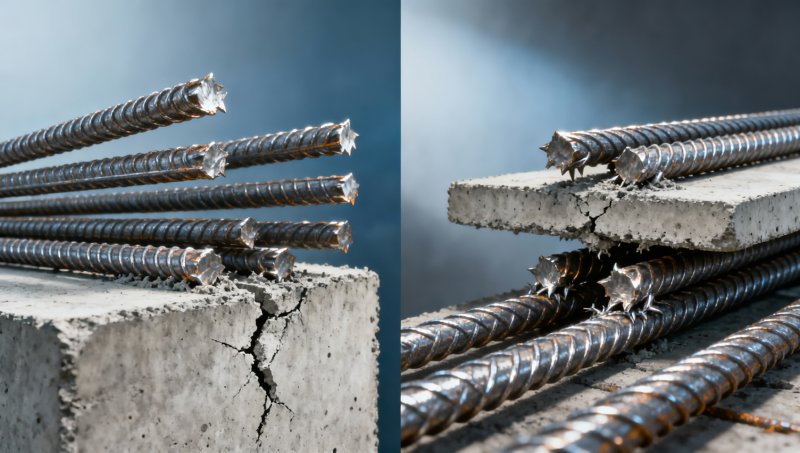
When people search whether rib pattern affects bond, they are usually trying to answer a more practical question: Will this rebar perform reliably in the structure I am building? The short answer is yes, because the ribs on deformed rebar are the main mechanical feature that allows load transfer between steel and concrete.
Compared with plain bars, deformed rebar for concrete develops bond through a combination of adhesion, friction, and mechanical interlock. Among these, mechanical interlock created by transverse ribs is the most important once loading increases. If rib height, spacing, angle, and relative rib area are not suitable, the bar may slip more easily, require longer development length, or create less predictable anchorage performance.
For project stakeholders, this affects several real-world concerns:
- Structural safety and load transfer reliability
- Crack width control in slabs, beams, and walls
- Anchorage and lap splice performance
- Construction tolerance sensitivity
- Material acceptance, compliance, and sourcing risk
- Long-term durability under repeated loading or harsh environments
That is why rib pattern is not just a manufacturing detail. It is a performance factor that influences both technical design and procurement quality control.
How rib pattern changes bond in concrete
The bond behavior of rebar in concrete depends heavily on how the ribs engage the surrounding hardened concrete. As tensile force is transferred from steel to concrete, the ribs bear against the concrete and create local compressive and shear stresses. A well-designed rib pattern improves this interaction in several ways.
1. Rib height affects mechanical interlock.
Higher ribs generally improve resistance to slip because they provide stronger bearing against concrete. But excessively aggressive rib geometry can also increase splitting stresses in poorly confined concrete.
2. Rib spacing influences stress distribution.
If ribs are spaced too far apart, bond transfer becomes less uniform. If spacing is too tight, concrete between ribs may not engage optimally, especially when placement quality is poor.
3. Rib angle affects load transfer direction.
The angle of the ribs changes how force is transmitted into the surrounding concrete. Proper geometry supports better anchorage without causing unnecessary damage to the concrete matrix.
4. Relative rib area supports development length performance.
A larger effective rib area often improves bond efficiency, which can help bars achieve required development within practical lengths, subject to code requirements and concrete quality.
5. Uniformity matters as much as nominal design.
A theoretically good rib pattern is less useful if rolling quality is inconsistent. Variations in rib height or deformation shape can create unpredictable bond behavior across batches.
In practice, the best-performing deformed rebar for concrete is not simply the most aggressive profile. It is the one with balanced deformation geometry, stable dimensional control, and standard-compliant production.
When rib pattern matters most in real projects
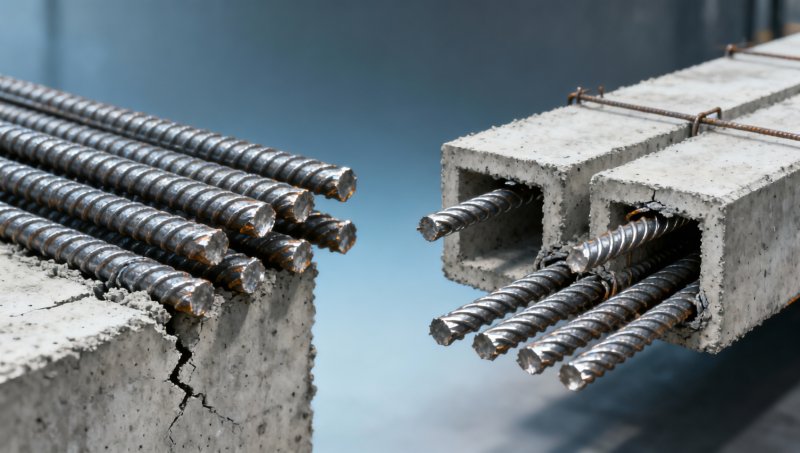
Not every structure is equally sensitive to rib design. In some applications, standard compliant deformed bars will perform adequately regardless of small pattern differences. In other cases, rib geometry becomes much more important.
It matters more in:
- Short anchorage zones
- Congested reinforcement areas
- Lap splice critical regions
- Thin slabs and walls where crack control is important
- Seismic detailing zones with cyclic loading
- Precast elements with strict dimensional and bond requirements
- Projects where concrete quality or site execution may vary
For example, in a rebar for concrete slab application, bond affects how efficiently tensile stresses are transferred, especially around supports, openings, and lap zones. If the bar slips more than expected, crack widths may increase and service performance can decline even if ultimate strength is not immediately compromised.
For procurement teams and quality managers, this means rebar should not be assessed by diameter and grade alone. Surface deformation quality should also be part of supplier evaluation.
What can reduce bond even if the rib pattern looks good
One of the most common mistakes is to assume that rib geometry alone determines bond performance. In reality, several project variables can weaken bond even when the bar itself is well made.
- Poor concrete compaction: Voids around the bar reduce rib engagement.
- Low concrete strength: Weak surrounding concrete fails earlier under rib bearing pressure.
- Insufficient cover or confinement: This increases the risk of splitting cracks.
- Rust, oil, or contamination: Surface conditions can reduce initial adhesion and affect consistency.
- Improper bar placement: Excessive movement during pouring can disturb the bond zone.
- Out-of-tolerance manufacturing: Inconsistent rib dimensions reduce predictability.
This is especially relevant for project teams balancing steel selection with broader durability needs. In some mixed-material construction and infrastructure environments, teams also evaluate corrosion-resistant components for adjacent systems, supports, or fluid transport lines. In such cases, products like Galv Steel Tube may be considered for low-pressure fluid pipelines, support frames, or industrial applications where extended service life and corrosion resistance are required. While this is a different product category from reinforcing bar, the procurement logic is similar: material performance depends not only on nominal specification, but on manufacturing quality, standard compliance, and fit for actual service conditions.
How to evaluate rebar bond performance before purchase or use
If you are selecting rebar for a project, especially across international supply chains, use a practical review method instead of relying on appearance alone.
Check relevant standards first.
Ask whether the rebar complies with ASTM, EN, JIS, or GB requirements applicable to the target market. These standards typically define deformation requirements, dimensional tolerances, and mechanical properties that indirectly support bond performance.
Review deformation consistency.
Inspect whether the rib pattern is uniform along the bar length and across bundles. Uneven deformation may indicate unstable rolling control.
Verify mill quality documentation.
A credible manufacturer should provide test certificates, heat numbers, grade information, dimensional records, and traceability data.
Consider the application, not only the price.
For high-risk structures or demanding anchorage details, lower-cost material with poor deformation control may increase overall project risk, rework, and approval delays.
Assess supplier capability.
A qualified structural steel manufacturer with modern facilities and quality control systems is better positioned to deliver consistent product performance batch after batch.
Coordinate design assumptions with supplied material.
Engineers should ensure that actual supplied rebar matches the code basis and detailing assumptions used in drawings and calculations.
Does a more aggressive rib pattern always mean better performance?
No. This is where technical judgment is important. More pronounced ribs may improve mechanical interlock, but there is a balance to maintain. If ribs generate excessive radial pressure on the surrounding concrete, the bar may promote splitting rather than stable bond mobilization, especially where cover is limited or confinement is weak.
In other words, bond performance is an optimization problem, not a maximum-rib problem. The best result comes from matching:
- Bar grade and diameter
- Rib geometry
- Concrete strength
- Cover and confinement
- Development and splice detailing
- Construction quality
This is why experienced engineers and buyers usually prefer standard-compliant, well-controlled deformed bars from reliable producers over bars that simply appear rougher or more heavily deformed.
What this means for sourcing, quality control, and project risk
For contractors, consultants, and procurement managers, the key takeaway is practical: rib pattern does affect bond, and bond affects project outcomes. But from a sourcing standpoint, the real issue is consistency and compliance rather than visual exaggeration of deformation.
A good purchasing decision should reduce the chance of:
- On-site rejection due to dimensional irregularity
- Unexpected performance concerns in anchorage zones
- Delays from documentation gaps or non-traceable batches
- Serviceability issues such as wider cracking in slabs and walls
- Higher lifecycle cost caused by poor quality material choices
For global buyers, working with manufacturers that understand international specifications, maintain stable production, and provide dependable lead times can significantly lower sourcing uncertainty. This is particularly important for projects that require multiple steel product categories and coordinated quality assurance across the supply chain.
To conclude, yes, the rib pattern of deformed rebar for concrete does affect bond—sometimes significantly. It influences slip resistance, anchorage behavior, crack control, and overall structural reliability. But the most useful decision criterion is not whether the ribs look more pronounced. It is whether the deformation pattern is properly designed, consistently manufactured, and supported by recognized standards and quality control. For engineers, contractors, and buyers, the smartest approach is to evaluate rebar as a performance-critical product, not a commodity defined only by size and grade.
Please give us a message


Please enter what you want to find