When evaluating ss pipe for water supply, buyers often compare hygiene, corrosion resistance, lifespan, and total cost alongside factors like ASTM steel pipe standards and ss304 pipe price. For engineers, procurement teams, and project managers, understanding whether stainless steel pipe fits potable water systems is essential to balancing safety, durability, and budget in residential, commercial, and industrial applications.
In the steel industry, the answer is usually yes, but only when material grade, pipe specification, fabrication quality, water chemistry, and installation conditions are matched correctly. Stainless steel pipe is widely used in clean water, hot water, and process water systems because it offers strong corrosion resistance, smooth internal surfaces, and a long service life that can often exceed 30 years under suitable operating conditions.
However, not all stainless steel pipe performs the same way. A buyer comparing 201, 304, and 316 grades for water supply will see meaningful differences in chloride tolerance, weld performance, and long-term maintenance risk. For B2B purchasers and technical evaluators, the right decision depends on project class, local water quality, operating temperature, budget range, and required standards such as ASTM, EN, JIS, or GB.
This article explains where ss pipe works well in water supply systems, when it may be a higher-value option than galvanized or plastic pipe, what standards and inspection points matter, and how procurement teams can reduce sourcing risk while controlling lifecycle cost.
Why Stainless Steel Pipe Is Considered for Water Supply
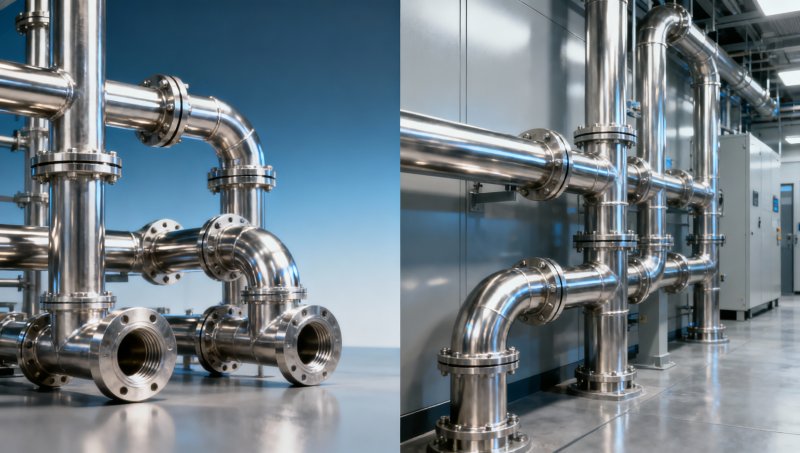
Stainless steel pipe is commonly selected for water supply because it combines mechanical strength with corrosion resistance and sanitation performance. In potable water systems, these three factors directly affect leakage risk, water quality stability, and maintenance frequency. Compared with ordinary carbon steel pipe, stainless steel is far less likely to rust internally when exposed to oxygenated water over many years.
For building owners and project managers, one practical advantage is service life. In many indoor water systems with moderate chloride content and correct installation, 304 stainless steel pipe can remain stable for 20 to 30 years or longer. In harsher environments such as coastal regions, water with higher chloride concentration, or hot water lines above 60°C, 316 stainless steel often provides a safer margin.
Another reason buyers consider ss pipe is hygiene. Stainless steel has a smooth, dense surface that reduces scale buildup and helps limit areas where contamination can accumulate. This matters in residential towers, hospitals, food plants, hotels, schools, and commercial buildings where water cleanliness and reliable flow are part of operational safety.
From a procurement perspective, stainless steel also supports predictable lifecycle cost. The initial ss304 pipe price is usually higher than galvanized steel or some plastic piping, but the long-term cost may be lower when repair frequency, replacement cycles, shutdown losses, and water-quality-related complaints are included in the calculation.
Key benefits in practical systems
- Strong corrosion resistance in clean water, hot water, and many treated water environments.
- High strength under pressure, making it suitable for risers, pump rooms, mechanical spaces, and industrial water loops.
- Low internal roughness, which supports steady flow and can reduce pressure loss over long pipe runs.
- Good temperature resistance compared with many plastic alternatives, especially in hot water systems between 40°C and 90°C.
The table below shows how stainless steel pipe typically compares with other common water supply materials in commercial and industrial projects.
The comparison makes one point clear: stainless steel pipe is often a premium but practical option for projects where service life, cleanliness, and system stability matter more than the lowest first cost. For water supply systems that must remain reliable for 10, 20, or 30 years, that trade-off can be commercially sound.
How to Judge Whether SS Pipe Is the Right Choice
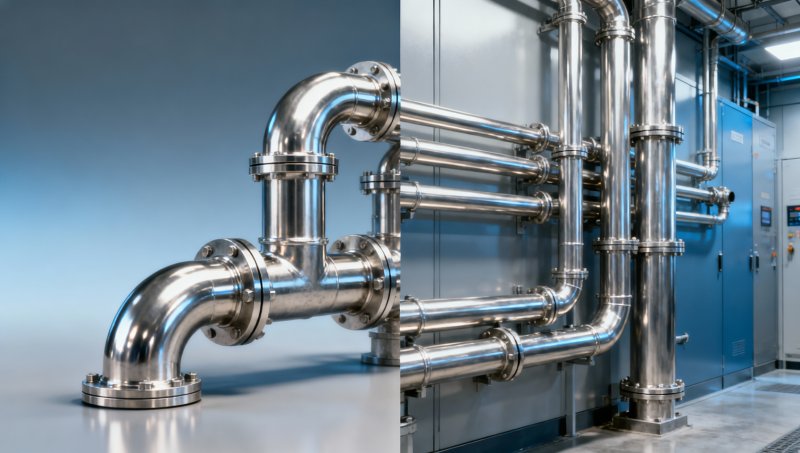
The question is not simply whether stainless steel pipe is good, but whether it is good for a specific water supply condition. Technical assessment should start with water chemistry, especially chloride level, pH range, dissolved oxygen, and cleaning chemicals. Even a high-quality pipe can fail early if the grade is wrong for the environment or if welding and passivation are poorly controlled.
In many projects, 304 stainless steel is adequate for indoor potable water with low to moderate chloride content. It is widely chosen for apartment buildings, office towers, schools, and light commercial systems. If the site is close to the sea, the water source is more aggressive, or hot water recirculation is continuous, 316 may be the safer specification even if the upfront cost is 15% to 35% higher.
Wall thickness and manufacturing standard also matter. Buyers should verify pipe dimensions, pressure class, weld quality, surface condition, and tolerance. ASTM steel pipe standards, EN requirements, and project-specific standards help define acceptable quality levels. In tender evaluation, material grade alone is not enough; mill test certificates, dimensional inspection, and traceability should also be reviewed.
Installation method affects the final result as much as the material itself. Poor cutting, contaminated tools, low-quality welding consumables, or mixed-metal contact can introduce corrosion points. For this reason, quality control teams usually check 4 core factors: material verification, fabrication process, joining method, and post-installation cleaning.
A practical selection checklist
- Confirm water type: potable, hot water, treated process water, or mixed-use building supply.
- Check environmental risk: inland, coastal, chemical exposure, or buried service lines.
- Define the grade: 304 for standard indoor use, 316 for higher chloride or more corrosive conditions.
- Verify standards and tolerance: review ASTM, EN, JIS, or GB compliance and dimensional accuracy.
- Assess total cost: compare purchase price, installation cost, maintenance interval, and expected replacement cycle.
Typical decision factors by project type
Residential and commercial buildings usually focus on hygiene, clean appearance, and long service life. Industrial users may prioritize pressure resistance, compatibility with process conditions, and maintenance shutdown cost. Public projects often place extra emphasis on code compliance, inspection records, and long procurement cycles of 4 to 12 weeks.
For buyers working across building and steel structure supply chains, it is also useful to source from manufacturers that can support both piping-related steel products and structural components. For example, projects combining utility lines, mechanical supports, and equipment platforms may also require section steel. In such cases, a qualified Channel Steel Supplier can support brackets, wall beams, lightweight roof framing, and mechanical supports while maintaining stable dimensional control and export-ready documentation.
For structural applications, common channel steel options may include Q195, Q235B, Q345B, 304, or 316 grades, with thickness ranging from 1.5mm to 25mm, length from 6m to 12m, and height from 80mm to 160mm. These parameters are relevant when pipe support design must align with corrosion risk, load demand, and fabrication tolerance such as thickness tolerance of ±0.02mm and height tolerance of ±2mm.
Standards, Grades, and Quality Control Points That Matter
For engineers and quality managers, the suitability of ss pipe for water supply depends on verification, not assumption. The most important review items usually include material grade, chemical composition, mechanical properties, hydrostatic or non-destructive testing where required, surface finish, and document traceability. If these points are weak, even attractive pricing can lead to rework, leakage, or premature corrosion.
ASTM steel pipe standards are often referenced in international procurement because they provide a clear framework for dimensions, materials, and testing. Depending on project location, EN, JIS, and GB standards may also be accepted. Global buyers should confirm whether the tender requires exact standard equivalence or only general compliance, because this can affect supplier qualification and inspection scope.
Surface condition deserves more attention than many buyers give it. In water systems, a cleaner internal surface supports better hygiene and more stable flow. Weld seam quality, heat tint removal, and passivation quality can all influence corrosion behavior. This is especially important in thin-wall stainless piping and in hot water loops where local defects may become failure points over time.
Manufacturers with stable facilities and export experience can usually support consistent production batches, controlled lead times, and documentation packages for multi-market projects. For global buyers sourcing from China, this matters because delivery consistency is often as important as unit price, particularly in projects with phased installation over 2 to 6 months.
Quality control review table
The table below summarizes the most useful inspection points for technical evaluation, procurement review, and site acceptance.
For many procurement teams, the key conclusion is simple: do not judge stainless steel pipe only by grade and price. A lower-cost offer can become more expensive if thickness is inconsistent, finishing is poor, or documentation is incomplete. Quality review should involve procurement, engineering, and QC together before order confirmation.
Cost, Lifecycle Value, and Procurement Strategy
One of the most common buying questions is whether ss304 pipe price is justified for water supply. The answer depends on project horizon. If the system is temporary, low-pressure, or easy to replace, the premium may not always be necessary. But for hospitals, hotels, industrial plants, schools, and high-rise buildings, lifecycle value often outweighs the initial purchase difference.
A practical cost review should include at least 5 elements: material price, joining and installation labor, support steel and accessories, maintenance frequency, and replacement risk. Stainless steel pipe can reduce hidden costs because it generally needs less internal corrosion management than galvanized steel and offers better structural confidence than some lightweight piping in demanding mechanical spaces.
Lead time is another purchasing factor. For standard sizes, many exporters can arrange shipment in about 15 to 30 days depending on quantity, surface finish, and destination. For customized dimensions, mixed-grade orders, or project packages that include support steel sections, the cycle may extend to 4 to 8 weeks. Buyers should confirm packing, marking, port terms, and inspection timing before deposit release.
Financial approvers also want risk visibility. In water supply projects, one pipe failure can trigger wall opening, service interruption, reputational damage, and labor cost far greater than the original material difference. That is why many decision-makers compare total ownership cost over 10 to 20 years rather than the ex-works price alone.
Procurement comparison for decision-makers
The following table helps procurement and commercial teams frame a more balanced decision between lower first cost and longer-term value.
The commercial takeaway is that stainless steel pipe is often a strategic purchase, not merely a material upgrade. Buyers who define performance targets, inspection scope, and delivery milestones early are more likely to achieve reliable cost control and smoother project execution.
Common Mistakes, Maintenance Advice, and FAQ
Even high-quality ss pipe can underperform when the specification or installation practice is wrong. One common mistake is choosing a lower grade only to reduce initial cost, then using it in hot water recirculation or chloride-rich conditions. Another is failing to isolate stainless steel from incompatible metals, which can increase galvanic corrosion risk at connections or supports.
Maintenance requirements are usually moderate, but not zero. In commercial buildings and industrial facilities, periodic inspection every 6 to 12 months is a practical approach. Operators should check visible joints, support points, signs of leakage, insulation moisture, and abnormal discoloration. Water treatment conditions should also be reviewed if scaling or corrosion symptoms appear.
For project teams managing both piping and structural steel, integration planning matters. Pipe supports, brackets, and utility frames should be selected with compatible corrosion protection and adequate strength. In some projects, hot-dip galvanized or stainless-compatible support sections are preferred depending on indoor or outdoor exposure and expected maintenance interval.
Below are several frequently asked questions that buyers, engineers, and end users commonly raise when evaluating stainless steel pipe for water supply systems.
Is 304 stainless steel safe for drinking water?
In many standard indoor potable water applications, 304 stainless steel is a widely accepted and practical choice. It offers good corrosion resistance and hygienic performance when water chemistry is moderate and fabrication is properly controlled. For higher chloride exposure or coastal projects, 316 may provide a more conservative solution.
Is 201 stainless steel suitable for water supply?
201 stainless steel is generally less preferred for demanding potable water systems because its corrosion resistance is lower than 304 or 316. It may appear attractive on price, but for long-term water service, especially in humid or corrosive environments, many engineers choose 304 as a minimum practical grade.
How long can ss pipe last in a building water system?
Under suitable water quality and proper installation, a stainless steel water supply pipe system may serve for 20 to 30 years or more. Actual life depends on grade, wall thickness, flow condition, temperature, chloride level, and whether weld areas were correctly finished and passivated.
What should buyers request from suppliers?
At minimum, buyers should request grade confirmation, dimensional details, standard compliance, inspection records, and traceable mill documentation. For export projects, it is also useful to confirm packaging method, delivery schedule, and whether the supplier can support related steel products for pipe supports or structure coordination.
Stainless steel pipe is a strong option for water supply systems when the grade matches the environment, quality control is verified, and lifecycle cost is evaluated alongside purchase price. For developers, engineers, distributors, and procurement teams seeking reliable steel solutions, working with an experienced Chinese manufacturer can improve consistency in standards compliance, supply stability, and project coordination. If you need support on water system material selection, related structural steel components, or customized export supply, contact Hongteng Fengda to get technical details, sourcing guidance, and a tailored solution for your project.
Please give us a message


Please enter what you want to find