When comparing I beam vs H beam strength in long-span structures, the short answer is this: as span length increases, overall beam performance depends less on the name of the section and more on section modulus, moment of inertia, flange/web proportions, lateral stability, and connection design. In many practical long-span applications, H beams are often preferred because their wider flanges and more balanced geometry usually provide better load distribution and stability. However, that does not mean an I beam is always weaker. The right choice depends on load type, span, support condition, fabrication method, and budget.
For engineers, buyers, project managers, and steel sourcing teams, this matters because a poor beam choice in long spans can lead to excessive deflection, vibration, higher steel consumption, difficult installation, or unnecessary cost. This guide explains what really changes when span gets longer and how to evaluate I beam vs H beam strength in a practical way.
What matters most when span gets longer?
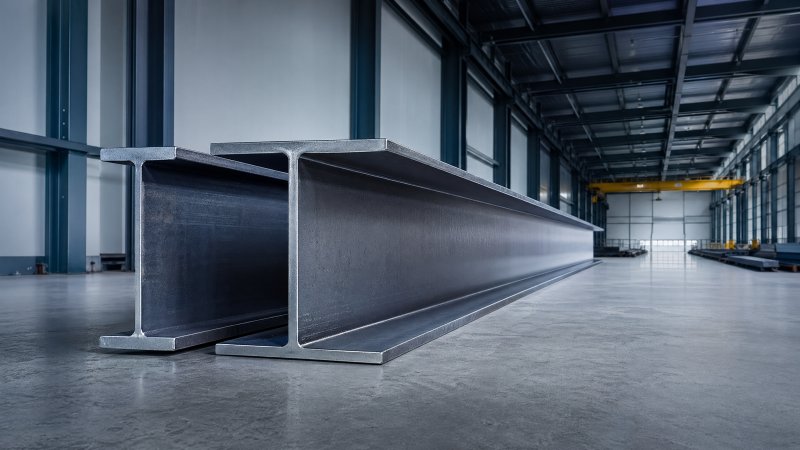
As span length increases, the design challenge changes. In short spans, many beam sections can meet basic strength requirements without much difficulty. In long spans, however, several issues become more critical at the same time:
- Bending moment rises significantly, increasing demand on section capacity.
- Deflection becomes a major control factor, sometimes even more important than ultimate strength.
- Lateral-torsional buckling risk increases, especially for slender members without enough restraint.
- Self-weight grows in importance, because heavier beams add load to the structure itself.
- Connection and erection requirements become more complex, affecting total project cost and schedule.
That is why the question is not simply “Which is stronger?” but rather “Which section performs better and more efficiently over the required span under actual project conditions?”
I beam vs H beam: what is the practical structural difference?
In many markets, the terms are sometimes used loosely, but in practical structural discussion:
- I beams often have narrower flanges and a relatively taller web.
- H beams usually have wider flanges, greater flange thickness, and a cross-section that is closer to a balanced shape.
This difference matters because beam strength in long spans is closely linked to how steel is distributed away from the neutral axis. Wider and thicker flanges generally improve resistance to bending and may help with stability under certain loading conditions. That is one reason H beams are commonly selected for columns, transfer beams, heavy platforms, industrial buildings, and larger-span structural frameworks.
In contrast, some I beams may still be efficient where loading is moderate, span is controlled, or weight reduction is important. So the comparison should be based on section properties rather than shape labels alone.
Which one is usually better for long-span strength?
For longer spans, H beams are often the more favorable option because they commonly offer:
- Higher moment of inertia for a given application range
- Better flange support against bending stresses
- Improved overall stability in many structural layouts
- Good suitability for heavy loads and large building frames
But this should be understood correctly. H beams are not automatically stronger in every case. A properly sized I beam can outperform a smaller H beam if its section properties are better matched to the design demand. What long-span design really requires is enough:
- Section modulus for bending strength
- Moment of inertia for stiffness and deflection control
- Torsional resistance for stability
- Local buckling resistance in flange and web elements
So if two sections are compared, engineers should look at the actual section tables, not only at whether the product is called an I beam or H beam.
Why deflection often becomes more important than pure strength
Many buyers and non-technical decision makers focus first on load capacity, but in long spans, deflection can become the controlling criterion. A beam may be strong enough to avoid failure, yet still bend too much for serviceability requirements.
Excessive deflection can cause:
- Floor vibration and poor user comfort
- Cracking in finishes or walls
- Roof ponding issues
- Misalignment of connected elements
- Reduced confidence in structural quality
This is where H beams often show an advantage in practical projects, because their geometry can help achieve better stiffness for longer spans. In warehouses, industrial sheds, mezzanines, and equipment-support platforms, stiffness is often just as important as nominal strength.
What engineers and buyers should compare instead of only beam shape
If your team is evaluating a long-span steel member, these are the key comparison points:
- Span length
As span increases, even small differences in section stiffness can have a large effect. - Type of load
Uniformly distributed loads, point loads, moving equipment loads, and dynamic loads affect section choice differently. - Support conditions
Simply supported and continuous beams behave differently under the same loading. - Unbraced length
Longer unbraced lengths increase buckling risk. - Deflection limit
Serviceability limits may govern section selection before strength does. - Fabrication and connection requirements
Larger sections may improve performance but add handling, welding, and transport complexity. - Total installed cost
The cheapest section per ton is not always the lowest-cost project solution.
For project teams sourcing related materials, durability also matters. In secondary structural members, cladding systems, purlins, deck support, and fabricated accessories, corrosion protection can strongly affect maintenance cost and service life. In such cases, materials such as Steel Coil Galvanized are widely used for cold formed profiles, roofing, wall systems, and custom components where zinc coating helps protect the steel surface. Common grades include DX51D+Z, SGCC, and S350GD+Z, with thickness from 0.12mm to 3.5mm and zinc coating options such as 60-275g/m², depending on the environment and application.
When an I beam may still be the right choice
Even in projects discussing long spans, I beams can still make sense when:
- The span is moderate rather than extreme
- The loading is relatively light
- Lateral restraint is well provided
- The design prioritizes availability or compatibility with an existing structure
- The engineer verifies adequate stiffness and stability through calculation
In some supply markets, certain I beam sizes may also be easier to source quickly, which can support schedule-sensitive projects. For procurement teams, this means structural efficiency should be balanced with lead time, shipping cost, regional standard availability, and fabrication practicality.
How to make a better decision for real projects
If you are selecting between I beam and H beam for a longer span, a practical decision process is:
- Define the real span, support condition, and load case clearly.
- Check both ultimate strength and serviceability deflection.
- Review lateral stability and need for bracing.
- Compare section properties, not just section names.
- Consider fabrication, transport, and installation constraints.
- Evaluate lifecycle cost, not only steel weight.
- Confirm compliance with required standards such as ASTM, EN, JIS, or GB.
For buyers and commercial evaluators, asking suppliers for section data, mill certification, tolerance control, and standard compliance is essential. A reliable structural steel manufacturer should be able to support not only product supply, but also specification matching, quality consistency, and customized production where required.
Final takeaway on I beam vs H beam strength in long spans
When span gets longer, the comparison between I beam vs H beam strength becomes a performance question, not just a shape question. In many long-span applications, H beams are often preferred because they typically provide better bending efficiency, stiffness, and stability. But the correct answer always depends on actual section properties, structural design conditions, and project priorities.
If you need a simple rule of thumb, use this: for longer spans and heavier loads, H beams are more commonly the safer and more practical starting point; for lighter or more constrained applications, a properly selected I beam may still be fully suitable.
The best decision comes from checking strength, deflection, stability, fabrication, and total project value together. That approach reduces design risk, controls cost, and leads to a more reliable structure over the long term.
Please give us a message


Please enter what you want to find