Understanding a high strength steel plate mill test report is essential for buyers, engineers, and quality teams who need to verify compliance, mechanical performance, and project suitability. Whether you source high strength steel plate for construction, compare steel sheet price, or evaluate suppliers alongside products like galvanized steel for construction and steel rebar for construction, knowing how to read an MTR helps reduce risk and make informed decisions.
In steel procurement, the mill test report, also called an MTR or mill certificate, is one of the most important technical documents in the supply chain. It connects the delivered plate to its heat number, chemical composition, mechanical properties, dimensions, and test results. For structural projects, fabrication workshops, distributors, and project owners, this document often determines whether material can move from receiving inspection to cutting, welding, and final installation.
For high strength steel plate, reading the report correctly matters even more because yield strength, tensile strength, impact performance, and standard compliance directly affect safety, fabrication behavior, and total project cost. A misunderstanding of one line item can lead to nonconforming material, delayed approval, or expensive rework. This guide explains how to read the report step by step and what to verify before accepting the material.
What a mill test report is and why it matters
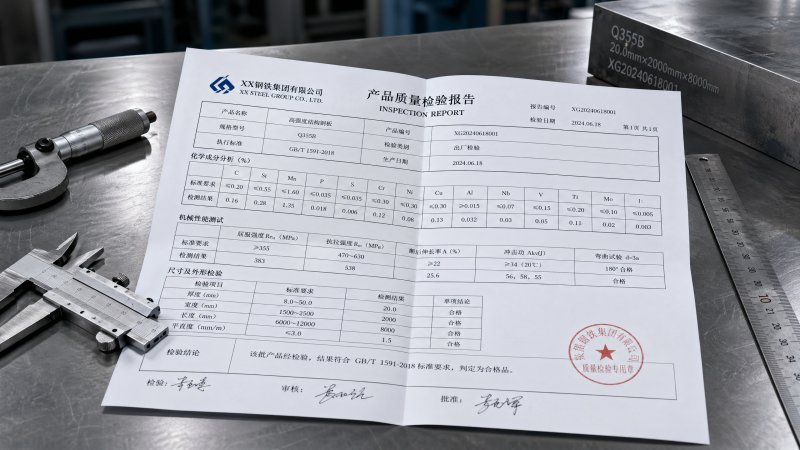
A mill test report is the manufacturer’s record of the steel plate produced from a specific heat or batch. It usually includes 6 core groups of information: producer details, purchase reference, material grade, dimensions and quantity, chemical analysis, and mechanical test results. In many international transactions, the MTR is required before shipment release, customs documentation, or third-party inspection approval.
For high strength steel plate used in bridges, buildings, equipment frames, heavy machinery, and industrial structures, the report serves two practical purposes. First, it confirms whether the delivered plate meets standards such as ASTM, EN, JIS, or GB. Second, it helps technical teams judge whether the plate is suitable for welding, cold forming, cutting, and load-bearing service conditions.
Buyers often focus only on price per ton, but quality teams usually review at least 4 more variables: grade conformity, thickness tolerance, mechanical results, and traceability. If any one of these is unclear, the risk increases. A low steel sheet price can quickly become expensive if the material fails impact testing, does not match the ordered grade, or cannot be linked to the stamped heat number on the plate surface.
For a structural steel manufacturer and exporter, document accuracy is also part of service quality. Global projects commonly require document packages within 24–72 hours after production or before dispatch. Reliable suppliers support this process with clear heat traceability, standard marking, and consistent format, which helps procurement, QA, and project management teams make faster decisions.
Typical sections found on an MTR
Although layouts vary by mill, most reports contain similar sections. The table below shows the most common items and why each one matters during technical and commercial review.
The key point is that an MTR is not just a file for recordkeeping. It is a decision tool. If the plate marking, purchase order, and certificate do not match exactly, many responsible project teams will quarantine the material until the discrepancy is resolved.
How to check identity, grade, dimensions, and traceability
The first review step is basic identification. Before studying chemistry and strength values, confirm that the report belongs to the actual plate. Check the manufacturer name, MTR number, heat number, plate number, material grade, and specification standard. Then compare them against the purchase order, packing list, and stencil or marking on the steel plate. This 3-way match is the foundation of quality control.
High strength steel plate may be ordered in grades such as ASTM A572, A514, A588, EN S355, S460, S690, or corresponding GB grades. A common mistake is assuming that a “similar” grade is acceptable. In reality, even when nominal yield strength appears close, chemistry limits, impact requirements, and delivery conditions can differ. One grade substitution without written approval can affect welding procedures and design acceptance.
Dimensions also deserve careful review. The MTR normally lists thickness, width, length, number of plates, and theoretical or actual weight. For example, a project may order 20 mm × 2,000 mm × 6,000 mm plate with tolerance according to the applicable standard. If thickness is within standard but below the project’s minimum design reserve, the engineering team may still require review. That is why procurement should not separate commercial acceptance from technical acceptance.
Traceability is especially important when steel will be cut into smaller components. Once the full plate is divided, each fabricated part should still be traceable to the original heat number. In many workshops, this is managed through transfer marking, traveler sheets, or digital inventory records. Losing traceability at this stage can create serious documentation gaps during final inspection or owner audit.
A practical receiving checklist
The following checklist helps operators, inspectors, and purchasing teams review the basic conformity of an incoming shipment within the first 15–30 minutes per batch.
- Confirm the steel grade on the MTR matches the purchase order and approved technical specification.
- Match the heat number on the report to the marking stamped, painted, or tagged on each plate.
- Verify thickness, width, and length against the ordered size and the applicable tolerance standard.
- Check total quantity, number of pieces, and net weight against packing and shipping documents.
- Review whether the report includes the required standard edition, test condition, and signature or authorization.
When these basic items are correct, the team can move to the deeper technical review of chemistry and mechanical performance. Skipping this first step often causes later confusion, especially when multiple heats are delivered in one shipment.
How to read chemical composition and mechanical properties
After identity is confirmed, the next step is to study the chemical composition. For high strength steel plate, the report may list carbon, manganese, silicon, phosphorus, sulfur, and microalloying elements such as niobium, vanadium, or titanium. In many structural applications, lower carbon and controlled sulfur and phosphorus levels support better weldability and toughness. Even small chemistry differences can influence preheat requirements and heat-affected zone behavior.
Mechanical properties are usually shown through yield strength, tensile strength, elongation, and sometimes impact energy. For example, a plate may need minimum yield at 355 MPa, 460 MPa, or higher depending on grade. Tensile strength is often expressed as a range rather than a single number, while elongation may require a minimum percentage such as 18%, 20%, or more depending on thickness and standard. These values must be read as a complete set, not in isolation.
Impact testing is another critical line item in cold-region or dynamically loaded structures. Charpy V-notch test results may be reported at 0°C, -20°C, or -40°C with values in joules. If a project specification requires low-temperature toughness and the MTR shows only room-temperature results, the material may still be noncompliant even if yield and tensile values look acceptable. This is a frequent issue in export projects that serve multiple climate zones.
It also helps to understand the difference between minimum required values and actual test values. The report normally shows the actual measured result, which should meet or exceed the minimum requirement. However, unusually high hardness or very high strength compared with the grade target can sometimes raise fabrication concerns, especially for forming or welding. Balanced properties are often more useful than simply the highest number.
What to look for in the data table
This simplified comparison shows how users can read typical MTR values against the ordered requirement. Exact requirements depend on the specific standard and plate thickness.
The main lesson is simple: always compare the test result with the exact requirement format. Some properties require “not less than,” while others require staying within a range. Reading only one column without the standard context can lead to wrong acceptance decisions.
Common mistakes when reviewing an MTR and how to avoid them
One common mistake is relying only on the material name without checking the governing standard and delivery condition. Two plates may both be called high strength steel, but one may be normalized, another thermo-mechanically rolled, and another quenched and tempered. These differences affect strength distribution, weldability, and end-use suitability. Project teams should treat the full designation as the real product identity, not the short trade description.
Another mistake is treating the MTR as a stand-alone approval document. In practice, it should be reviewed together with drawings, project specifications, welding procedure requirements, and any third-party inspection clauses. A plate that passes standard mill requirements may still need additional ultrasonic testing, through-thickness performance, or low-temperature impact verification depending on the application. This is common in offshore, bridge, and critical building structures.
Commercial teams sometimes overlook the value of format consistency. When projects involve 20, 50, or 100 plates from multiple heats, inconsistent certificates can slow down internal approval and create avoidable queries. Reliable exporters usually provide organized documentation packages including MTRs, packing lists, invoices, and, where required, inspection records. This saves time for distributors, EPC contractors, and owner representatives.
In some sourcing situations, buyers compare high strength carbon steel with stainless or special alloy products used in related industrial environments. For example, when corrosion resistance and formability are more important than structural yield ratio, products such as 201 Stainless Steel Coil may enter the evaluation list for equipment covers, kitchen-related fabrication, decorative engineering, or light industrial components. Its typical tensile strength is ≥ 520 MPa, yield strength is ≥ 275 MPa, elongation can reach about 55–60%, and thickness options may range from 2.5 mm to 10.0 mm with widths from 610 mm to 2000 mm. The key lesson is that every material must be assessed against the actual service condition rather than by price or appearance alone.
A 5-point error prevention routine
- Read the standard and grade exactly as written, including suffixes and delivery condition.
- Check whether test temperature, specimen direction, and thickness range affect the required values.
- Confirm the MTR heat number matches physical marking before unloading into mixed inventory.
- Escalate any substitution, missing item, or overwritten value for engineering approval.
- Archive the MTR with receiving records so it remains traceable through fabrication and shipment.
This routine is simple, but it can prevent many costly problems. In real projects, the biggest losses often come not from dramatic material failure, but from preventable documentation mismatch and late-stage rejection.
How buyers and project teams should use MTRs in procurement decisions
For procurement, an MTR should be used as part of a broader supplier evaluation process. Price, lead time, and freight terms matter, but so do production capability, standard coverage, quality consistency, and communication speed. For many global projects, the best supplier is not simply the one with the lowest quotation, but the one that can deliver compliant material with stable documentation and predictable lead times of 2–6 weeks depending on grade, thickness, and tonnage.
Project managers and financial approvers also benefit from understanding the report. Clear certificates reduce the chance of material disputes, site delays, and reinspection cost. When material is urgently needed for fabrication or installation, one missing test item can create a chain reaction: inspection hold, production rescheduling, labor idle time, and delayed milestone billing. In many projects, documentation quality has a direct cost impact even before steel reaches the site.
For distributors and fabricators, a strong supplier relationship often includes pre-shipment document review. Instead of waiting until the cargo arrives, buyers can request draft MTRs, plate lists, and marking details 3–5 days before dispatch. This allows technical teams to identify issues early and reduce port storage risk or warehouse segregation problems after arrival.
Companies that source structural steel internationally should also work with manufacturers that understand multiple standards such as ASTM, EN, JIS, and GB. Suppliers with modern manufacturing facilities, strict quality control, and export experience can usually support standard plate products as well as customized structural solutions. This is especially valuable when a project combines beams, channels, angle steel, cold formed profiles, and plate products under one procurement plan.
Procurement decision factors linked to MTR review
The table below shows how different business roles typically use MTR data during sourcing and approval.
This shows why MTR review should be cross-functional. Technical and commercial goals are linked, and the document is one of the few places where those goals meet in a measurable way.
FAQ for practical use
How many MTRs should come with one shipment?
Usually one certificate is issued per heat, batch, or plate group depending on the mill’s system and the order structure. If a shipment contains 3 heats, you may receive 3 separate reports or one compiled package with clearly separated heat records. The important point is that each delivered plate must be traceable to its own test data.
Can a buyer accept steel without an MTR?
For low-risk commodity applications, some markets may treat this more flexibly, but for structural, industrial, or export projects, accepting steel without an MTR is generally poor practice. Without traceable evidence of chemistry and mechanical performance, it becomes difficult to prove compliance, support claims, or pass project audits.
What if the measured result is close to the minimum limit?
If the result still meets the standard, the material may be acceptable. However, when the project involves severe cold service, heavy welding, or demanding forming operations, engineering review is advisable. Compliance is the first threshold, but fitness for the exact application is the final decision point.
Reading a high strength steel plate mill test report correctly helps every stakeholder make better decisions, from the receiving inspector on the warehouse floor to the engineer, buyer, distributor, and executive approving project risk. The most important checks are identity, traceability, chemistry, mechanical properties, dimensions, and standard compliance. When these items are reviewed systematically, the chance of delay, rejection, and hidden cost is significantly lower.
For global buyers seeking structural steel products, customized solutions, and dependable export support, working with an experienced manufacturer matters as much as understanding the document itself. If you need support with high strength steel plate, structural sections, standard compliance review, or customized sourcing for construction and industrial projects, contact us to discuss your requirements, request technical details, or get a tailored supply solution.
Please give us a message


Please enter what you want to find