Choosing an ASTM A106 Gr.B equivalent may seem cost-effective, but in critical applications, substitution without full verification can create serious performance and compliance risks. This article explains why ASTM A106 Gr.B specification and ASTM A106 Gr B chemical composition must be reviewed carefully, especially when sourcing ASTM A106 Gr B pipe for industrial or structural projects.
For buyers, engineers, QA teams, project managers, and business decision-makers, the issue is not simply whether another grade looks similar on paper. The real question is whether the substitute can deliver the same pressure performance, temperature reliability, welding response, inspection acceptance, and contractual compliance across the full life cycle of the project.
In global steel procurement, substitution risk often appears during cost control, stock shortages, delivery pressure, or cross-standard sourcing. A material may match one or two values, such as tensile strength or carbon content, yet still fail in wall thickness tolerance, heat treatment condition, traceability, or code acceptance. That is where expensive rework, delayed approvals, and operational hazards begin.
For industrial plants, energy systems, mechanical fabrication, and certain structural support applications, ASTM A106 Grade B remains a highly specified seamless carbon steel pipe standard. Understanding when an “equivalent” is acceptable and when it is not is essential for safe procurement and responsible project execution.
Why ASTM A106 Gr.B Is Frequently Misunderstood in Procurement
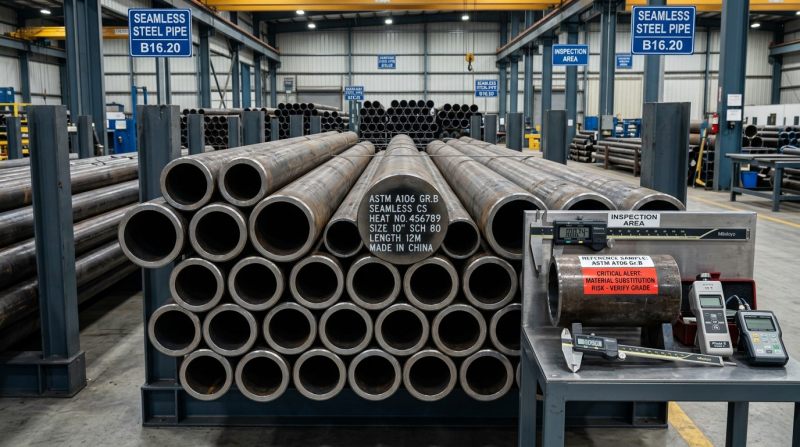
ASTM A106 Gr.B is commonly used for seamless carbon steel pipe in high-temperature service. In practice, many buyers compare it with ASTM A53, API 5L, DIN, EN, or GB pipe grades because they may appear close in chemistry or strength. However, “close” is not the same as interchangeable. A project can pass desk review and still fail field acceptance if the substitute does not satisfy the original design basis.
The misunderstanding usually starts with partial comparison. A purchaser may look at yield strength and tensile strength only. A fabricator may focus on weldability. A commercial team may compare price per ton and lead time, such as 2–4 weeks versus 5–7 weeks. But engineering review must consider at least 6 factors: manufacturing route, seamless versus welded form, dimensional tolerance, testing scope, intended temperature range, and end-use code requirements.
ASTM A106 Grade B is not only about chemistry. It is also about how the pipe is made, tested, marked, and supplied. For example, seamless production matters in systems where pressure cycling, elevated temperature, and inspection sensitivity increase service risk. In many plant environments, a small difference in manufacturing route can create a much bigger difference in reliability than a 10–20 MPa change in strength data.
Another source of confusion is terminology. The phrase “ASTM A106 Gr.B equivalent” may mean commercial equivalent, mechanical equivalent, code-accepted alternative, or customer-approved substitute. These are not identical concepts. A sales substitute that works for a non-critical support frame may be unacceptable for a steam line, process line, or high-temperature transfer service.
What ASTM A106 Grade B Typically Represents
In most procurement specifications, ASTM A106 Grade B refers to seamless carbon steel pipe for high-temperature service, usually purchased in standard sizes with defined testing and marking requirements. The grade is widely recognized in industrial fabrication, energy projects, refineries, power plants, and general process systems where service conditions demand predictable pressure integrity.
- Seamless pipe form rather than a welded alternative in many specified cases
- Common use in moderate to elevated temperature systems
- Defined chemical composition and mechanical property expectations
- Inspection, hydrostatic or nondestructive testing, and traceability requirements
The point for buyers is simple: material substitution should start with service conditions and specification intent, not with price alone. If the original standard was selected for a reason, that reason must be technically reviewed before any equivalent is considered acceptable.
The Hidden Risk Behind “Equivalent” Chemical and Mechanical Properties
A substitute often looks acceptable because one data sheet shows similar carbon, manganese, and tensile ranges. Yet chemistry is only part of the decision. ASTM A106 Gr B chemical composition must be checked together with deoxidation practice, heat treatment condition, sulfur and phosphorus limits, and application-specific concerns such as low-formability behavior or welding response in thicker sections.
A difference of 0.05% in carbon or a tighter limit on sulfur may seem small, but in fabrication it can influence weld procedure qualification, heat input tolerance, crack sensitivity, and post-weld performance. On large projects with 50, 100, or 500 tons of mixed pipe and structural steel procurement, these differences can multiply into serious quality control complications.
Mechanical properties are equally easy to misread. Two materials may both exceed a minimum tensile requirement, but one may have lower elongation, different hardness behavior, or less predictable toughness in the actual service range. In systems exposed to thermal fluctuation, vibration, or repeated shutdown cycles, that difference becomes operationally relevant.
The table below highlights why single-point comparison is unsafe when assessing substitution.
The key conclusion is that no single property proves equivalence. A106 substitution should be reviewed as a package, including chemistry, mechanical data, production method, inspection regime, and final service condition.
Chemical Comparison Is Necessary but Not Sufficient
Technical evaluators should verify at least 4 layers: standard scope, manufacturing route, chemical composition, and mandatory tests. If only one or two layers are checked, the approval process becomes commercially convenient but technically weak.
Minimum checks before approving a substitute
- Confirm whether the original specification requires seamless pipe and whether the proposed substitute is also seamless.
- Compare ASTM A106 Gr B chemical composition line by line, not by summary statement.
- Review tensile, yield, and elongation as a combined performance set.
- Check NDT, hydrostatic testing, heat treatment, and marking requirements.
- Verify whether the end user, inspector, or project code accepts the substitute in writing.
This process may add 1–3 working days to procurement approval, but it can prevent weeks of delay caused by rejection, re-documentation, or replacement after delivery.
When an Equivalent Grade Becomes Unsafe or Non-Compliant
There are several project conditions where substitution risk rises sharply. The first is elevated temperature service. ASTM A106 Grade B is frequently selected because its specification intent aligns with such service conditions. If a substitute was originally designed for lower-demand utility piping or general transport, it may not offer the same confidence in thermal stability or long-term pressure performance.
The second high-risk condition is code-driven procurement. In EPC projects, owner specifications, third-party inspection plans, and contract language may name ASTM A106 Gr.B directly. Even if another grade is technically workable, undocumented substitution can create compliance issues at document review, FAT, site acceptance, or insurance assessment stages. For projects with 3-party or 4-party approval chains, this can stop installation completely.
The third risk appears in mixed fabrication environments. Many exporters and manufacturers supply pipe together with angle steel, channel steel, beams, and custom structural steel components. In these projects, buyers sometimes try to standardize sourcing across multiple steel categories for cost efficiency. That can work for some secondary materials, but pressure-service pipe and structural profiles should never be treated as interchangeable procurement logic.
Even outside pipe applications, the same discipline applies. For example, in building envelope or industrial panel systems, coated sheet products must be specified by coating mass, substrate grade, and processing condition rather than visual similarity. A practical example is AZ150 Galvalume Steel Coil, where coating designation, steel grade options such as SGCC, DC51D, DX52D, or S250GD-S550GD, and thickness range of 0.125–2.0 mm directly affect corrosion resistance, forming performance, and downstream fabrication suitability.
Typical No-Substitution or High-Control Scenarios
The following table shows where equivalent selection should be restricted or subject to strict engineering approval.
The lesson is that “equivalent” should never be approved in isolation. It must be tied to service severity, code environment, and document control. A substitute that is acceptable in one project can be unsafe or non-compliant in another.
Common warning signs during sourcing
- The supplier states “same as A106B” but cannot provide full MTC details or testing scope.
- The offered price is 8%–15% lower, but no explanation is given for manufacturing route or inspection differences.
- The quotation mixes seamless and welded options under one line item.
- The substitute grade is accepted verbally, but not approved in revised drawings or purchase documents.
These signals do not always mean the product is poor. They mean the review is incomplete, and incomplete review is exactly where substitution risk becomes dangerous.
A Practical Evaluation Framework for Engineers, Buyers, and QA Teams
A reliable substitution review should be structured, documented, and fast enough to support project schedules. For most B2B steel procurement teams, a 5-step method is practical. It aligns engineering, purchasing, quality, and management without creating unnecessary delay.
Step 1 is to define the actual service condition: pressure level, temperature range, fluid type, corrosion exposure, and fabrication route. Step 2 is to review the original standard intent. Step 3 is to compare the candidate material at chemistry, mechanical, dimensional, and testing levels. Step 4 is to verify code and customer acceptance. Step 5 is to lock the approval in procurement and quality records.
This process matters especially when sourcing from international suppliers. A capable Chinese structural steel manufacturer and exporter can support cross-standard procurement efficiently, but the buyer still needs clear technical definitions. Good sourcing is not just about factory capacity; it is about matching the right standard to the right application and maintaining traceability from quotation to shipment.
Hongteng Fengda, as a structural steel manufacturer and exporter from China, supports global buyers with standard and customized steel products across ASTM, EN, JIS, and GB systems. For project teams buying beams, channels, angles, cold formed profiles, and related steel components together with industrial materials, this multi-standard familiarity helps reduce confusion during technical comparison and document review.
Recommended 5-Step Review Path
- Identify whether the pipe is for high-temperature, pressure, or code-sensitive service.
- Collect the full ASTM A106 Gr.B specification and actual project purchase requirements.
- Compare the proposed equivalent against chemistry, mechanical values, manufacturing route, tests, and traceability.
- Obtain technical, QA, and client approval before PO release if any difference exists.
- Verify MTC, marking, dimensions, and inspection records again before shipment and upon receipt.
The table below can be used internally by purchasing and quality teams as a quick screening tool.
A disciplined review process usually saves more money than aggressive substitution. It reduces site rejection, prevents purchase duplication, and protects project schedules that may be worth far more than the material cost difference.
FAQ: Real Questions Buyers and Project Teams Ask
In steel sourcing, practical questions often matter more than textbook definitions. The answers below focus on common decision points faced by procurement teams, technical reviewers, and project managers working with industrial or structural steel packages.
Can ASTM A53 or API 5L always replace ASTM A106 Gr.B?
No. They may overlap in some dimensions or performance ranges, but they are not automatically interchangeable. The answer depends on service temperature, pressure, whether seamless construction is required, project code, and customer specification. In low-risk utility use, a substitute may be accepted after review. In high-temperature or code-sensitive systems, direct replacement without approval is risky.
What documents should be checked before approving an equivalent?
At minimum, review the material test certificate, product standard, chemical composition, mechanical properties, test records, dimensions, and marking details. Also compare the purchase specification, approved vendor documents, and any end-user comments. A complete review package often includes 7–10 checkpoints, depending on project complexity.
How much cost saving justifies substitution review?
There is no universal threshold, but many project teams become interested when the gap reaches 5%–12%. Even then, savings should be balanced against approval time, engineering hours, inspection risk, and replacement exposure. A lower unit price is not real savings if it causes one week of delay or field rejection.
How can global buyers reduce sourcing risk across multiple steel products?
Work with suppliers that understand cross-standard requirements and can provide clear technical documents for each steel category. For example, coated steel products such as AZ150 Galvalume Steel Coil should be evaluated by coating mass, substrate grade, yield range, and surface treatment options like chromated, oiled, or AFP, while structural sections and pipes must be reviewed against their own applicable standards and service conditions.
When ASTM A106 Gr.B is specified, treating another grade as a safe substitute without full verification can create technical, commercial, and compliance problems that far exceed any short-term price advantage. The safest path is to compare specification intent, ASTM A106 Gr B chemical composition, mechanical performance, manufacturing route, and approval requirements as one complete package.
For global buyers managing structural steel, industrial steel, and customized procurement from China, disciplined material review supports lower sourcing risk, steadier delivery, and better project control. If you need support comparing steel standards, reviewing product suitability, or building a reliable supply plan for your project, contact Hongteng Fengda to get technical assistance, product details, and a tailored sourcing solution.
Please give us a message


Please enter what you want to find