Small mistakes in how to calculate i beam weight can quickly lead to inflated budgets, underquoted bids, and costly procurement decisions. For buyers, engineers, and project managers comparing steel products from a China Steel Supplier, understanding the real formula behind beam weight is essential for accurate cost planning, supplier evaluation, and smoother structural steel sourcing.
In structural steel purchasing, weight is not just a technical number on a mill list. It directly affects material cost, freight, lifting plans, coating quantities, and even customs declarations for export shipments. A miscalculation of only 3% to 5% across a project with 80 to 200 tons of steel can create a visible budget gap that procurement, finance, and project management teams must absorb later.
This issue is especially important when sourcing from international suppliers. Buyers may compare offers by piece, by meter, or by ton, while engineers review section properties and quality teams focus on standards such as ASTM, EN, JIS, or GB. If everyone is using a different basis for i beam weight, the final cost estimate can quickly become unreliable.
For global buyers working with a structural steel manufacturer and exporter from China, the goal is simple: use the correct i beam weight formula, verify section data against the right standard, and align technical calculations with commercial quoting. That combination reduces sourcing risk, improves bid accuracy, and supports better project delivery.
Why I Beam Weight Matters More Than Many Buyers Expect
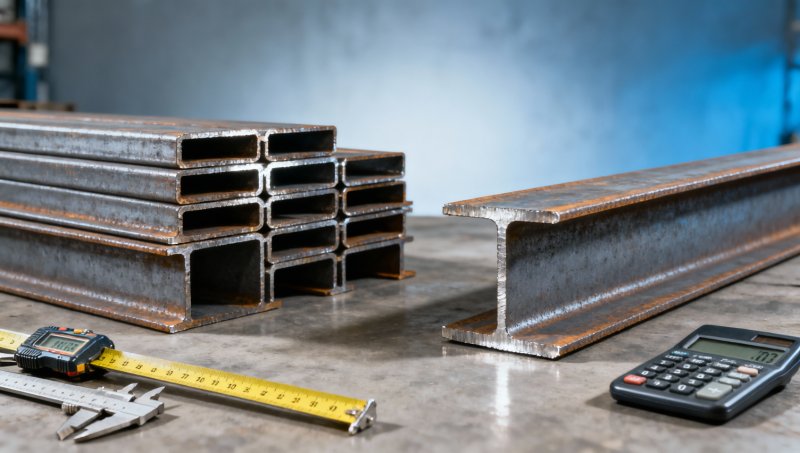
An i beam may be purchased as a standard rolled section, a cut-to-length member, or a fabricated component. In all three cases, weight influences the final transaction. Steel is commonly quoted by metric ton, but project teams often estimate using length, quantity, or drawings first. If the conversion from dimensions to theoretical mass is wrong, all downstream calculations become unstable.
For example, if a team assumes an i beam weighs 31.5 kg/m but the actual standard section weighs 36.2 kg/m, the difference is 4.7 kg per meter. Over 1,000 meters, that becomes 4.7 tons. At a steel price of USD 650 to USD 900 per ton depending on grade, coating, and market timing, the cost variance can already reach several thousand dollars before freight, processing, and tax are added.
Weight errors also distort logistics planning. Sea freight, truck loading, crane selection, and site handling all depend on real mass. A 20-foot container, a 40-foot container, or a truck trailer each has practical load limits. If the estimated weight is understated, loading plans may fail. If it is overstated, buyers may reserve more transport capacity than necessary and pay avoidable costs.
For manufacturers such as Hongteng Fengda, accurate weight calculation supports better quotation transparency. As a structural steel manufacturer and exporter from China supplying angle steel, channel steel, steel beams, cold formed profiles, and customized structural components, the company’s role is not only to produce steel but also to help buyers align specifications, quantity takeoff, and commercial evaluation across international standards.
The practical impact of i beam weight can be summarized across several business functions:
- Engineering uses weight to confirm section selection and structural assumptions.
- Procurement uses weight to compare supplier quotations on the same basis.
- Finance uses total tonnage to check budget exposure and approval thresholds.
- Logistics uses weight to plan packaging, loading, and shipment batches.
- Quality teams use standard section data to verify whether supplied material matches the ordered profile.
Where estimation mistakes usually start
Most mistakes begin in early-stage estimating, when teams rely on rough dimensions instead of standard section tables. An i beam is not a solid rectangle. Its web thickness, flange thickness, root radius, taper, and production standard all affect the true cross-sectional area. A simple width × height approximation can be off by more than 8% in some profiles.
Another common issue is mixing theoretical weight and actual shipped weight. Theoretical weight is derived from geometry and steel density, usually around 7.85 g/cm³ or 7850 kg/m³. Actual weight may vary within manufacturing tolerances. For budgeting, theoretical weight is the normal basis. For packing and transport, actual bundle weight may be the better reference.
The Correct I Beam Weight Formula and the Key Variables Behind It
The basic logic of the i beam weight formula is straightforward: weight per meter equals cross-sectional area multiplied by density. In metric terms, the common expression is Weight (kg/m) = Area (cm²) × 0.785. This works because 1 cm² of steel section over 1 meter length corresponds to approximately 0.785 kg when density is taken as 7.85 g/cm³.
However, the challenge is not the density factor. The challenge is obtaining the correct cross-sectional area. For standard hot rolled beams, the best practice is to use the official section table from the applicable standard rather than manually rebuilding the profile from nominal dimensions. Standards may define flange shape and tolerances differently, so two beams with similar nominal depth can still have different kg/m values.
When a standard table is unavailable, the section can be approximated using flange area plus web area, then adjusted for geometry details. A simplified estimate may be written as: Area ≈ 2 × flange width × flange thickness + (overall height - 2 × flange thickness) × web thickness. This is useful for early budgeting, but it remains an estimate and should be replaced by official section data before ordering.
Below is a simple comparison of methods commonly used in steel projects:
The key conclusion is that beam designation and standard matter more than many non-technical buyers expect. A correct formula with incomplete dimensions can still produce a wrong answer. In practice, using the official beam table from ASTM, EN, JIS, or GB documentation is usually the safest route for quotation comparison and purchase approval.
Important variables that affect kg/m
Four variables should always be checked before confirming any i beam weight calculation:
- The exact beam type, such as IPE, IPN, H-beam, W-shape, or a GB standard section.
- The nominal dimensions, including depth, flange width, web thickness, and flange thickness.
- The reference standard and revision used by the supplier and by the design team.
- The commercial basis, meaning whether the quote is by theoretical tonnage, actual weighbridge value, or bundle count.
A quick example
If a standard section has an area of 46.1 cm², its theoretical weight is 46.1 × 0.785 = 36.19 kg/m. If the project needs 240 pieces at 6 meters each, the total length is 1,440 meters and total theoretical weight is about 52.1 tons. That number becomes the basis for steel cost, galvanizing estimate if required, and shipment planning.
The Most Common Formula Mistakes That Distort Cost Estimates
The first major mistake is confusing i beams with H-beams or universal beams. In daily trade language, the terms are sometimes used loosely, especially across different regions. But section geometry differs. A profile with wider flanges and different web proportions may carry a noticeably different kg/m. If a buyer compares suppliers using only nominal depth, the wrong section family can produce a false cost advantage.
The second mistake is using nominal dimensions and ignoring radii, taper, or standard-specific geometry. This often occurs in spreadsheet calculations created for speed. While the approach may appear efficient, it can create a 2% to 6% gap on ordinary sections and a larger deviation on less common profiles. On a 120-ton order, a 4% error means nearly 4.8 tons of unplanned difference.
The third mistake is mixing units. Some teams switch between millimeters, centimeters, meters, kilograms, and pounds without a controlled conversion method. A missed decimal place in thickness or an incorrect area unit can multiply the error by 10 or even 100. This is one of the fastest ways to generate bid prices that look competitive but are impossible to execute profitably.
The fourth mistake is forgetting add-on processing. If beams are drilled, cut, welded, or surface-treated, the final invoiced mass or processing cost can differ from raw theoretical tonnage. Galvanizing, for instance, is often priced with reference to tonnage, surface area, or a combined processing basis. Estimators who consider only the base beam weight may understate real project cost.
In some construction packages, buyers also need related flat products for roofing, cladding, partitions, equipment covers, or protective enclosures. In that case, it helps to compare beam tonnage separately from sheet-based items such as Galv Sheeting. This galvanized steel and carbon steel sheet solution is available in thicknesses from 0.12mm to 6.00mm, widths from 600mm to 1500mm, and lengths from 1m to 12m with customization support, which makes it suitable for construction, energy, transportation, and light industrial applications that often accompany structural steel packages.
Mistake-to-impact map
The following table shows how typical formula errors translate into commercial risk:
A disciplined estimating workflow should therefore separate three numbers: theoretical section weight, fabricated or processed weight, and logistics weight. When these values are managed independently, cost review becomes far more accurate and internal approval is easier.
Another hidden issue: coating and downstream items
If a project includes both heavy structural members and secondary sheet products, each product group should be priced with its own formula. For example, galvanized sheet products may be specified under grades such as DX51D+Z, SGCC, or S350GD+Z with zinc coating ranges like 60–275g/m². These are not calculated the same way as rolled i beams, and mixing the methods creates procurement confusion.
How Buyers and Engineers Can Verify Beam Weight Before Requesting Quotes
The best time to verify weight is before RFQ release, not after supplier offers arrive. Once quotations are issued, commercial teams naturally focus on unit price. But if each supplier interpreted the beam designation differently, the comparison is already flawed. A 5-step verification routine can prevent that problem and improve quote quality from the start.
A practical 5-step checking process
- Confirm the exact section designation on drawings, not just the nominal depth.
- Match the section to the required standard such as ASTM, EN, JIS, or GB.
- Pull the official kg/m value from a reliable section table or supplier technical catalog.
- Multiply kg/m by total length and then add a reasonable allowance for cutting, splicing, or fabrication if applicable.
- Cross-check the final tonnage with freight planning and commercial quotation format.
This process is especially useful for multinational sourcing projects. North American, European, Middle Eastern, and Southeast Asian buyers may use different section naming conventions. An exporter with experience across markets can help translate one specification basis into another without changing the intended structural performance.
For technical evaluators and quality teams, weight verification should also be tied to dimensional tolerance review. If the beam is custom fabricated, the buyer should check cutting tolerance, hole location tolerance, weld details, and surface condition. A beam that matches theoretical tonnage but fails drawing requirements can still cause project delay.
For procurement and finance teams, the recommendation is to maintain one approved weight sheet that everyone uses. This single reference should show item code, standard, kg/m, quantity, total length, and total theoretical tonnage. When internal stakeholders work from the same sheet, bid alignment and approval time typically improve.
What to ask your supplier
Before confirming an order, buyers should request a concise technical-commercial clarification list:
- Which exact beam standard and section table was used for the quotation?
- Is the quoted tonnage theoretical or based on expected actual shipment weight?
- Does the price include cutting, drilling, welding, galvanizing, or painting?
- What is the standard production lead time, such as 15–30 days for standard sections or longer for custom fabrication?
- How will material certificates and dimensional inspection records be provided?
A reliable structural steel supplier should be able to answer these questions clearly. Hongteng Fengda’s strength in standard and OEM structural steel supply supports this kind of pre-order coordination, which is essential when buyers need stable production capacity, consistent quality, and dependable lead times.
Cost Control, Sourcing Strategy, and Supplier Selection in Real Projects
Correct beam weight calculation is not only about engineering accuracy. It is also a purchasing strategy tool. In many projects, the lowest apparent quote is not the lowest final cost. If one supplier based pricing on underestimated tonnage or omitted processing steps, the contract may later require variation orders, delayed approvals, or rework. Decision-makers should therefore review cost on a landed and usable basis, not only per-ton headline price.
A sound sourcing model should compare at least four dimensions: section accuracy, manufacturing capability, delivery reliability, and document transparency. For export purchases, there is a fifth dimension as well: the supplier’s ability to support international standards and communication across commercial and technical teams. This becomes more important when project schedules are tight, for example when fabrication windows are only 2 to 4 weeks between drawing approval and site shipment.
Below is a useful comparison framework for evaluating structural steel offers:
The strongest suppliers are usually those who can connect technical accuracy with commercial discipline. That means they do not simply send a price list. They help confirm section details, explain tonnage assumptions, support standard compliance, and provide realistic lead times. This is particularly valuable for distributors, contractors, project owners, and industrial manufacturers handling multi-item steel procurement from a China-based source.
When should you request a customized solution?
Customization is worth discussing when at least one of the following applies:
- The project includes mixed products such as beams, channels, angle steel, and sheet components.
- Parts require OEM fabrication instead of standard stock lengths.
- The buyer must comply with a specific standard across multiple countries or end users.
- The delivery program needs phased shipments over 2, 3, or more batches.
- The internal approval process requires clearer cost breakdown by raw steel, processing, and freight.
In these cases, accurate weight formulas become the backbone of a broader supply solution. They support cleaner quotations, stronger contract alignment, and fewer surprises after PO release.
FAQ: Practical Questions About I Beam Weight and Cost Accuracy
How much error is acceptable in early-stage beam weight estimates?
For concept budgeting, a rough estimate within 3% to 5% may be workable if clearly labeled as preliminary. For procurement, contract review, or freight booking, the target should be much tighter and based on official section tables. The closer the project is to purchase approval, the less tolerance there is for approximation.
Should buyers use theoretical weight or actual weight for payment?
That depends on the commercial agreement. Many steel transactions use theoretical weight from the standard section table because it is easier to verify consistently. Actual weight may be relevant for logistics or when specific contract terms define weighbridge measurement. The key is to state the basis clearly before the quotation is finalized.
What documents help verify beam weight during quality inspection?
Useful documents include the mill certificate, section dimension sheet, packing list with bundle weights, and inspection records linked to the applicable standard. For fabricated steel, buyers may also request cut lists, shop drawings, and processing records. Together, these documents help quality managers confirm that the supplied product matches both technical and commercial expectations.
Can a supplier support both standard sections and related galvanized sheet products?
Yes, many project buyers prefer a supplier or supply partner that can coordinate multiple steel categories. For example, alongside beams and profiles, some projects require galvanized sheet materials for construction enclosures, equipment housings, or agricultural and industrial applications. A product such as Galv Sheeting may be relevant in those packages when buyers need grades such as DX51D+Z, SGCC, or S550GD+Z and compliance with standards including ASTM, DIN, JIS, GB, or EN.
Wrong i beam weight calculations rarely stay isolated as a technical issue. They spread into budget overruns, weak quote comparisons, freight surprises, and approval delays. The most effective solution is to use the correct section standard, confirm kg/m from reliable tables, separate theoretical and actual weight where needed, and work with a supplier that understands both steel manufacturing and export project requirements.
Hongteng Fengda supports global buyers with structural steel products, customized solutions, stable production capacity, and quality control aligned with major international standards. If you need help checking beam weight, comparing steel quotations, or building a more accurate sourcing plan, contact us now to get a customized solution, discuss product details, and explore the right structural steel package for your project.
Please give us a message


Please enter what you want to find