Selecting the right API 5L Steel Pipe grade is essential for safe, cost-effective pressure line projects. From material strength and toughness to compliance with standards such as ASTM A106 pipe requirements, buyers and engineers must evaluate performance under real operating conditions. This guide explains key API 5L Steel Pipe grades, helping project teams, procurement managers, and technical evaluators make informed decisions with confidence.
In pressure line projects, pipe grade selection affects not only design performance, but also welding behavior, inspection scope, procurement cost, and long-term operating risk. A mismatch between grade and service condition can lead to avoidable downtime, repair work, or overengineering that raises project budgets without adding practical value.
For buyers, EPC teams, quality managers, and distributors, understanding the difference between API 5L PSL1 and PSL2, as well as common grades such as B, X42, X52, X60, and X70, is especially important when comparing tenders across international supply chains. This is also where an experienced steel manufacturer and exporter can help reduce sourcing uncertainty and improve specification alignment.
Understanding API 5L Grades and Why They Matter
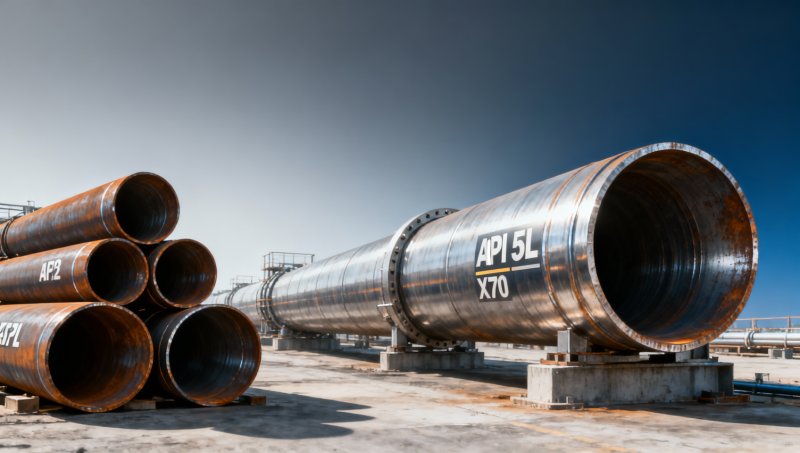
API 5L is the widely used standard for line pipe intended for transporting oil, gas, water, and other fluids under pressure. In practical terms, the standard defines chemical composition, mechanical properties, manufacturing route, testing requirements, and delivery condition. Grades are usually identified by a letter or by yield strength levels such as X42, X52, X60, and X70.
The “X” designation refers to minimum yield strength in ksi. For example, X52 means a minimum yield strength of 52 ksi, which is approximately 359 MPa. As grade increases, strength generally improves, allowing thinner wall design in some projects. However, higher grade does not automatically mean better choice, because weldability, toughness, temperature exposure, and total installed cost must also be assessed.
Another key distinction is PSL1 versus PSL2. PSL1 is the basic product specification level, while PSL2 includes tighter control over chemistry, impact properties, non-destructive testing, and traceability. For critical transmission lines, offshore service, or projects with stricter owner specifications, PSL2 is often preferred even when the nominal grade remains the same.
Technical teams should also remember that API 5L line pipe and ASTM A106 pipe are not interchangeable in every case. ASTM A106 is commonly used for high-temperature service piping in plants, while API 5L is focused on line pipe service. Some projects may compare both during engineering review, but the final selection must follow design code, medium, temperature, pressure range, and end-use requirements.
Common API 5L grade positions in project design
In lower to moderate pressure systems, Grade B and X42 are often considered practical options, especially where forming, welding, and broad availability are important. X52 is one of the most commonly specified grades because it balances strength, cost, and fabrication convenience across many onshore pipeline applications.
X60 and X70 are usually selected where operators want higher pressure capability, reduced wall thickness, or weight savings across long-distance transmission lines. In these cases, material control, welding procedure qualification, and impact toughness become more important, particularly in colder environments or where fracture control is part of project risk management.
The table below summarizes the role of several common grades in pressure line planning.
The main takeaway is that grade selection should follow service demand, not just strength preference. For many buyers, X52 delivers a practical middle ground, while PSL2 requirements often become the deciding factor for quality-sensitive projects.
How to Match Pipe Grade to Pressure, Temperature, and Service Risk
Selecting API 5L Steel Pipe for a real project starts with operating data. Engineers normally review design pressure, design temperature, transported medium, corrosion allowance, installation environment, and expected service life. A line carrying dry natural gas over 100 km will have different priorities from a short industrial water line or a refinery transfer line exposed to elevated temperatures.
Pressure alone should not drive grade choice. A higher grade may support a thinner wall, but lower wall thickness can alter buckling resistance, transportation handling, and welding window. For example, if a project requires strong field weldability across multiple contractors, selecting X60 instead of X70 may improve fabrication stability even when both meet the pressure target on paper.
Temperature is another decisive factor. In low-temperature service, toughness testing becomes more important because brittle fracture risk rises as temperature drops. For some specifications, impact testing at 0°C, -20°C, or lower may be requested depending on region and owner standards. In such cases, PSL2 and supplementary requirements deserve close attention during mill evaluation.
Corrosive environments require a broader review beyond base grade. If the fluid contains H2S, CO2, chlorides, or variable moisture content, buyers may need additional material restrictions, coating systems, or sour service suitability review. Grade strength is only one part of the performance package; chemistry control, hardness limits, and surface protection also influence long-term reliability.
Four practical selection checks
- Confirm whether the project standard calls for PSL1 or PSL2, and whether impact testing, NDT, or traceability records are mandatory.
- Review design pressure and wall thickness together rather than selecting by strength class only.
- Check installation conditions such as cold weather, offshore exposure, buried service, or high cyclic loading.
- Align weld procedure qualification with pipe chemistry, especially for X60 and above where heat input control may be tighter.
Typical risk areas in purchasing review
Procurement teams should verify whether test certificates match heat number traceability, whether body and seam inspection are included, and whether dimensional tolerances meet project drawings. Lead times for standard sizes may be 3–6 weeks, while project-specific dimensions or stricter inspection packages can extend delivery to 6–10 weeks depending on order volume and mill schedule.
For companies sourcing broader steel packages, supplier coordination matters as much as pipe data. A manufacturer with export experience can support document consistency across structural steel, fabricated components, and accessory materials. In some mixed-supply projects, buyers also consolidate supporting materials such as Galvanized Steel Wire for packaging, mesh, barrier isolation, or construction site use, improving supplier management efficiency.
The following table helps map operating conditions to a more suitable grade strategy.
A project-grade decision is usually strongest when pressure, environment, and fabrication conditions are reviewed together. This approach helps avoid both under-specification and unnecessary material upgrades.
PSL1 vs PSL2, Manufacturing Route, and Inspection Priorities
Many sourcing problems occur not because the nominal grade is wrong, but because the specification level is incomplete. A buyer may request X52 without clearly stating PSL1 or PSL2, or may assume all mills include the same inspection package. In practice, the difference can affect chemistry limits, impact testing, non-destructive examination, and documentation depth.
PSL1 is usually suitable for less demanding applications where standard line pipe performance is acceptable. PSL2 is more controlled and often required for critical energy infrastructure, regulated cross-border supply, or projects where owner documentation review is rigorous. The added controls may increase cost, but they also reduce uncertainty in service performance and acceptance procedures.
Manufacturing route also matters. API 5L pipe may be supplied as seamless, ERW, LSAW, or SSAW depending on size range and project purpose. Seamless pipe is commonly chosen for smaller diameters and certain severe conditions, while welded pipe options are often more economical for larger diameters. However, the best route depends on dimensions, pressure class, line length, and inspection philosophy rather than habit alone.
Quality control teams should verify dimensional tolerances, hydrostatic testing, ultrasonic or electromagnetic inspection where required, and coating or marking requirements if included in the order. For export projects, document consistency across mill test certificates, packing lists, inspection reports, and shipping marks can significantly reduce clearance delays and receiving disputes.
Checklist for supplier evaluation
- Confirm pipe type, grade, PSL level, size, wall thickness, and length range in one written specification sheet.
- Request sample MTC format before order confirmation to verify chemistry, tensile results, and heat traceability fields.
- Clarify whether third-party inspection is required at pre-production, in-process, or final release stage.
- Check packing method, end protection, marking format, and export bundle or loose loading method.
- Verify realistic production lead time based on tonnage, not only on catalog availability.
Related supply coordination in steel projects
In many industrial and construction supply programs, line pipe orders are handled together with structural steel, channels, beams, cold formed profiles, or auxiliary steel items. This can simplify project planning if the supplier has stable production control and experience with ASTM, EN, JIS, and GB-oriented documentation. It is particularly useful for overseas buyers managing 2 or 3 shipment categories in the same project window.
For example, supporting site materials may include coil-packed wire products with diameters from 0.25 mm to 5.0 mm, zinc coating around 8–25 g/m2, and tensile strength of 350–550 MPa for packaging, mesh, daily industrial use, or temporary isolation. When these items are sourced alongside pipe and structural components, procurement teams can gain better schedule visibility and fewer handoff points.
Cost Control, Delivery Planning, and Common Buying Mistakes
The lowest ex-works price is rarely the lowest project cost. A cheaper API 5L Steel Pipe offer can become expensive if documentation is incomplete, testing must be repeated, coating damage appears during transport, or field welding productivity drops because chemistry control is inconsistent. Total cost should include mill compliance, inspection scope, logistics method, and installation efficiency.
Delivery planning is another common blind spot. Standard grades in standard sizes may move quickly, but custom wall thickness, special length distribution, or enhanced inspection requirements can add 2–4 weeks. Imported projects should also allow time for booking, customs clearance, and inland transport. For critical schedules, buyers should request a milestone plan covering production, inspection, packing, and shipping.
A frequent mistake is specifying a high grade to “play safe” without checking field conditions. This may raise raw material cost, increase welding complexity, and limit supplier options. Another common error is failing to define whether the project accepts equivalent standards or whether API 5L must be supplied exactly as listed in bid documents. Small specification gaps often cause the biggest commercial disputes.
Distributors and project managers should also look beyond one order cycle. A supplier that maintains consistent quality, lead time discipline, and responsive export communication can reduce sourcing risk across repeat purchases. That reliability often matters more than a small unit-price difference, especially when project delay penalties or shutdown exposure are significant.
Common mistakes to avoid
- Ordering by grade only without confirming PSL1 or PSL2.
- Comparing API 5L and ASTM A106 pipe only by price instead of service intent.
- Ignoring impact testing needs in cold or critical service.
- Assuming all mills provide the same NDT and traceability package.
- Leaving packing, marking, and shipping terms undefined for export orders.
The table below highlights a practical buying framework for commercial and technical teams.
A disciplined buying process turns grade selection into a cost-control tool rather than a compliance burden. Projects that define the technical package clearly usually achieve smoother inspection, faster shipment release, and fewer site-level surprises.
FAQ for Engineers, Buyers, and Project Decision Makers
How do I choose between API 5L Grade B and X52?
Start with design pressure, wall thickness, and fabrication conditions. Grade B may be sufficient for moderate-duty lines and can be easier to source in some standard configurations. X52 is often preferred when projects need higher strength with a practical balance of weldability and cost. If the line is long, pressure-sensitive, or weight optimization matters, X52 often makes stronger commercial sense.
Is PSL2 always better than PSL1?
Not always. PSL2 provides tighter control and is often required for more critical applications, but it may add cost and longer lead time. For non-critical services, PSL1 may be entirely appropriate if it meets project code and owner specification. The right choice depends on service severity, inspection philosophy, and acceptance requirements rather than preference alone.
Can API 5L replace ASTM A106 pipe?
Only when the design basis allows it. API 5L is primarily for line pipe service, while ASTM A106 is commonly used in process piping and elevated-temperature systems. The standards differ in intent and acceptance criteria. Engineering teams should review code compliance, temperature range, fluid type, and owner approval before substitution.
What should be included in an RFQ for pressure line pipe?
A solid RFQ should include grade, PSL level, pipe type, OD, wall thickness, length range, quantity, end preparation, testing requirements, documentation package, coating if needed, and shipping terms. If third-party inspection is required, state the hold points clearly. This reduces quote variation and shortens technical clarification cycles.
Choosing the right API 5L Steel Pipe grade means balancing strength, toughness, fabrication practicality, compliance level, and commercial risk. For many projects, the best result comes from defining service conditions clearly, comparing PSL requirements carefully, and working with a supplier that understands both technical standards and export execution.
Hongteng Fengda supports global buyers with reliable steel manufacturing, strict quality control, and coordinated supply for structural and industrial steel needs. If you are reviewing pressure line materials, comparing grades, or planning a mixed steel procurement package, contact us today to discuss specifications, delivery options, and a solution tailored to your project.
Please give us a message


Please enter what you want to find