Before approving materials for any project, technical evaluators need a clear method for how to test structural steel quality and verify compliance with required standards. From chemical composition and mechanical properties to dimensional accuracy and surface condition, each checkpoint affects safety, performance, and procurement risk. This guide outlines practical inspection points to help ensure structural steel meets project specifications before acceptance.
What should technical evaluators check first before accepting structural steel?
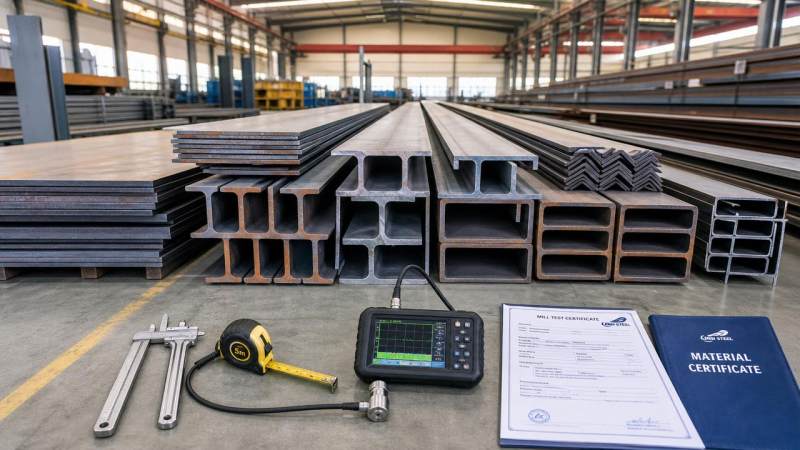
When reviewing how to test structural steel quality, the first step is not lab testing. It is document control. Many acceptance problems begin with mismatched grade, incomplete mill test certificates, or unclear traceability between the delivered batch and the approved purchase specification.
For technical evaluation personnel, the practical sequence is straightforward: confirm standards, verify batch identity, inspect appearance, measure dimensions, and then decide whether additional destructive or non-destructive testing is necessary. This reduces the risk of approving steel that looks acceptable but fails critical project requirements.
Initial acceptance checklist
- Match the purchase order, drawing notes, and approved steel grade against the material certificate.
- Confirm the declared standard such as ASTM, EN, JIS, or GB is the one required by the project.
- Check heat number, bundle tag, marking, and traceability records for each batch.
- Inspect for corrosion, lamination, edge cracking, deformation, coating defects, or transport damage.
- Measure thickness, width, length, straightness, web and flange dimensions, and compare them with tolerance limits.
This sequence matters because even if mechanical values are acceptable, a traceability break can still make the material non-compliant. In international procurement, documentation quality is often as important as physical quality.
How to test structural steel quality with document and standard verification
Before cutting samples or calling for third-party inspection, technical teams should compare the delivered steel against project-required standards and certificate content. This is the fastest way to identify major compliance gaps.
The table below helps evaluators review the core document items that support structural steel acceptance and reduce commercial and engineering risk.
If any item is inconsistent, the batch should move to hold status rather than immediate approval. A common mistake is to rely on a generic certificate while the actual project requires grade-specific impact testing, tighter tolerances, or supplementary requirements.
Common document-related risks
- The steel grade on the label matches, but the standard edition or supplementary condition does not.
- The mill certificate covers a broader production lot than the actual delivered batch.
- Mechanical test values are listed, but no reference temperature is shown for impact properties.
- The certificate is complete, but there is no clear link between document heat number and physical marking.
Which physical tests matter most for structural steel acceptance?
If you need to know how to test structural steel quality beyond paperwork, focus on the properties that directly affect structural reliability. Chemical composition controls weldability and strength potential. Mechanical properties confirm load-bearing performance. Surface and internal soundness influence fabrication quality and long-term durability.
Key test categories
- Chemical analysis to verify elements such as carbon, manganese, sulfur, phosphorus, and alloy additions where specified.
- Tensile testing to confirm yield strength, tensile strength, and elongation.
- Impact testing when low-temperature toughness or dynamic performance is required.
- Dimensional inspection for thickness, profile geometry, straightness, and length tolerance.
- Surface and NDT checks for cracks, lamination, inclusions, weld-zone defects, or coating irregularities.
The exact test plan depends on project type. For building frames, yield strength, dimensional tolerance, and weldability may be the priority. For cold-region infrastructure or heavy industrial structures, impact toughness and stricter defect screening often become more important.
Some evaluators also review supporting materials used in fabrication. For example, when assessing sheet-based components or formed sections for construction and steel structures, Cold Rolled Steel Coil may be considered for applications such as factory steel frameworks, curtain wall support components, or certain load-bearing formed parts where dimensional consistency, clean surface condition, and balanced mechanical properties are required.
Available grades can include Q355, Q345B, Q345C, Q390, Q420, Q460, Q500, Q550, Q620, Q690, Q890C, 16Mo3, 16MnL, 16MnR, 16Mng, and 16MnDR, with supply aligned to standards such as AISI, ASTM, DIN, JIS, GB, SUS, and EN. For technical teams, the main point is not the product name itself, but whether the grade, thickness range, and forming route match the structural function and fabrication process.
How to compare test methods when time, cost, and risk all matter
Technical evaluators often balance tight schedules against the need for reliable acceptance. The table below compares common test methods used when deciding how to test structural steel quality before approval.
Not every batch needs the full list. A risk-based approach works better. For standard building projects with stable suppliers, certificate review plus dimensional checks and periodic witness testing may be sufficient. For critical infrastructure or new suppliers, broader verification is justified.
What dimensional and surface checks are often missed?
Many teams focus on strength values and overlook geometry. Yet fabrication delays often come from out-of-tolerance dimensions, poor flatness, or edge defects rather than failed tensile results. Learning how to test structural steel quality means paying close attention to shop-floor usability.
Critical inspection points on arrival
- Thickness variation across the section, especially on plate, coil-derived sections, and formed profiles.
- Camber, twist, and straightness on beams, channels, and angles that affect fit-up.
- Edge condition, burrs, and local cracking that can complicate welding or forming.
- Surface rust, pitting, scale adhesion, oil contamination, or paint damage depending on delivery condition.
- Lamination signs or delamination risk on heavy sections and plates.
If steel is supplied clean or with blasting and painting according to customer requirement, the visual criteria should be agreed before shipment. Evaluators should also define whether minor cosmetic marks are acceptable or whether the project requires stricter appearance control for exposed structural applications.
How should buyers decide between routine inspection and third-party testing?
The best answer depends on supplier history, project criticality, and the cost of failure. Over-testing increases cost and slows delivery. Under-testing increases the risk of rework, claims, and site delays. The goal is a practical acceptance strategy.
This selection table can help procurement and technical teams choose the right level of verification before acceptance.
This approach is especially useful for global sourcing. A supplier with modern production facilities, stable export experience, and strict quality control can support more predictable acceptance outcomes, provided traceability and standards alignment are maintained throughout production and shipment.
Why do sourcing teams work with experienced structural steel exporters?
Testing alone cannot solve every procurement problem. Technical evaluators also care about consistency between batches, dependable lead times, support for multiple standards, and the ability to handle OEM requirements without losing traceability.
Hongteng Fengda operates as a professional structural steel manufacturer and exporter from China, supplying angle steel, channel steel, steel beams, cold formed steel profiles, and customized structural steel components for global construction, industrial, and manufacturing projects. For evaluators, this matters because acceptance is easier when production capability and quality control are aligned with ASTM, EN, JIS, and GB requirements from the start.
What technical buyers typically value
- Stable production capacity that supports repeat orders without major property variation.
- Clear documentation and batch traceability for easier incoming inspection.
- Support for standard specifications and customized OEM solutions.
- Experience serving buyers in North America, Europe, the Middle East, and Southeast Asia, where compliance expectations may differ.
For many projects, supplier selection is part of how to test structural steel quality in practice. A capable supplier reduces the number of unknowns before the batch even reaches the inspection stage.
FAQ: practical questions about how to test structural steel quality
Is a mill test certificate enough for structural steel acceptance?
Not always. A certificate is the starting point, not the whole decision. It should be checked against traceability marks, dimensions, surface condition, and any project-specific requirements such as impact testing or third-party witness inspection. For repeat supply from a proven source, it may be enough with random verification. For new suppliers or critical projects, it usually is not.
Which test is most important when schedule is tight?
If time is limited, prioritize certificate review, grade verification, dimensional inspection, and a focused mechanical check. These steps identify the most common causes of rejection without delaying the project more than necessary. If the material is for low-temperature or high-risk service, toughness testing should not be skipped just to save time.
How do I know if a batch needs third-party testing?
Use a risk-based rule. Third-party testing is more appropriate when the supplier is new, the specification is complex, the steel is for critical load-bearing use, or the project contract requires independent verification. It is also useful when delivered documentation is incomplete or inconsistent.
What are the most common acceptance mistakes?
The most common issues are approving steel by appearance only, ignoring traceability, assuming equivalent grades are automatically interchangeable, and failing to verify dimensional tolerances. Another frequent mistake is checking strength values while missing surface defects or internal discontinuities that later affect fabrication.
Why choose us for structural steel evaluation support and supply coordination?
If your team is reviewing how to test structural steel quality before acceptance, we can support the process with practical supply-side coordination rather than generic sales language. Hongteng Fengda helps buyers confirm grade selection, specification matching, dimensional requirements, delivery condition, and applicable standards before shipment, which reduces downstream inspection uncertainty.
You can consult us about parameter confirmation, product selection for beams, channels, angles, cold formed profiles, or customized components, expected delivery schedules, OEM manufacturing options, certificate and standards alignment, sample support, and quotation planning for export projects. This is especially useful when your project must balance compliance, cost control, and dependable lead time.
A well-managed acceptance process protects both safety and procurement efficiency. If you need support comparing grades, reviewing application scenarios, or coordinating documentation for structural steel orders, contact our team with your drawings, standards, and quantity list for a focused technical discussion.
Please give us a message


Please enter what you want to find