For after-sales maintenance teams, identifying common defects in steel beams and solutions is essential to structural safety, cost control, and schedule protection.
Different service environments create different risks. A warehouse beam fails differently from a marine platform beam or a crane runway beam.
This guide explains where defects appear, how to inspect them, and which corrective actions fit each working scenario.
As a structural steel manufacturer and exporter from China, Hongteng Fengda supports global projects with ASTM, EN, JIS, and GB compliant steel solutions.
Why inspection priorities change by service scenario
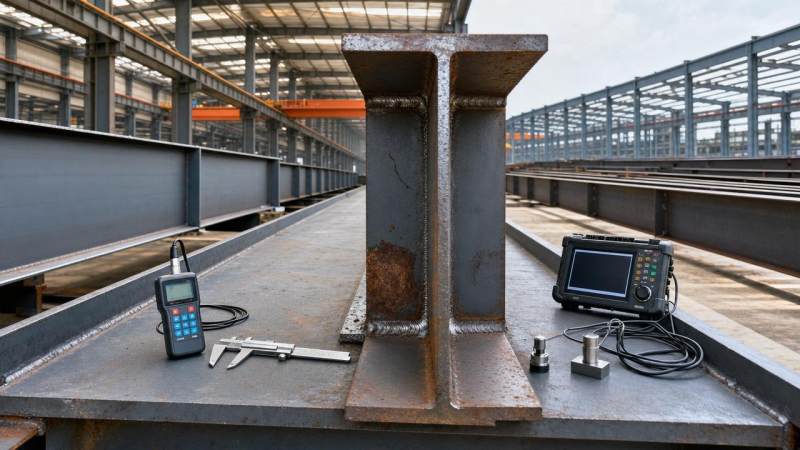
Common defects in steel beams and solutions should never be judged in isolation. The same visible mark may indicate minor wear or serious structural distress.
Inspection results depend on load pattern, humidity, chemical exposure, welding quality, and installation accuracy.
In dry buildings, corrosion may progress slowly. In coastal or industrial zones, section loss can accelerate and weaken the beam rapidly.
For this reason, effective defect control starts with scenario recognition, then moves to visual checks, measurement, and repair selection.
Building frames: how to spot early beam defects indoors
Indoor building frames usually face stable loads, but defects still develop from fabrication errors, fire exposure, water leaks, or overloading.
The most common signs are flange bending, local rust near joints, and hairline weld cracks around connection plates.
Key judgment points in enclosed structures
- Check beam camber against design expectations.
- Look for water staining near roof leaks or HVAC lines.
- Inspect bolted and welded joints for slippage or separation.
- Measure any permanent deflection after heavy temporary loading.
If deflection grows over time, the issue may involve overload, reduced section, or hidden connection weakness.
Industrial plants: where fatigue and heat create hidden risks
Industrial beam systems often support vibration, moving equipment, repeated lifting, and thermal cycling.
Here, common defects in steel beams and solutions often center on fatigue cracks, web buckling, and distortion near stiffeners.
What to inspect around machinery and repeated loads
Start with beam ends, cope cuts, weld toes, and support seats. These areas concentrate stress during repeated service cycles.
Use straightedges and feeler gauges to identify out-of-plane deformation. Small distortions may signal deeper load redistribution.
In corrosive workshops, suspended handling systems also need durable support accessories such as Hot dipped Galvanized Steel Wire Rope.
For mining, marine industries, cranes, elevators, drilling, railways, and cableways, galvanized rope offers corrosion options for mild to severe conditions.
Available structures include 6X7+FC, 6X19+IWR, and 8x19S+FC, with diameters from 1.0mm to 22mm and tensile strength from 1470Mpa to 1960Mpa.
Outdoor and marine projects: corrosion is often the first warning
Bridges, yards, ports, and exposed plant structures experience moisture, salt, UV variation, and airborne pollutants.
In these settings, common defects in steel beams and solutions usually begin with coating damage and then progress to pitting or section loss.
Visible signs that should not be ignored
- Blistering paint or red rust spreading from edges.
- Pitting around drainage traps and bolt holes.
- Pack rust between contact surfaces.
- Warping from uneven corrosion or restrained expansion.
A thickness gauge helps confirm whether corrosion is superficial or structurally relevant. Always compare readings with original section dimensions.
Typical steel beam defects and practical ways to identify them
A useful inspection routine follows the same path every time. Check surface condition, geometry, joints, load path, and surrounding environment.
Corrosion and section loss
Look for rust layers, flaking steel, reduced edge thickness, and trapped moisture. Probe suspect areas carefully after removing loose scale.
Web buckling
Web buckling appears as waviness or local folding, often near concentrated loads, supports, or stiffener terminations.
Weld cracks
Fine cracks often begin at weld toes or crater ends. Clean the area and use dye penetrant or magnetic particle testing when needed.
Dimensional distortion
Measure twist, bow, sweep, and flange misalignment. Distortion can come from heat, bad handling, or unstable support conditions.
Excessive deflection
Compare the in-service profile with baseline levels. Progressive sag often points to overload, creep-like effects, or hidden damage.
How scenario needs differ when choosing solutions
This comparison helps turn common defects in steel beams and solutions into action plans rather than general observations.
Recommended actions for repair, reinforcement, and prevention
Not every defect requires replacement. The right decision depends on defect depth, location, growth rate, and structural function.
- Remove moisture sources before treating corrosion.
- Grind and inspect crack zones before any weld repair.
- Add stiffeners where web instability is confirmed.
- Use plate reinforcement for local section loss when engineering review allows.
- Recheck alignment after repair to confirm load transfer.
- Document baseline readings for future comparison.
Preventive measures include coating maintenance, drainage improvement, proper storage, controlled lifting, and inspection scheduling based on exposure severity.
Frequent misjudgments that delay effective beam maintenance
One common mistake is treating surface rust as cosmetic without checking thickness loss beneath it.
Another mistake is repairing a crack without addressing the source of repeated stress.
Teams also misread fabrication camber as damage, or overlook drainage details that accelerate corrosion in hidden pockets.
Good inspection practice combines visual evidence, measurements, service history, and engineering judgment.
Next steps for safer inspections and better steel performance
Understanding common defects in steel beams and solutions helps reduce downtime and protect long-term structural value.
Create a scenario-based checklist for indoor, industrial, outdoor, and lifting structures. Record defect type, location, severity, and likely cause.
When replacement or customized structural steel is needed, choose products made under strict quality control and recognized international standards.
Hongteng Fengda provides structural steel products and tailored solutions for global construction, industrial, and manufacturing applications with reliable lead times.
Please give us a message


Please enter what you want to find