On-site fit up often depends on more than fabrication quality alone—l angle steel dimensions directly influence alignment, connection accuracy, and installation efficiency. For contractors, engineers, and buyers comparing steel plate for construction, steel rebar cost, or galvanized steel price, understanding dimensional tolerance in angle steel helps reduce rework, control project risk, and improve structural performance from factory to site.
In structural steel work, the difference between a smooth installation and a delay-filled erection sequence can come down to a few millimeters. Leg length, thickness, corner radius, straightness, and length tolerance all affect how an L angle steel member fits with base plates, gusset plates, bolts, cleats, and welded assemblies. This matters not only to fabricators, but also to site teams, QC personnel, procurement managers, distributors, and project decision-makers evaluating total project cost.
For global buyers sourcing from China, dimensional consistency is especially important because shipping cycles can range from 2 to 6 weeks depending on destination, making late corrections expensive. Hongteng Fengda, as a structural steel manufacturer and exporter, supports customers with angle steel, channels, beams, cold formed profiles, and customized structural components produced to ASTM, EN, JIS, and GB-related requirements. The practical goal is simple: deliver steel that fits the drawing, fits the connection, and fits the schedule.
Why L Angle Steel Dimensions Matter During Site Fit Up
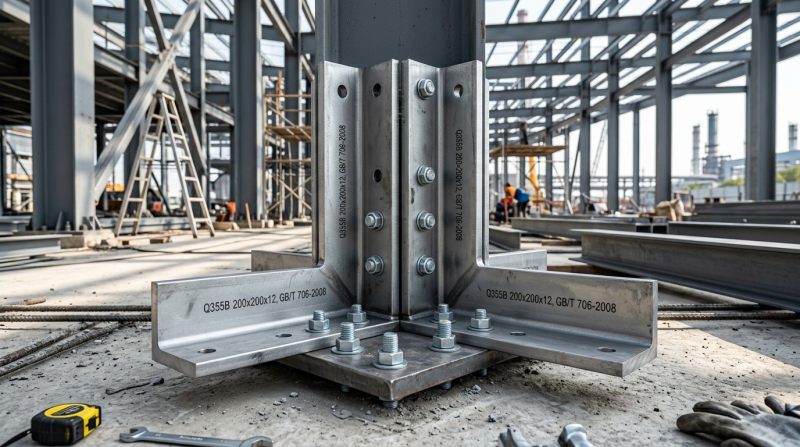
L angle steel is widely used in frames, supports, bracing systems, platforms, equipment bases, edge protection, and connection assemblies. While it may appear to be a simple profile, small dimensional deviations can create cumulative alignment problems. A leg length deviation of even 2–3 mm on multiple members can shift bolt lines, create uneven bearing surfaces, or force installers to enlarge holes on site.
In practice, fit up depends on the interaction between at least 5 dimensional factors: equal or unequal leg size, thickness, inside corner geometry, member length, and straightness. If one of these falls outside the acceptable project range, connection plates may not sit flush, weld gaps may become inconsistent, and mechanical fastening time may increase by 10% to 25% compared with properly controlled material.
This issue is more serious in modular construction, prefabricated plant structures, and steel stair systems, where tolerances stack up across repeated parts. When projects use pre-drilled connections, the room for adjustment is limited. A fabricator may be within a general mill standard, but still outside the tighter dimensional expectations of a high-precision project.
For procurement teams, the cost impact is broader than material price per ton. Poor fit up can increase crane time, labor hours, welding correction work, and schedule disruption. On export projects, where replacement lead time may take 20–45 days including production and shipping, correct dimension control at source is often more valuable than choosing the cheapest quotation.
Key dimensional elements that influence installation
- Leg length accuracy: affects edge alignment, gusset contact, and bolt hole positioning.
- Thickness consistency: influences weld preparation, bearing capacity, and connection stiffness.
- Length tolerance: matters in repeated framing members and stair or platform fabrication.
- Straightness and twist: impacts line-up during assembly, especially for members above 3 m.
- Inside radius and edge condition: can affect contact area with plates or mating profiles.
When site teams understand these factors early, they can specify the right standard, tolerance expectation, and inspection checkpoints before purchase orders are released. That prevents many avoidable problems from reaching the installation stage.
Critical Dimensions, Tolerances, and Their Practical Impact
Not every project needs the same tolerance level. A warehouse secondary support bracket may accept wider dimensional variation than a pre-engineered assembly with slotted connections or automated welding jigs. The first step is to match dimensional control to the actual use case rather than assuming all angle steel performs the same way.
The table below shows how common dimensional parameters affect fit up risk in typical structural steel applications. These are practical reference points used during technical review, not a substitute for project drawings or applicable standards.
The main takeaway is that dimension control should be reviewed based on connection type. Bolted structures usually require tighter leg and hole relationship control, while welded structures may tolerate some variation but become sensitive to gap and distortion. Long members introduce another layer of risk because twist and sweep are harder to correct without rework.
How different standards affect expectations
Angle steel supplied to ASTM, EN, JIS, or GB frameworks may all be acceptable, but the dimensional expectations in a buyer’s project documentation can still differ. A purchasing team should confirm at least 4 items before production: profile standard, steel grade, allowable dimensional deviation, and inspection method. If these are not aligned, disputes often appear only after the container arrives on site.
For critical jobs, many buyers request mill inspection records plus pre-shipment dimensional checks on a sample ratio such as 5%, 10%, or 100% for custom fabricated pieces. That additional control is usually justified when the cost of installation delay exceeds the inspection cost.
Common technical review points
- Confirm whether equal angle or unequal angle is specified and whether substitution is allowed.
- Check if nominal thickness matches the load case and welding procedure.
- Review whether cut length tolerance is suitable for module-based assembly.
- Verify whether surface condition or galvanizing thickness may influence final fit.
These checks are simple, but they directly affect whether the steel can move from unloading to erection without added correction work.
How Fabrication, Related Steel Products, and Surface Conditions Influence Fit Up
Fit up on site is rarely isolated to angle steel alone. In many projects, L angle steel interfaces with plates, channels, beams, anti-slip flooring, machine bases, or shipbuilding structures. If one component has stable dimensions while the mating part varies, the assembly still becomes difficult. That is why experienced buyers evaluate the whole system rather than a single profile in isolation.
A practical example is platform fabrication. Angle steel may be used for edge framing or stiffeners, while patterned plate is used as the walking surface. If the plate thickness, width tolerance, or pattern height is inconsistent, fit up between frame and floor plate can become uneven, especially where drainage slope, anti-slip performance, and welded perimeter accuracy are required.
For applications in transportation, construction, decoration, machinery, shipbuilding, and equipment-floor areas, buyers often compare material options not only by price but also by how predictably they integrate during fabrication. In this context, A36 Patterned steel plate can be a useful companion product in steel platform and floor systems because it combines anti-skid performance with common structural grades such as A36, Q235B, 235JR, S235, SS400, and SM400B.
Its typical dimensional range includes thickness from 2 mm to 8 mm, width from 600 mm to 1800 mm, and length from 2 m to 12 m, with thickness tolerance at +/-0.02 mm and width tolerance at +/-2 mm according to the supplied product information. For projects where angle frames support deck plates, these dimensional controls help reduce edge mismatch and improve welding consistency.
System-based dimensional review
When angle steel is used together with flooring or support plates, the dimensional review should cover not only the section itself, but also the combined assembly tolerance. The table below shows how related steel components can influence final fit up quality.
This comparison shows that successful fit up depends on dimensional coordination across the assembly. A supplier with broad structural steel capability can help buyers review these interfaces earlier, reducing surprises during installation. That is especially useful for OEM or customized structural components with more than 3 interacting steel parts.
Selection, Inspection, and Procurement Strategies for Better On-Site Results
Selecting angle steel for site fit up should not be treated as a generic commodity purchase. A technically sound sourcing process typically includes 5 stages: drawing review, standard confirmation, tolerance alignment, sample or pre-shipment inspection, and packing or labeling control. Each stage reduces a different type of project risk.
For technical evaluators and project managers, the most common mistake is approving a steel grade without confirming dimensional expectations. For procurement teams, another frequent issue is focusing only on unit price per metric ton while ignoring correction cost at site. In many construction and industrial projects, one day of delayed installation can outweigh the savings gained from choosing a lower-cost but less controlled source.
Buyers working with global suppliers should also ask how the product will be measured and reported. For example, if a project needs cut-to-length angle members for repeated modules, measurement at 3 random pieces per bundle may not be enough. For customized components, 100% dimensional verification on critical dimensions may be the safer option.
Procurement checklist for L angle steel
- Specify steel grade and standard clearly, such as ASTM, EN, JIS, or GB-based project requirements.
- List critical tolerances separately from basic material description, especially leg size, thickness, and cut length.
- Identify whether the angle steel will be welded, bolted, galvanized, or combined with deck or plate products.
- Request inspection records for dimensions, straightness, and visual condition before shipment.
- Confirm lead time, packing method, piece marking, and bundle traceability for site receiving efficiency.
The table below can help procurement and business teams compare suppliers beyond headline price. It is particularly useful when multiple quotations appear similar on paper.
A supplier such as Hongteng Fengda can add value when the job involves standard profiles plus OEM structural parts, because coordination between material supply and fabrication details becomes easier. For distributors, agents, and project owners, this reduces sourcing fragmentation and can improve accountability across the delivery chain.
Common Fit Up Problems, Prevention Methods, and Project FAQ
Even when steel meets a recognized standard, site problems can still occur if the project requires tighter execution control. The most common issues include bolt hole mismatch, gap inconsistency in welded corners, out-of-square frames, and member twist after transport. Most of these are preventable through earlier technical clarification rather than field correction.
A strong prevention strategy usually includes 3 layers: material verification at production, dimensional sampling before shipment, and receiving inspection at site. For projects with long transport routes to North America, Europe, the Middle East, or Southeast Asia, packing protection and bundle identification also matter because damaged edges or mixed bundles can slow down installation.
The questions below reflect what engineers, QC teams, purchasers, and distributors commonly ask when evaluating angle steel for structural use.
How tight should tolerance be for site-fit angle steel?
It depends on the connection and repetition level. For simple welded supports, general mill tolerance may be sufficient. For pre-drilled, modular, or repeatable assemblies, buyers often need closer control on leg length, cut length, and straightness. The right approach is to define critical dimensions on the drawing instead of relying only on nominal size.
Does galvanizing affect fit up?
Yes. Zinc buildup can reduce clearance in bolted holes or on mating surfaces, especially on smaller connections. If galvanizing is required, hole allowance and contact surfaces should be reviewed before fabrication. This is a common issue when buyers compare galvanized steel price but do not assess how the coating may affect assembly.
What inspection items should be prioritized before shipment?
For most projects, prioritize 6 items: leg size, thickness, cut length, straightness, twist, and visual edge condition. For fabricated assemblies, include hole position and welding readiness. If the steel will interface with deck plate or support plates, check the combined dimension at the assembly level as well.
What is a reasonable export lead time for structural steel components?
Lead time varies with quantity, customization, and destination. For standard material, production may be shorter, while custom processed structural components can require several additional steps. Buyers should separate manufacturing lead time from sea transit time and keep a buffer for inspection, documentation, and port handling.
If your project depends on accurate site fit, dimensional control should be treated as a commercial and technical requirement from the beginning. Hongteng Fengda supplies structural steel products and customized solutions designed to support reliable installation, stable quality, and manageable project risk across global markets. To discuss angle steel specifications, related steel components, or a custom sourcing plan, contact us today to get technical support, product details, and a tailored solution for your project.
Please give us a message


Please enter what you want to find