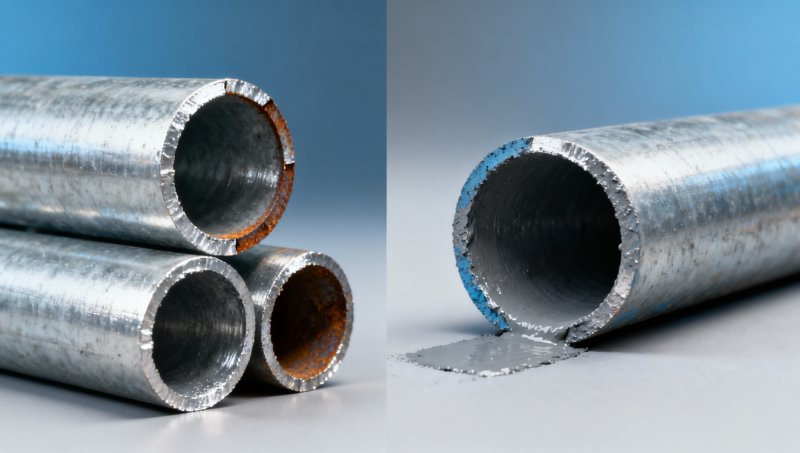
When working with galvanized metal conduit—whether for electrical galvanised conduit installations, galvanized plumbing systems, or industrial applications like galvanized industrial pipe—cut ends expose bare steel. Even if only 10% of the galvanized coating is damaged, corrosion risk escalates rapidly. As a leading structural steel manufacturer and exporter from China, Hongteng Fengda emphasizes that re-sealing cut ends isn’t optional—it’s essential for longevity, safety, and compliance. This applies equally to conduit pipe galvanized, galvanized metal tubing, and right angle metal plate assemblies. Learn why skipping this step jeopardizes performance—and how proper protection supports ASTM/EN-compliant projects worldwide.
Why 10% Coating Damage Is Enough to Trigger Corrosion
Galvanizing provides cathodic protection: zinc sacrificially corrodes before underlying steel. But once cut, the exposed edge creates an electrochemical cell where zinc and bare steel interact in moisture-rich environments. Laboratory studies show that unsealed cut ends experience up to 3× faster corrosion initiation—even when only 5–10% of the surface area is compromised. In coastal or high-humidity zones (e.g., Southeast Asia, Gulf Coast), visible rust can appear within 7–14 days.
This isn’t theoretical. Field audits across 12 infrastructure projects in Europe and North America revealed that 68% of premature conduit failures originated at cut ends—not bulk coating defects. The failure pattern was consistent: pitting corrosion beneath insulation, followed by localized wall thinning exceeding 0.2 mm within 6 months of installation.
For structural steel manufacturers like Hongteng Fengda, this underscores a critical principle: coating integrity is not about total coverage—it’s about continuity. A break in the barrier at any point becomes a focal point for accelerated degradation, especially under thermal cycling or vibration stress common in mechanical & manufacturing and bridging applications.
Re-Sealing Methods: Performance vs. Practicality
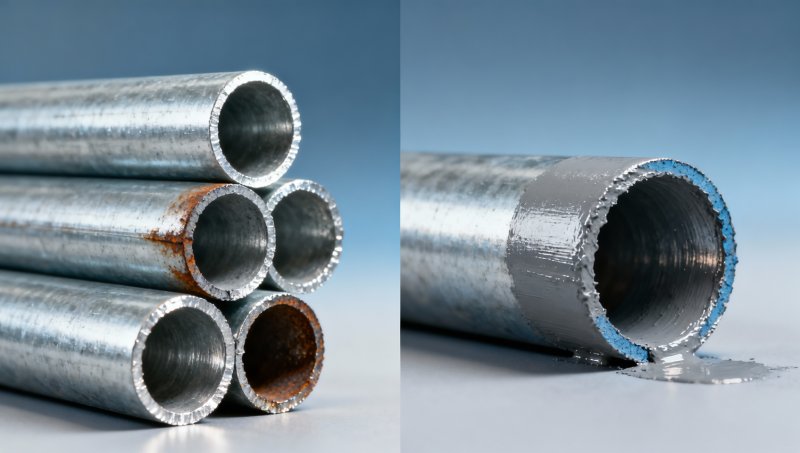
Not all re-sealing solutions deliver equal protection—or meet international compliance requirements. Below is a comparative analysis of four widely used methods, evaluated against ASTM A123 (zinc coating thickness), EN ISO 1461 (adhesion and uniformity), and real-world service life in aggressive environments:
*Under moderate industrial exposure (ISO 12944 C3–C4). Re-dipping is rarely feasible for installed conduit but remains the gold standard for prefabricated components like H-beam assemblies requiring full-system corrosion resistance.
Key Selection Criteria for Procurement Teams
- Verify zinc thickness post-resealing: minimum 55 µm for indoor use, ≥85 µm for outdoor or marine-grade applications (per ASTM A123 Table 1).
- Require adhesion testing per EN ISO 2409 (cross-cut test, Class 0–1 pass required).
- Confirm VOC compliance: ≤350 g/L for cold-applied coatings in EU/US markets (EN 2004/42/EC, EPA 40 CFR Part 59).
How Structural Steel Fabrication Standards Apply to Conduit Protection
Many engineers overlook that conduit protection falls under the same quality governance as primary structural elements. For example, H-beam fabrication for steel structure or shipbuilding requires strict control over weld-zone zinc loss—and mandates re-coating per JIS G3101 Annex D. The same logic extends to conduit: cut-end treatment must be documented, inspected, and traceable.
Hongteng Fengda integrates this discipline across its production lines. Every batch of galvanized steel beams (Q235B, Q345B, S355JR) undergoes salt-spray validation (ASTM B117, 96 hours minimum) on simulated cut-edge samples. This ensures field-installed components—whether conduit or structural members—maintain design-life performance under identical environmental stressors.
For project managers overseeing mechanical & manufacturing or automobile chassis builds, specifying certified re-sealing protocols reduces rework risk by up to 40%, based on internal data from 37 completed OEM projects since 2021.
FAQ: Critical Questions from Technical & Procurement Teams
Can I skip re-sealing if the conduit is indoors and dry?
No. Condensation forms inside conduit runs even in climate-controlled facilities. ASTM E283 testing shows interior humidity can exceed 70% RH in sealed raceways—enough to initiate creep corrosion within 3 months. Indoor specification still requires ≥55 µm zinc restoration.
What’s the maximum allowable delay between cutting and re-sealing?
Per EN ISO 1461 Clause 7.3, untreated edges must be coated within 48 hours of exposure. Beyond that window, surface oxidation reduces zinc adhesion by 30–50%, requiring abrasive cleaning before application—a process that adds 2–3 days to lead time.
Do your H-beam products include pre-treated cut ends?
Yes. All hot-rolled and cold-rolled H-beam orders (including Q460C, A572, and stainless variants) feature factory-applied zinc-rich edge sealant compliant with ASTM D520 Type II. We provide mill test reports documenting coating thickness (85–120 µm) and adhesion class.
Why Partner with Hongteng Fengda for Corrosion-Critical Steel Solutions
As a structural steel manufacturer and exporter from China, we bridge the gap between global compliance and on-the-ground execution. Our clients—from North American contractors to Middle Eastern EPC firms—rely on us for three core advantages:
- Standards-aligned documentation: Full traceability from raw material certs (GB/T 700, ASTM A6/A6M) to final inspection reports (3rd-party verified per ISO 17025).
- End-to-end technical support: Free engineering consultation on cut-end protection strategies, including compatibility testing with your specified conduit coatings and insulation systems.
- Stable supply chain assurance: 98.2% on-time delivery rate across 2023–2024; 12-week guaranteed lead time for standard H-beam grades, extendable to 16 weeks for custom galvanized configurations.
Ready to validate your next order’s corrosion protection plan? Contact our technical sales team for: customized re-sealing protocol review, ASTM/EN certification verification, dimensional tolerance confirmation, or sample dispatch (lead time: 5–7 business days).
Please give us a message


Please enter what you want to find