When sourcing l shaped metal bars or bracing angle in steel structure, understanding the galvanization method is critical—especially for corrosion resistance and project longevity. Not all ‘galv angle’ products are hot-dip coated; some are only electrogalvanized, with significant differences in coating thickness, durability, and compliance with standards like ASTM A36 angle or EN 10025. As a trusted structural steel manufacturer & exporter from China, Hongteng Fengda clarifies these distinctions for procurement teams, engineers, and project managers—ensuring informed decisions on galvanized angle, angle galvanized, steel ka angle, and other l shape steel solutions.
Hot-Dip vs. Electrogalvanized: What’s the Real Difference?
The term “galv angle” is often used generically—but it masks a fundamental technical divergence. Hot-dip galvanizing (HDG) immerses steel angles in molten zinc at ~450°C, forming a metallurgical bond with a typical coating thickness of 50–100 µm. Electrogalvanizing (EG), by contrast, applies zinc via electrolytic deposition—yielding a thinner, smoother layer of just 5–15 µm.
This difference directly impacts performance: HDG offers superior corrosion resistance in harsh environments (e.g., coastal, industrial, or high-humidity sites), with service life exceeding 20 years under ISO 9223 C4 conditions. EG provides adequate protection indoors or in mild atmospheres but fails rapidly under abrasion or chemical exposure—making it unsuitable for structural bracing, scaffolding, or outdoor framing where mechanical integrity is non-negotiable.
From a compliance standpoint, ASTM A123 governs hot-dip galvanized structural steel, while ASTM B695 applies to electro-deposited coatings—yet many suppliers mislabel EG products as “galv angle” without disclosing process or thickness. That ambiguity risks premature rust-through, weld spatter interference, and non-conformance during third-party QA audits.
The table underscores why specification clarity matters—not just for durability, but for lifecycle cost control. A $0.80/kg EG angle may appear economical upfront, yet replacement, rework, or warranty claims can inflate total cost of ownership by 200–300% over 10 years. At Hongteng Fengda, every galvanized angle shipment includes mill test reports verifying coating mass per ASTM A123 Annex A—and we support third-party verification upon request.
Which Applications Demand Hot-Dip—And Where Might Electrogalvanizing Suffice?
Structural applications require predictable, long-term performance—especially when angles serve load-bearing functions, fire-rated assemblies, or seismic bracing. Hot-dip galvanized angle is mandatory for:
- Outdoor steel frameworks exposed to rain, salt spray, or industrial pollutants (EN 10025 S355J2 + Z275 coating)
- Bridge railings, transmission towers, and utility poles requiring ≥25-year design life
- Marine infrastructure components subject to cyclic wet/dry conditions and chloride ingress
- Fire-resistance rated connections where coating integrity must survive 120-minute exposure per ASTM E119
Electrogalvanized angle may be acceptable only in controlled interior settings: light-duty shelving supports, HVAC duct hangers, or non-structural trim where humidity stays below 60% RH and no mechanical abrasion occurs. Even then, its use requires explicit engineering sign-off—and should never be substituted without recalculating corrosion allowance per ISO 12944 Part 5.
For projects spanning multiple climate zones—such as Middle Eastern solar farms or Southeast Asian port terminals—we recommend hybrid solutions: HDG for primary structural angles, paired with AZ50 Galvalume Steel Coil for cladding and secondary framing. Its Al-Zn-Si alloy coating (55% Al, 43.5% Zn, 1.5% Si) delivers 3–5× longer service life than standard GI coil in acidic or marine atmospheres—while maintaining full compatibility with roll-forming and welding processes.
How to Verify Galvanization Method Before Purchase
Procurement teams face real risk when relying solely on supplier claims. Here’s how to validate galvanization type before order placement:
- Request certified test reports: Ask for ASTM A123 or ASTM B695-compliant coating thickness data—not just “zinc-coated.” HDG reports must list average coating mass (e.g., Z275 = 275 g/m²).
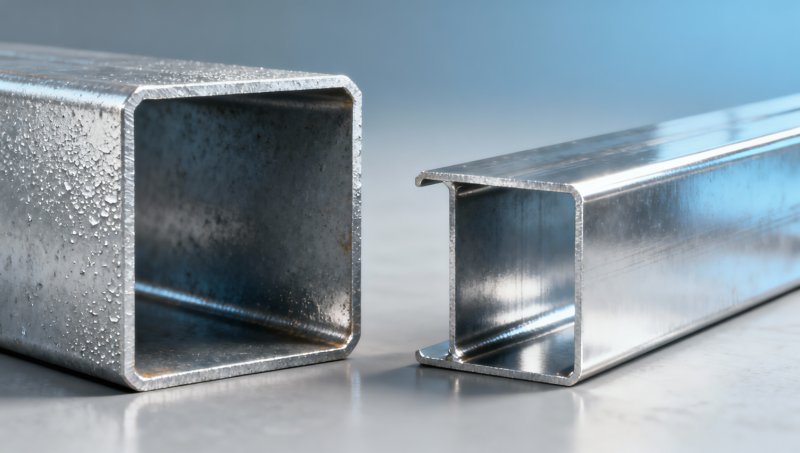
- Inspect surface morphology: HDG shows characteristic spangle patterns and slight roughness; EG yields uniform, mirror-like finish with no visible crystallization.
- Confirm furnace temperature records: Reputable HDG lines maintain bath temp within ±5°C of 450°C—verify via production logs, not just declarations.
- Check weldability notes: EG layers contain organic passivates that generate toxic fumes when welded; HDG requires no pre-weld cleaning beyond standard mill scale removal.
At Hongteng Fengda, every batch undergoes four-point coating thickness measurement using magnetic induction gauges calibrated to ISO 2178. We also offer optional destructive cross-section analysis (per ASTM B499) for high-risk projects—completed within 7 working days of sample receipt.
Why Global Buyers Choose Hongteng Fengda for Galvanized Structural Steel
As a structural steel manufacturer & exporter from China, Hongteng Fengda bridges global compliance needs with localized execution rigor. Our galvanized angle production adheres to ASTM A36, EN 10025-2, and GB/T 706—backed by ISO 9001-certified QC workflows across 3 shift-based inspection stages: raw material screening, in-process thickness verification, and final dimensional/chemical validation.
We support buyers with:
- Custom galvanizing specifications—including dual-coat systems (e.g., HDG + epoxy topcoat) for extreme environments
- Lead times of 15–25 days for standard sizes (50×50×5 mm to 150×150×12 mm), with expedited options down to 10 days
- Documentation packages including MTRs, EN 10204 3.1 certificates, and customs-ready export paperwork
- OEM labeling, packaging, and logistics coordination for direct site delivery across North America, EU, and GCC markets
Whether you’re evaluating galvanized angle for a new refinery in Saudi Arabia or specifying steel ka angle for a prefabricated hospital in Germany, our engineering team provides free technical consultation—covering coating selection, weld procedure qualification, and international standard alignment. Contact us today to request a sample pack, review your spec sheet, or get an accurate quote with full traceability documentation.
Please give us a message


Please enter what you want to find