When specifying flat plate stainless steel for architectural design, professionals often ask: Can it be laser-cut without compromising corrosion resistance? The answer lies in material grade selection, cutting parameters, and post-processing—critical considerations for stainless flat sheet for architectural use, stainless flat plate for chemical processing, and stainless steel metal plates for oil and gas industry. As a trusted flat plate stainless steel supplier in Middle East and SST plate manufacturer in Southeast Asia, Hongteng Fengda ensures precision laser-cutting while maintaining integrity across all grades—including those used alongside stainless round bar for construction projects or automotive applications. Explore the technical facts behind durable, code-compliant fabrication.
How Laser Cutting Affects Stainless Steel’s Corrosion Resistance
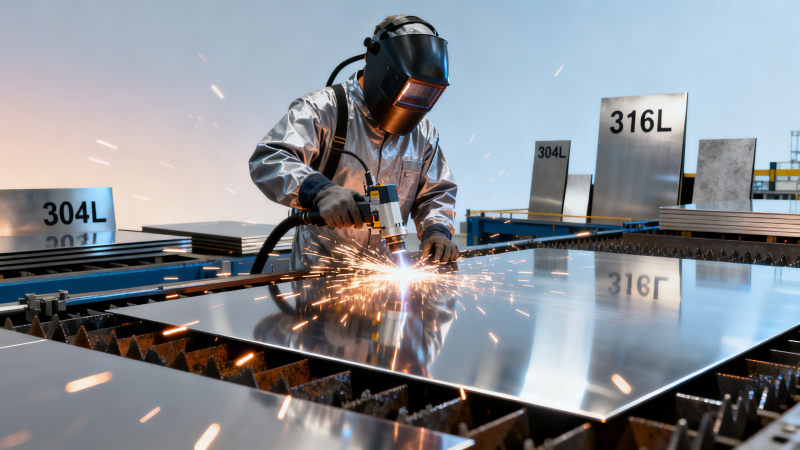
Laser cutting stainless steel flat plate is widely adopted for its speed, accuracy, and flexibility—but thermal input inevitably alters the microstructure near the cut edge. The heat-affected zone (HAZ) may experience chromium carbide precipitation at grain boundaries when temperatures exceed 425–850°C, reducing local chromium availability and impairing passive film formation. This sensitization risk is most pronounced in austenitic grades like 304 and 316 if cooling is uncontrolled or post-processing is omitted.
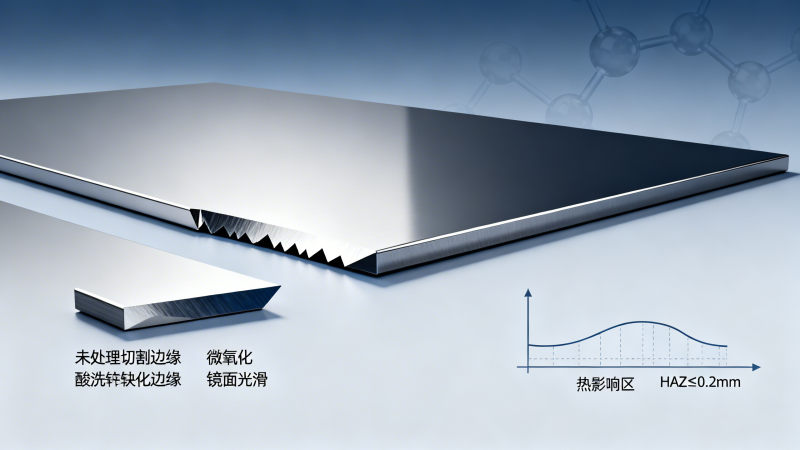
However, modern fiber laser systems—operating at wavelengths of 1.07 μm and pulse durations under 100 ns—enable precise energy delivery. With optimized power density (typically 10⁶–10⁷ W/cm²), assist gas selection (nitrogen for clean edges; oxygen for thicker sections), and controlled feed rates (0.5–3 m/min depending on thickness), HAZ width can be limited to ≤0.2 mm even on 12-mm-thick 316L plates. That narrow thermal footprint significantly reduces sensitization potential.
Material grade remains foundational: low-carbon variants (e.g., 304L, 316L) with carbon content ≤0.03% resist intergranular corrosion far better than standard 304 (≤0.08%). Dual-certified EN 1.4404 / ASTM A240 S31603 plates—commonly supplied by Hongteng Fengda for façade and cladding projects—meet both European and North American corrosion performance benchmarks when cut and finished correctly.
This table confirms that grade selection directly governs thermal sensitivity—and thus dictates whether post-cut treatment is optional or essential. For high-value architectural installations where aesthetics and longevity are non-negotiable, Hongteng Fengda applies automated passivation lines certified to ASTM A967 Method A (nitric acid) or Method F (citric acid), achieving uniform Cr:Fe ratios ≥1.5:1 across cut edges.
Critical Post-Processing Steps to Restore Integrity
Laser cutting alone does not guarantee long-term corrosion resistance. Three sequential post-processing steps are indispensable for architectural-grade stainless flat plate:
- Mechanical descaling: Abrasive brushing or blasting removes oxidized scale and embedded iron particles—critical since free iron contamination initiates rust staining within 72 hours of exposure to humidity.
- Chemical passivation: Immersion in 20–25% nitric acid at 50–60°C for 30 minutes dissolves surface iron and enriches chromium oxide layer thickness to 2–4 nm, verified via XPS analysis.
- Neutralization & drying: Rinsing with deionized water (conductivity<2 μS/cm) followed by forced-air drying at ≤40°C prevents water-spot residue and chloride retention.
Hongteng Fengda integrates these steps into a single-line process with inline conductivity monitoring and real-time pH logging—ensuring every batch meets ASTM A1080 requirements for architectural stainless components. Lead time for fully processed 316L flat plate (up to 3000 × 12000 mm) averages 12–18 working days from order confirmation, including third-party inspection per EN 10204 3.2.
For structural integration—such as connecting laser-cut stainless panels to load-bearing frames—compatibility with carbon steel elements becomes vital. Our Q195 Carbon Steel Round Bar offers tensile strength of 315–430 MPa and yield strength ≥195 MPa, meeting GB/T 701 standards for handrail, staircase, and balcony support systems. Its hot-rolled surface finish provides optimal adhesion for powder-coated finishes applied after welding to stainless assemblies.
Application-Specific Recommendations Across Industries
Corrosion resistance requirements vary sharply by end use. In architectural façades exposed to urban pollution and sea salt, 316L with ≥2.5% Mo and laser-cut edges treated per ASTM A380 is mandatory. In chemical processing vessels, duplex 2205 offers superior resistance to chloride stress cracking—especially when cut using nitrogen-assisted lasers at ≤1.2 m/min feed rate to minimize nitride formation.
Oil and gas platforms demand even stricter controls: API RP 581 mandates post-weld heat treatment (PWHT) simulation for any cut edge subjected to sour service (H₂S > 10 ppm). Here, laser-cut 2507 super duplex plates undergo solution annealing at 1080°C ±10°C followed by rapid water quenching—restoring ferrite/austenite phase balance and preventing sigma-phase embrittlement.
These thresholds reflect field-proven failure data: panels with HAZ widths exceeding 0.3 mm in coastal architecture show pitting initiation within 18 months; untreated 2205 edges in chemical plants exhibit micro-cracking after 14,000 hours of cyclic thermal loading. Hongteng Fengda’s QA team validates each lot against these benchmarks before shipment—supporting buyers in North America, Europe, the Middle East, and Southeast Asia with full traceability down to heat number and melt analysis.
Why Partner with a Certified Structural Steel Manufacturer?
Procurement decisions for stainless flat plate must balance technical compliance, supply chain resilience, and lifecycle cost. Generic suppliers often lack integrated post-processing capabilities—forcing clients to coordinate cutting, passivation, and inspection across three vendors, adding 22–35 days to project timelines and increasing quality variance risk by up to 40%.
Hongteng Fengda operates vertically integrated facilities certified to ISO 9001:2015 and ISO 14001:2015, with in-house laser cutting (max plate size 15,000 × 3,000 mm), automated passivation lines, and metallurgical labs performing ASTM E112 grain size analysis and ASTM G48 ferric chloride testing. We supply ASTM A240, EN 10088-2, and GB/T 4237-compliant plates—with MOQ as low as 500 kg for custom-cut batches—and maintain 98.7% on-time delivery across 42 countries.
Whether you’re specifying stainless flat plate for a Dubai skyscraper façade, a Singapore pharmaceutical plant, or a Texas refinery upgrade, our engineering team provides free DFM (Design for Manufacturability) reviews—including laser path optimization, kerf compensation modeling, and weld joint preparation guidance—to ensure corrosion resistance isn’t compromised at any stage.
Ready to specify laser-cut stainless flat plate with guaranteed corrosion performance? Contact Hongteng Fengda today for a technical consultation, material certification package, or customized sample set—including cross-section SEM imaging of your selected grade and cut parameters.
- steel supplier
- structural steel
- Structural Steel
- stainless steel supplier
- sst plate
- stainless steel metal plates
- stainless flat plate
- stainless flat sheet
- flat plate stainless steel
- stainless round
- flat plate stainless steel supplier in Middle East
- stainless flat sheet for architectural use
- stainless flat plate for chemical processing
- stainless steel metal plates for oil and gas industry
- sst plate manufacturer in Southeast Asia
- stainless round bar for construction projects
- flat plate stainless steel for architectural design
Related recommendations
 Is acero galvanizado para exterior vulnerable to white rust formation during monsoon storage?Acero galvanizado para exterior *is* vulnerable to white rust in monsoons — but it’s preventable. Discover proven storage & handling strategies that protect your structural steel.
 Does ASTM A 36 plate meet impact toughness requirements for low-temperature bridge girders?Does ASTM A 36 plate meet low-temp bridge requirements? Short answer: no—unless specially tested. Discover why toughness matters more than strength in cold climates.
 Does ASTM A653 certification cover both zinc-coated and zinc-iron alloy coated steels?ASTM A653 covers both zinc-coated and zinc-iron alloy coated steels—but they’re not interchangeable. Learn key differences in testing, performance & certification.
 Does acero prepintado require surface pretreatment before welding or cutting?Does acero prepintado require pretreatment before welding or cutting? Discover when grinding is essential—and when it’s not—for safety, weld integrity & corrosion resistance.
Please give us a message


Please enter what you want to find