Changing the steel grade does not normally change the theoretical weight per meter of a 200 mm I-beam when its section dimensions stay the same. Common structural carbon steels have similar densities. A higher-strength grade can carry different design stresses, but it does not make an otherwise identical beam meaningfully lighter.
If you are searching for “200 i beam weight per meter,” the first detail to establish is the full section designation. A nominal depth of 200 mm does not identify one universal weight. Flange width, web thickness, flange thickness, and section shape determine how much steel is present in each meter.
This distinction helps explain why two suppliers can quote different kg/m values for beams described as “200 mm,” while offering different grades of the same precisely specified section should normally leave its tabulated weight unchanged.
Steel grade describes material properties; section size determines steel volume
A steel grade specifies material requirements, including mechanical properties and chemical composition. Depending on the specification, it may also address toughness or other characteristics relevant to fabrication and service. These requirements help determine whether the steel is suitable for a particular structural duty.
Weight follows a separate relationship: the volume of steel multiplied by its density. For a beam of constant cross-section, its mass per meter depends on the cross-sectional area and the density used in the calculation.
Mass per meter = cross-sectional area × steel density
Structural steel weight tables commonly use a nominal density of 7,850 kg/m³. With cross-sectional area expressed in mm², the relationship becomes:
Mass per meter in kg/m = cross-sectional area in mm² × 0.00785
For illustration, a hypothetical section with an area of 3,000 mm² would have a calculated mass of 23.55 kg/m using that density. This is a calculation example, not a standard weight for every 200 mm beam.
Changing the grade while retaining that area generally leaves the theoretical mass at the same value. Small differences in alloy content do not usually justify separate weight calculations for ordinary structural carbon steel grades. This reasoning should not automatically be extended to stainless steels or other alloy families with different densities.
Why “200 mm I-beam” is not enough to select a weight
The 200 mm description usually refers to nominal section depth: the overall distance from the outside of the upper flange to the outside of the lower flange. It says little about how wide or thick the rest of the section is.
Picture two beams with the same overall height. One has narrow flanges and a thin web. The other has wider flanges and thicker material throughout. Both may be described informally as 200 mm beams, but the second contains more steel per meter and therefore weighs more.
The dimensions that explain this difference are:
- Overall depth: the height of the section.
- Flange width: the width of the top and bottom horizontal parts.
- Web thickness: the thickness of the vertical part connecting the flanges.
- Flange thickness: the thickness of the horizontal parts.
- Root geometry: the rounded transitions between the web and flanges in rolled sections.
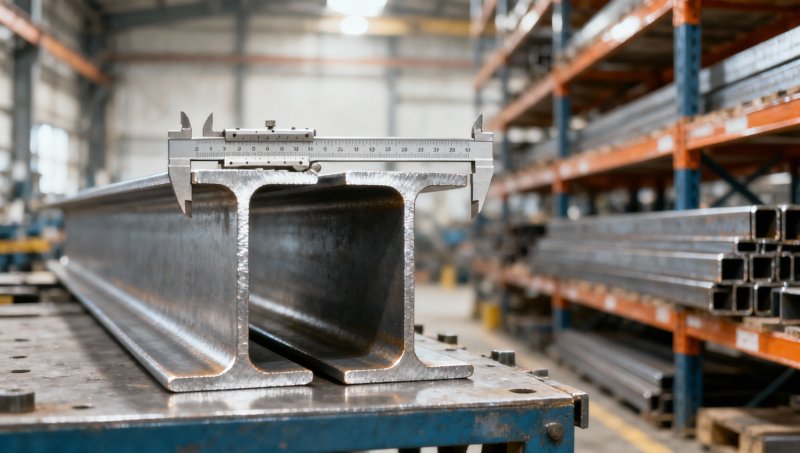
For a simplified section with parallel flanges, cross-sectional area can be estimated as twice the flange width multiplied by flange thickness, plus the clear web height multiplied by web thickness. The clear web height excludes the flange thicknesses.
That simplified calculation does not fully represent rolled root fillets, tapered flanges, or every dimensional detail. A section table provides the appropriate nominal area and mass for the specified rolled profile. For a fabricated beam, the calculation should follow its actual plate dimensions and relevant fabrication details.
Section families also matter. European IPE and IPN profiles, Japanese sections, Chinese sections, and American beam designations follow different dimensional systems. A beam described as an I-beam in a sales listing may also be a wide-flange or H-shaped section. Matching the approximate depth across these systems does not establish matching geometry or weight.
What changes the kg/m value—and what usually does not?
When comparing specifications, separate changes to the material from changes to the physical product. The following comparison helps identify the likely reason for a different weight.
For example, if a quotation changes both the grade and the web thickness, the resulting weight difference should not be attributed to grade alone. The comparison has changed two variables, and the thicker web directly increases the amount of steel.
A lighter quotation deserves the same attention. It may represent a lighter section series, narrower flanges, or different thicknesses. A lower kg/m value is useful only after establishing that the offered section meets the required structural specification.
Can higher-strength steel make a 200 mm beam lighter?
It can enable a lighter design in some circumstances, but that requires a change in section geometry. Simply supplying an existing section in a higher grade does not remove steel from it.
Suppose a beam design is governed by its resistance to yielding under load. A higher-strength grade may allow an engineer to consider a section with less material while meeting the relevant design requirements. If the selected section has a smaller cross-sectional area, its mass per meter decreases.
The weight saving comes from the revised section. The grade makes that revision possible under suitable conditions.
However, beam selection often depends on more than yield strength. Deflection, lateral stability, local buckling, connections, vibration, and fire design can all influence the required section. A higher grade does not automatically resolve these constraints.
Deflection is especially relevant to floor and roof beams. Common structural steel grades have broadly similar elastic stiffness. Keeping the same beam geometry while increasing yield strength therefore does not substantially reduce its elastic deflection under the same load and support conditions.
Reducing flange or web thickness can also affect stability. A slender component may buckle before the higher material strength can be fully used. Maintaining a 200 mm overall depth while removing material is consequently a structural redesign, not a straightforward grade substitution.
For quantity estimates, keep the specified section weight until an approved design identifies a different section. Assuming a weight reduction merely because a stronger grade is available can understate both material quantities and structural requirements.
Why delivered weight may differ from the section table
A weight table describes theoretical mass based on nominal geometry and the density adopted for calculation. Delivered steel has actual dimensions within the applicable manufacturing tolerances. Small dimensional variations can produce differences between calculated mass and scale weight.
This does not establish that one grade is heavier than another. Before interpreting a difference, identify what each figure represents: theoretical section mass, measured bare-steel mass, finished assembly mass, or shipment gross weight.
Surface treatments introduce another distinction. Paint or galvanizing adds material, while the ordinary section-table value generally describes the bare steel profile. Whether this matters to an estimate depends on its purpose and required accuracy.
A fabricated member may also include end plates, stiffeners, connection plates, or other attachments. Multiplying bare-beam kg/m by its length does not include those additions. Likewise, shipment gross weight may include packing and handling materials.
For commercial comparisons, establish whether the quotation uses theoretical or actual weight and what the stated mass includes. Two prices can appear inconsistent simply because they use different weight bases.
Use beam weight correctly in a material estimate
Once the section is identified, the basic quantity calculation is straightforward:
Total bare-beam mass = section mass per meter × total beam length
Use the supplied lengths for a purchasing estimate. Cutting waste and offcuts belong in the quantity plan; they do not change the beam’s kg/m. Keep connection components, protective treatments, and packing allowances separate where they are relevant.
A building’s load calculation also extends beyond beam self-weight. In a roof assembly, for example, cladding, purlins, insulation, and other permanent components contribute their own loads. A product such as PPGI Steel Sheet may serve as roof or wall cladding, but its sheet thickness, profile, and coatings require a separate quantity calculation. Its weight should not be folded into the I-beam’s tabulated kg/m.
Keeping these quantities separate makes changes easier to assess. A revised roof sheet specification changes the cladding allowance; a revised beam section changes the structural steel quantity. A grade change alone generally leaves the beam quantity calculation intact.
What to establish before comparing supplier figures
If two suppliers give different weights for a “200 mm I-beam,” start with the section descriptions. The most useful comparison is between complete specifications, rather than the shorthand size shown in a product heading.
Ask for the following details together:
- The full section designation and dimensional standard. These identify which profile and weight table apply.
- Overall depth, flange width, web thickness, and flange thickness. These reveal physical differences hidden by the nominal size.
- The steel grade and its material specification. Keep this separate from the section dimensions.
- The stated kg/m and its basis. Establish whether it is theoretical bare-section mass or another weight figure.
- Supply condition and included components. Identify coatings, fabrication, and attachments that affect the delivered product.
For international sourcing, this is particularly useful when a local design designation is translated into a supplier’s available section range. Hongteng Fengda supplies structural steel and customized components for international projects; a complete designation or dimensioned drawing gives a manufacturer a clearer basis for matching the requested profile than “200 mm beam” alone.
When comparing two grades of an identical section, the theoretical weight per meter should normally remain the same. When the kg/m differs, inspect the section geometry and weight basis first. That approach explains the difference more reliably than assuming stronger steel must be heavier—or that a higher grade automatically provides a lighter beam.
Please give us a message


Please enter what you want to find