Cutting a galvanized sheet steel angle leaves a narrow strip of bare steel along the cut face. On an indoor bracket kept dry, that edge may remain serviceable without immediate treatment; on an outdoor frame or a damp greenhouse support, it can become a starting point for rust. For exposed or regularly wet edges, remove burrs and contamination, dry the surface, and apply a repair coating approved for the actual sheet coating and service environment. Zinc-rich repair paint is a common option for conventional galvanized steel, but it is not automatically suitable for every prepainted or aluminum-zinc-coated sheet.
When working with angulo chapa galvanizada, do not assume that nearby zinc will protect any cut indefinitely. The surrounding coating can provide sacrificial protection to a narrow exposed edge, but its effectiveness depends on coating condition, exposed steel width, moisture, and contaminants. A durable repair therefore starts with identifying the material and exposure—not simply spraying silver paint over the cut.
Decide whether the edge needs additional protection
Zinc protects steel partly by corroding preferentially when both metals are connected through moisture. This helps explain why a clean cut in thin galvanized sheet does not necessarily rust immediately. However, the cut face has no continuous zinc barrier of its own. Grinding damage, salt deposits, trapped water, or a wider exposed area can overwhelm the protection available from adjacent zinc.
Examine where the angle will sit after installation. An edge sheltered inside a dry enclosure faces different conditions from an upward-facing cut beneath a leaking roof joint. Corners, overlapping sections, and contact with absorbent material deserve particular attention because they can stay wet after surrounding surfaces have dried.
Project requirements take priority over a general workshop rule. Where a drawing or specification calls for all cut surfaces to be repaired, a sheltered location is not a reason to omit that treatment.
Identify the coating before choosing a repair material
A bright metallic surface may be conventional zinc-coated steel or an aluminum-zinc-coated product. A colored angle may have an organic paint system over either substrate. Check the material certificate, order description, or supplier’s technical information rather than identifying the coating by appearance alone.
Choose a coating sold for corrosion repair, not merely for a galvanized-looking finish. Some silver aerosols primarily provide color and have limited sacrificial protection. For a zinc-rich product, check the manufacturer’s stated zinc content in the dry film, approved substrates, preparation requirements, application method, and any restrictions on topcoating. The word “zinc” on the container is not enough.
Zinc-rich coatings need the substrate contact and preparation specified by their manufacturer to function as intended. Applying them over rust, oil, or an incompatible factory paint can compromise adhesion or electrical contact. Organic and inorganic zinc-rich coatings also have different application requirements; a system suitable for prepared structural steel is not necessarily convenient for a thin folded angle.
Prepainted material requires particular care. For example, Color Coated Galvanized Steel Sheet PPGI includes supplied PPGL options with an aluminum-zinc steel substrate and finishes such as PE, HDP, SMP, and PVDF. The listed sheet thickness range is 0.2–1.2 mm. When such sheet is cut and formed into angles, select an edge treatment compatible with the specific substrate and factory finish; do not transfer a repair method from unpainted galvanized steel without confirmation.
A compatible barrier coating may be specified instead of, or over, a zinc-rich repair. On factory-coated sheet, the supplier may recommend a dedicated edge sealer or touch-up system. Matching the visible color alone does not establish compatibility or corrosion performance.
Prepare the cut without stripping away sound zinc
Whenever possible, protect edges before installation, while both sides remain accessible. Gather a suitable deburring tool, cleaning materials, the approved coating, a small brush if appropriate, and the product’s technical and safety data sheets. Wear cut-resistant hand protection when handling sheet, eye protection during deburring, and the ventilation and respiratory protection required for the coating.
- Remove cutting debris. Clear swarf from the angle, folds, and nearby finished surfaces. Loose steel particles can rust on top of intact galvanizing and create misleading stains.
- Deburr the cut lightly. Use a fine file or suitable deburring tool to remove sharp projections. Avoid aggressive grinding that exposes a wider strip of steel or thins the sheet.
- Remove grease and processing residue. Use a cleaner approved for the substrate and factory finish. Do not assume a strong solvent is safe on colored sheet.
- Remove salts and dirt. Solvent wiping alone may not remove water-soluble contamination. Where salt exposure is suspected, use the specified washing method and rinse as required.
- Treat existing corrosion. Remove loose rust and unsound material to the preparation level required by the repair product. Rust extending beneath adjacent coating needs attention beyond the visible cut face.
- Let the area dry completely. Check folds and overlaps for retained moisture before applying the coating.
Use abrasives and brushes intended for the surface being prepared, and avoid contaminated tools that can leave rusting particles behind. Keep preparation localized: sound surrounding zinc is useful protection and should not be removed merely to create a broad painted band.
Some repair coatings require light abrasion of the adjoining surface for adhesion. Follow that requirement within the intended overlap area, but do not improvise acid cleaning or etching. Residues, incompatible cleaners, and excessive attack on zinc can create a new corrosion problem.
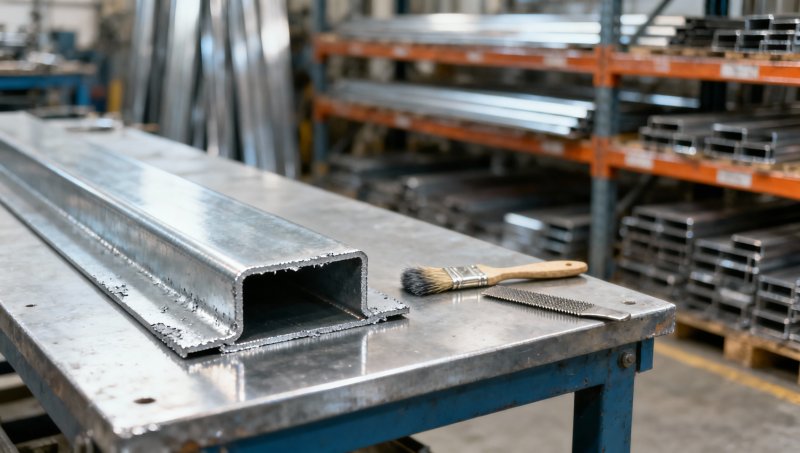
Apply the coating to the cut face, not just the visible sides
The narrow edge is easy to miss, especially when spraying parallel to the angle’s legs. Paint may cover both broad surfaces while leaving a discontinuous film across the actual cut. Position the component so that the complete cut face, its corners, and the inside of the angle are visible and reachable.
Control conditions and film build
Check the coating’s permitted air and surface temperatures, humidity limits, and required margin above the dew point. Metal can look dry and still collect condensation as temperature changes. Painting a cold angle immediately after bringing it into a warm, humid workshop can therefore produce poor adhesion.
Mix the product as instructed. Zinc-rich liquids can settle, so shaking an aerosol or stirring a liquid coating must follow the manufacturer’s directions. Apply a controlled first pass across the edge and onto the sound adjoining coating by the specified overlap. A small brush can help work a brush-approved product into the inside corner.
Do not substitute one heavy application for the required number of coats. Excessive build can sag, trap solvent, or crack, while an overly thin film leaves gaps. Follow the specified dry film thickness and recoat interval. Avoid inventing a universal thickness: appropriate film build depends on the repair material and system.
Very narrow cut faces are difficult to measure reliably with an ordinary coating thickness gauge. Where thickness verification is required, use the product or project’s accepted inspection method. Measurements on the adjacent flat surface alone do not prove complete edge coverage.
Add a topcoat only when the system allows it
A zinc-rich repair coat may be sufficient for some applications; more demanding exposure may require an approved topcoat. Check compatibility, curing time, and surface preparation between coats. A mismatched finishing paint can lift the repair, adhere poorly, or interfere with its intended performance.
Color touch-up should remain localized on prepainted sheet. A broad patch can weather differently from the original finish even when the initial color looks similar. Treat the exposed metal effectively without covering large areas of sound factory coating unnecessarily.
Prevent the installation from undoing the repair
Allow the coating to reach the specified handling cure before stacking or installing the angles. “Touch dry” does not necessarily mean resistant to clamp pressure, abrasion, or moisture. Separate repaired parts so that fresh edge coatings do not stick together or scrape against another sheet.
Inspect the edge again after fastening. Tools, brackets, and tight overlaps can damage a repair that looked complete on the bench. Drilling during installation also creates fresh exposed hole edges and loose swarf; address those areas using the applicable coating instructions and remove the debris promptly.
Where a cut sits inside an overlap, treat accessible surfaces before assembly if permitted by the joint specification. Do not apply paint or sealant indiscriminately to load-bearing connection surfaces whose friction, fit, or clamping behavior is controlled by the design.
Sealant is useful only where the detail calls for it and where it is compatible with the metals and coatings. It should not be treated as a substitute for corrosion repair. A poorly arranged seal can trap water behind the edge; drain paths and open ends must remain functional.
Read early defects before rust spreads
After curing, examine the cut under good lighting. Look for uncovered corners, pinholes, lifting, cracks, and coating rubbed away during handling. Repair defects using the product’s recoating procedure rather than simply covering a failing layer with more paint.
- Orange-brown staining: First distinguish loose swarf rust from corrosion originating at the edge. Clean away debris and inspect the underlying surface.
- White deposits on zinc: These may be zinc corrosion products rather than red steel rust. Check for persistent dampness or poor storage ventilation and remove deposits as required before repair.
- Blistering or peeling: Investigate moisture, contamination, inadequate preparation, or coating incompatibility. Remove unsound film before recoating.
- A rust line beneath adjacent paint: Check for underfilm corrosion. Repair must reach the sound boundary, not stop at the visible stain.
Make the first service inspection after the angle has experienced representative wet conditions, then set the maintenance interval according to exposure and observed condition. Repeated failure at the same edge usually calls for a change in drainage, cleaning, or coating selection—not another identical touch-up over the same defect.
Please give us a message


Please enter what you want to find