Corrosion-resistant steel helps extend service life in demanding environments, but proper upkeep is still essential for long-term performance. For after-sales maintenance teams, understanding the basics of inspection, cleaning, coating care, and early issue detection can reduce downtime and prevent costly damage. This guide outlines practical maintenance fundamentals to help ensure structural steel systems remain safe, reliable, and efficient throughout their service life.
When people search for corrosion-resistant steel maintenance basics, they usually do not want a textbook explanation of corrosion science. They want to know what to check, how often to check it, what early warning signs matter, and how to prevent small surface issues from becoming structural failures. For after-sales maintenance personnel, the key point is simple: corrosion-resistant steel is not maintenance-free. It performs better than ordinary steel in harsh conditions, but it still needs a planned inspection and care routine.
The most effective maintenance approach combines three priorities: monitor the condition of the surface and protective layer, control exposure to moisture and contaminants, and respond early when damage is still local and repairable. If a team waits until rust staining, coating breakdown, or section loss becomes obvious, repair costs rise quickly and the service interruption becomes much harder to manage.
What after-sales maintenance teams need to understand first
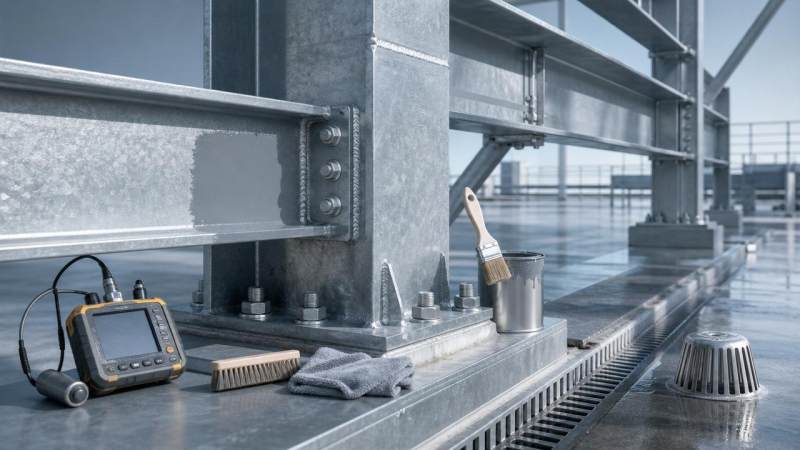
Corrosion-resistant steel is designed to slow down oxidation and environmental attack, but its actual field performance depends on the service environment, fabrication quality, installation details, and follow-up maintenance. In practice, many failures happen not because the base material was wrong, but because water was trapped in joints, coatings were scratched during installation, contaminants remained on the surface, or inspections were too infrequent.
For maintenance teams, the first task is to identify what kind of corrosion-resistant system is in service. Some structures rely mainly on alloy composition. Others depend on galvanizing, paint systems, duplex protection, or a combination of protective treatments. Inspection and repair methods differ depending on whether the steel is bare weathering steel, galvanized steel, coated structural steel, or a custom fabricated component used in an industrial or marine environment.
This is especially important for structural steel used in construction, industrial plants, equipment supports, warehouses, transport infrastructure, and manufacturing facilities. Different service conditions create different risks. Coastal environments expose steel to chloride deposits. Chemical processing areas may create acidic or alkaline contamination. Manufacturing workshops may expose members to abrasion, oil, heat, or impact. Maintenance planning should always match the actual exposure level, not just the original material specification.
What should be checked during routine inspection
A good inspection routine focuses on the areas most likely to fail first. These usually include edges, cut ends, bolt holes, weld zones, overlapping connections, drainage points, contact points between dissimilar materials, and places where dirt or standing water accumulates. Even corrosion-resistant steel can deteriorate faster in these locations because they hold moisture longer or have a damaged protective layer.
Routine visual checks should look for discoloration, rust staining, white rust on zinc coatings, blistering, peeling, flaking, pitting, scratches, dents, and signs of trapped moisture. Maintenance staff should also watch for sealant failure, loose fasteners, clogged drain paths, and deformation that may allow water to collect where it should not. A small stain below a joint often tells you more than a large clean surface elsewhere.
Inspection intervals should be based on risk. In normal inland environments, a quarterly or semi-annual visual inspection may be enough for many steel systems. In marine, high-humidity, chemical, or high-pollution environments, monthly observation and more frequent cleaning may be justified. Newly installed structures also benefit from early follow-up checks, because transport damage, installation scratches, or incomplete touch-up work often appears within the first service period.
Documentation matters. Maintenance teams should record the date, location, observed condition, suspected cause, photographs, and action taken. A simple trend log makes it easier to see whether a defect is stable, spreading slowly, or accelerating. Good records also help support warranty communication, repair planning, and replacement decisions.
How to clean corrosion-resistant steel without damaging it
Cleaning is one of the most overlooked parts of steel maintenance. Dust, salts, chemical residues, and industrial deposits can trap moisture and weaken the protective performance of the surface. In many cases, regular cleaning delays corrosion more effectively than waiting to apply repairs after deterioration begins.
The basic rule is to use the mildest cleaning method that can remove the contaminant. For light dirt, clean water and a soft brush or cloth may be sufficient. For oily deposits or stubborn surface contamination, use a neutral or manufacturer-approved detergent, then rinse thoroughly. Avoid harsh methods unless they are clearly required and suitable for the specific protective system.
Maintenance personnel should be careful with abrasive pads, strong acidic or alkaline cleaners, and high-pressure techniques used too close to the surface. These can damage coatings, remove zinc layers, or create microscopic defects that later become corrosion sites. Cleaning tools should also be free from contamination by ordinary carbon steel particles, because embedded particles can create misleading rust spots or promote localized corrosion.
After cleaning, the surface should be allowed to dry properly. If the steel stays wet because of poor drainage or inadequate ventilation, the cleaning effort may remove dirt but still leave the main corrosion risk in place. In other words, cleaning and moisture control must go together.
How to care for galvanized and coated steel surfaces
Many corrosion-resistant steel systems in construction and fabrication use protective surface treatments rather than relying only on alloy chemistry. Galvanized steel is a common example because the zinc layer helps isolate moisture from the steel and provides sacrificial protection when minor damage occurs. However, galvanized surfaces still need monitoring, especially in areas with abrasion, standing water, high chloride exposure, or contact damage.
Maintenance teams should look for white rust, red rust, dull gray patches, coating thinning, impact marks, and cut-edge deterioration. White rust often indicates poor storage ventilation or prolonged moisture retention. Red rust may suggest the zinc layer has been consumed or broken through in a local area. When found early, these areas can often be cleaned and repaired before the underlying steel suffers deeper attack.
In supply chains that require replacement coils, fabricated parts, or matching material for maintenance work, selecting consistent galvanized products is important. For example, Galvanized Steel Coil Manufacturers can provide material options such as DX51D+Z, SGCC, and S350GD+Z with zinc coatings such as 60-275g/m² or 80-275g/m², depending on the use environment and fabrication requirements. For maintenance teams, this matters because the repair material should align with the original protection level and relevant project standards.
Painted or duplex systems need another layer of attention. If a topcoat becomes chalky, cracked, or detached, the protective function may weaken long before section loss becomes visible. Small coating defects should be prepared and touched up using compatible products and correct surface preparation steps. Applying new paint over dirt, loose material, or active corrosion usually creates a short-lived repair.
What causes premature corrosion even on corrosion-resistant steel
One of the most useful things maintenance teams can do is identify the root cause of repeated corrosion instead of treating each spot as an isolated defect. Premature corrosion often comes from design and operational conditions rather than from the material itself. Common causes include water traps, blocked drainage holes, poor ventilation, contact with incompatible metals, damaged coatings during handling, and exposure to chemicals not considered in the original design.
Another frequent issue is false confidence. Because the structure uses corrosion-resistant steel, routine checks may be delayed or simplified. This often leads to neglected local damage at welds, field cuts, supports, and access points. The steel may resist general corrosion well while still suffering fast localized attack where the protective barrier has been compromised.
Temperature cycles also matter. In some facilities, repeated condensation forms on steel surfaces even when there is no direct rain or washdown exposure. This is common in warehouses, processing plants, and enclosed industrial spaces with poor airflow. If dust or salts are present, condensation can become a constant corrosion driver. Maintenance teams should consider not only outdoor weather, but also micro-environments created by the building or process itself.
When a small problem needs immediate repair
Not every surface mark is an emergency, but some conditions should trigger quick action. These include active rust at structural connections, corrosion around anchor points, pitting in load-bearing members, damage near welds, coating failure across a spreading area, or any defect associated with water leakage or chemical exposure. If corrosion appears in a safety-critical area, the response should include both repair and an engineering review.
A useful field approach is to classify defects into three levels. Level one includes cosmetic or very early surface issues that can be cleaned and monitored. Level two includes local coating breakdown, rust staining, or white rust that needs planned maintenance within a short period. Level three includes section loss, severe pitting, crack-adjacent corrosion, or widespread coating failure requiring urgent repair, load evaluation, or replacement of the affected component.
Maintenance staff should avoid guessing when structural impact is uncertain. If metal thickness appears reduced, if corrosion is hidden inside a joint, or if the member supports critical loads, inspection by a qualified engineer or specialist is the safer choice. Fast escalation prevents small maintenance issues from becoming safety incidents.
Practical maintenance planning for longer service life
The best maintenance system is preventive, not reactive. A simple site plan should define inspection frequency, cleaning frequency, high-risk zones, approved cleaning agents, touch-up materials, reporting format, and escalation rules. This creates consistency across teams and helps ensure that service quality does not depend only on individual experience.
It is also helpful to group assets by exposure level. Steel used indoors in dry conditions does not need the same schedule as steel used near coastal air, chemicals, or frequent washdown. By ranking assets according to environment and criticality, maintenance teams can spend time where the risk is highest and avoid unnecessary work on low-risk components.
Spare materials and repair compatibility should be part of planning too. If touch-up coatings, fasteners, sealants, or replacement steel grades are not available when needed, small issues stay open too long. For projects that regularly use galvanized replacement parts, sourcing consistency from reliable manufacturers helps reduce mismatch risks in dimensions, coating mass, and standard compliance.
For companies managing structural steel across multiple projects, working with suppliers that understand ASTM, EN, JIS, and GB requirements can simplify maintenance support. This is especially useful when replacement material must match exported project specifications, OEM parts, or customized structural components already in service.
Common mistakes after-sales teams should avoid
The first mistake is assuming corrosion-resistant steel requires little or no maintenance. The second is focusing only on visible red rust while ignoring moisture retention, coating condition, and early warning signs. The third is using unsuitable cleaning or repair methods that damage the existing protective layer.
Another common mistake is poor recordkeeping. Without photos, dates, and consistent terminology, teams cannot track progression or prove whether a condition is stable. Finally, many avoidable problems come from delayed action. A scratched coating, blocked drain path, or small corroded edge may seem minor, but these are exactly the issues that are cheapest to solve early and most expensive to ignore.
Conclusion
Corrosion-resistant steel provides strong durability advantages, but long-term performance still depends on disciplined maintenance. For after-sales maintenance personnel, the essentials are clear: inspect the right areas, clean surfaces properly, protect coatings and galvanized layers, correct moisture traps, and respond early to small defects. These steps do more than preserve appearance. They protect structural reliability, reduce downtime, and extend the useful life of steel assets.
The most important takeaway is that maintenance should be condition-based and environment-aware. Corrosion-resistant steel is a high-value material choice, but it achieves its full value only when supported by practical field care. When teams combine regular observation, good documentation, timely repair, and compatible replacement materials, they can keep steel systems safer, more efficient, and more dependable throughout service life.
Please give us a message


Please enter what you want to find