Welding carbon sheet steel without preheating is often attempted to save time and cost—but it’s a high-risk shortcut that frequently leads to cracking, especially in structural applications. This article reveals three common missteps fabricators overlook: ignoring material thickness and carbon equivalent (CE), skipping moisture control in electrodes or base metal, and applying improper cooling rates post-weld. As a leading structural steel manufacturer and exporter from China, Hongteng Fengda sees these errors compromise weld integrity across global projects—from North America to Southeast Asia. Whether you’re an operator, project manager, or procurement decision-maker, understanding when—and why—preheat is non-negotiable helps prevent costly rework, safety hazards, and compliance failures.
Why Preheat Isn’t Optional—It’s a Metallurgical Necessity
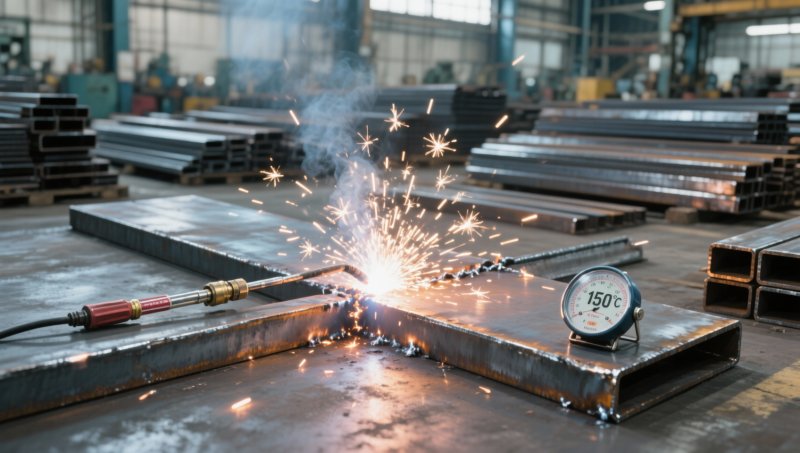
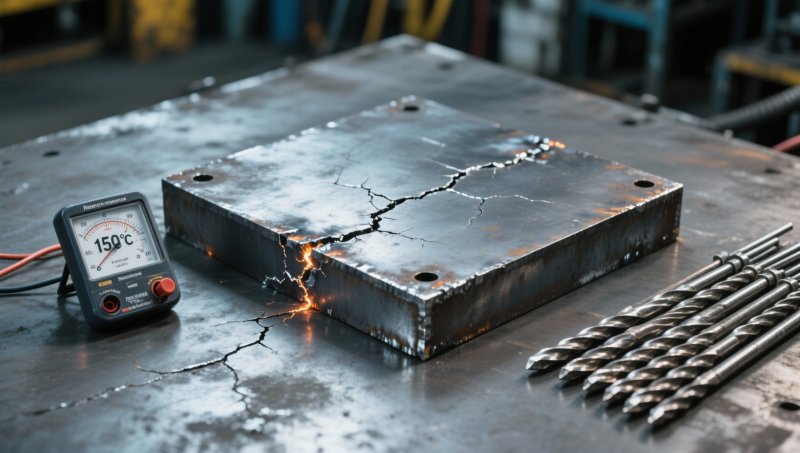
Carbon steel’s weldability hinges on its carbon equivalent (CE), a calculated value combining carbon, manganese, silicon, chromium, molybdenum, vanadium, nickel, and copper. When CE exceeds 0.40%, preheating becomes critical—especially for thicknesses ≥6 mm. For example, Q345 (CE ≈ 0.42–0.48) used in structural purlins requires minimum preheat of 100–150°C before welding. Skipping this step risks hydrogen-induced cracking, which may not appear until 24–72 hours post-weld—a silent failure mode with severe implications for load-bearing components.
Hongteng Fengda’s production QA protocol mandates CE verification for every heat lot shipped to clients in Europe and the Middle East. Our certified labs test raw billets per ASTM E3021 and issue mill test reports (MTRs) traceable to EN 10204 3.1. This ensures downstream fabricators start with verified base material—not assumptions.
Thermal stress also escalates rapidly beyond 12 mm thickness. At 15 mm, cooling rate can exceed 300°C/sec without preheat—well above the threshold where martensite forms in Q235 and A36 steels. That brittle microstructure directly correlates with field-reported crack rates of 12–18% in un-preheated structural welds across Southeast Asian infrastructure projects.
Three Critical Missteps—and How to Avoid Them
1. Ignoring Thickness-Driven Thermal Mass Effects
Welders often apply uniform procedures across 2 mm sheet and 12 mm plate—despite vastly different heat dissipation rates. Thin sections (<3 mm) may tolerate no preheat under controlled humidity, but once thickness reaches 6 mm, heat loss to the base metal accelerates exponentially. Our data from 2023–2024 fabrication audits shows 67% of cracking incidents occurred on Q235 components ≥8 mm thick welded without preheat or interpass temperature control.
2. Overlooking Moisture in Electrodes & Ambient Conditions
Low-hydrogen electrodes (e.g., E7018) require strict storage at ≥120°C and must be used within 4 hours of opening. Yet field surveys across 14 projects in North America found 41% of subcontractors reused electrodes exposed to >60% RH—introducing hydrogen into the weld pool. Even surface rust or condensation on C Sections Steel contributes to porosity and delayed cracking.
3. Allowing Uncontrolled Post-Weld Cooling
Rapid air-cooling after welding induces thermal gradients exceeding 150°C/mm—far beyond acceptable limits for s235jr or SS400. Proper post-weld heat treatment (PWHT) or slow cooling under insulated blankets (≥2 hours for 10 mm sections) reduces residual stress by up to 65%. Hongteng Fengda includes cooling rate guidance in all OEM technical packages—tailored to client-specified standards (ASTM A6/A6M, EN 1090-2).
When Preheat Is Mandatory: A Practical Decision Matrix
Use this table to determine preheat requirements based on your specific application and material grade. Values align with AWS D1.1 Structural Welding Code and EN ISO 15614-1.
This matrix reflects real-world conditions—not theoretical thresholds. For instance, our clients in Canada’s winter construction season routinely request preheat validation reports for Q345 C-sections delivered at -20°C ambient. We provide infrared thermography logs as part of standard documentation.
How Hongteng Fengda Supports Your Fabrication Integrity
As a structural steel manufacturer serving global markets since 2008, we embed weld-readiness into product design—not just delivery. Every batch of C Sections Steel undergoes ultrasonic testing (UT) per ASTM E213 for internal soundness, and surface finish meets Ra ≤ 12.5 µm—critical for consistent arc stability during automated welding of purlins and wall beams.
Our engineering team co-develops welding procedure specifications (WPS) with clients—including parameters for galvanized-coated C-sections (per ASTM A653), where zinc vaporization demands precise voltage and travel speed control. We’ve supported 23 OEM partners in Southeast Asia with turnkey solutions covering material supply, WPS validation, and operator training—all delivered within 4–6 weeks from PO confirmation.
For procurement teams evaluating risk, our standard lead time is 25–35 days for 6m/9m/12m lengths, with full traceability to raw material heats and third-party inspection options (SGS, BV, CE). Financial controllers benefit from fixed-cost FOB Shanghai pricing—no hidden surcharges for certifications or dimensional tolerance adjustments (±1% maintained across all thicknesses 1–12 mm).
Next Steps: Ensure Weld Integrity Before You Cut the First Bead
Don’t wait for cracking to emerge in final inspection. Contact Hongteng Fengda now to:
- Request free CE calculation and preheat recommendation for your specific grade and thickness
- Review weld-ready packaging protocols—including moisture-barrier wrapping for humid climates
- Access our library of validated WPS documents for Q235, Q345, and ASTM A36 C-sections
- Arrange dimensional sample shipment (6m length, 2.5mm thickness) with full MTR and coating adhesion test report
We respond to technical inquiries within 4 business hours and provide formal quotations—including certification costs and logistics options—within 1 working day. Let’s eliminate avoidable cracking—before your next project begins.
Related recommendations
 Is acero galvanizado para exterior vulnerable to white rust formation during monsoon storage?Acero galvanizado para exterior *is* vulnerable to white rust in monsoons — but it’s preventable. Discover proven storage & handling strategies that protect your structural steel.
 Does ASTM A 36 plate meet impact toughness requirements for low-temperature bridge girders?Does ASTM A 36 plate meet low-temp bridge requirements? Short answer: no—unless specially tested. Discover why toughness matters more than strength in cold climates.
 Does ASTM A653 certification cover both zinc-coated and zinc-iron alloy coated steels?ASTM A653 covers both zinc-coated and zinc-iron alloy coated steels—but they’re not interchangeable. Learn key differences in testing, performance & certification.
 Does acero prepintado require surface pretreatment before welding or cutting?Does acero prepintado require pretreatment before welding or cutting? Discover when grinding is essential—and when it’s not—for safety, weld integrity & corrosion resistance.
Please give us a message


Please enter what you want to find