For technical evaluators, the key question is whether 304 stainless steel coil tubing can maintain corrosion resistance and service life in chloride-containing environments. While 304 offers good formability, strength, and broad industrial use, its performance depends heavily on chloride concentration, temperature, and operating conditions. Understanding these limits is essential for selecting the right material and reducing long-term maintenance and replacement risks.
How Does 304 Stainless Steel Coil Tubing Perform in Chloride Environments?
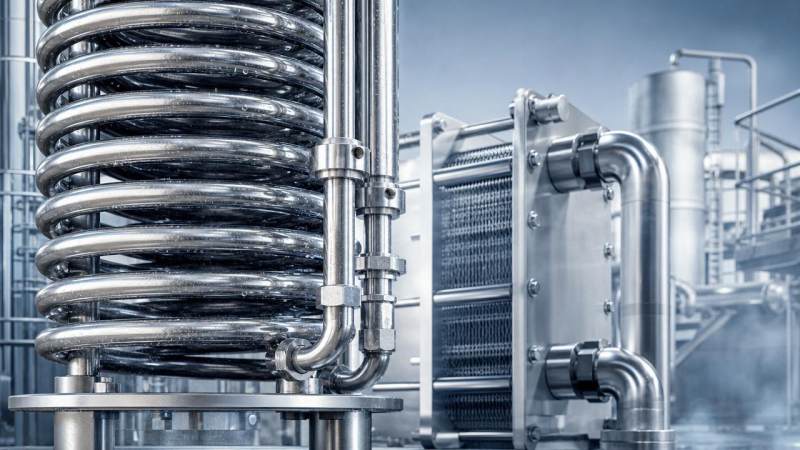
304 stainless steel coil tubing is an austenitic stainless steel product widely used in fluid handling, heat exchange, instrumentation, food processing, and light chemical systems. Its value comes from balanced corrosion resistance, good weldability, stable forming behavior, and accessible cost.
However, chloride exposure changes the evaluation logic. Chlorides can locally break down the passive oxide film that protects stainless steel. Once that film is damaged, pitting corrosion and crevice corrosion may start, especially in stagnant, warm, or oxygen-variable conditions.
For technical assessment, the right question is not simply whether 304 stainless steel coil tubing resists chlorides, but under what chloride level, temperature range, flow state, and cleaning regime it can still meet service life targets.
- Low chloride, low temperature, and clean service often allow satisfactory performance.
- Intermittent wet-dry cycles increase the chance of concentrated salt deposits.
- High temperature accelerates passive film instability and localized attack.
- Crevices at clamps, fittings, and deposits create more risk than open, flushed surfaces.
Why chloride attack is often localized rather than uniform
In many steel systems, uniform corrosion is easier to predict. With 304 stainless steel coil tubing, chloride damage is more often localized. That means tubing can look acceptable overall while pits develop at specific points. For evaluators, this is a critical risk because a single pit can cause leakage long before general wall loss becomes visible.
What Conditions Usually Determine Success or Failure?
Material selection should focus on the interaction between medium chemistry and system design. The table below helps technical teams quickly judge whether 304 stainless steel coil tubing is likely to face low, medium, or elevated chloride-related risk.
This matrix shows why two projects using the same 304 stainless steel coil tubing can produce very different results. A mild process stream in a clean, drained system may perform well, while a warm chloride-bearing line with deposits can fail unexpectedly.
Key technical red flags during evaluation
- Chloride-containing cleaning chemicals left on the surface after shutdown.
- Marine-adjacent installations where airborne salt accumulates over time.
- Hidden crevices inside instrumentation assemblies or supports.
- Weld discoloration or poor post-fabrication cleaning that weakens passive protection.
304 vs 316/316L: When Is Upgrading the Better Decision?
For many evaluators, the real decision is not whether 304 stainless steel coil tubing is usable, but when the risk premium justifies moving to a molybdenum-bearing grade. In chloride service, 316 or 316L often becomes the more conservative option because molybdenum improves resistance to pitting and crevice corrosion.
The following comparison table supports early-stage selection where cost, service life, maintenance access, and exposure severity all matter.
If a system has repeated chloride cleaning, marine splash influence, elevated temperature, or costly downtime consequences, upgrading can be easier to justify than repeated repairs. For broader corrosion-critical fabrication, engineers also consider products such as 316L Stainless Steel Plate when designing tanks, covers, support components, or welded assemblies around the tubing network.
Where 316L becomes especially relevant
316L stainless steel is widely selected in chemical, food industry, medical equipment construction, agriculture and ship parts, and high temperature applications. Its low carbon design helps reduce sensitization concerns in welded parts, and it is commonly used in larger welded sections beyond thin tubing alone.
Typical data for 316L plate products includes tensile strength of at least 520 MPa, yield strength of at least 275 MPa, elongation around 55 to 60 percent, hardness up to 183 HB or 100 HRB, density of 7.98 g/cm³, and elastic modulus of 193 GPa. These values support structural and fabricated component selection where corrosion resistance and fabrication performance must be balanced.
Which Applications Are Usually Acceptable for 304 Stainless Steel Coil Tubing?
Technical evaluators should separate acceptable chloride contact from aggressive chloride service. 304 stainless steel coil tubing may still be a practical option in controlled environments where chloride presence is limited and maintenance is realistic.
More suitable scenarios
- Indoor process lines carrying low-chloride fluids at moderate temperature.
- Instrumentation tubing in dry industrial spaces with minimal salt contamination.
- Food or beverage systems where chloride-bearing cleaners are tightly controlled and thoroughly rinsed.
- Heat exchanger or coil applications with confirmed water chemistry management.
Less suitable scenarios
- Coastal outdoor installations with regular salt spray accumulation.
- Warm brine, saline washdown, or chloride-rich cleaning cycles.
- Dead-leg tubing arrangements where liquid remains trapped after shutdown.
- Systems where tubing failure would trigger contamination, safety, or major production losses.
This distinction matters in sourcing. A lower-cost grade can be commercially sensible only if service conditions are honestly defined. Underestimated chloride severity is one of the most common causes of premature stainless steel replacement.
What Should Technical Evaluators Check Before Procurement?
A disciplined procurement review reduces the risk of choosing 304 stainless steel coil tubing based on catalog familiarity rather than actual operating conditions. The checklist below is useful for RFQ preparation, supplier comparison, and internal approval.
Technical evaluation should not end with grade selection. Surface finish, dimensional tolerance, coil consistency, documentation, and delivery reliability all affect final project risk. This is especially important for export procurement where replacement lead time may be long.
A practical sourcing workflow
- Define medium, chloride range, operating temperature, and cleaning cycle.
- Decide whether failure mode would be tolerable, repairable, or critical.
- Compare 304 against 316 or 316L for full life-cycle cost, not purchase price only.
- Confirm supplier capability for standards, OEM dimensions, and inspection records.
- Where uncertainty remains, request samples or pilot validation before scale purchase.
How Do Standards, Manufacturing Quality, and Export Supply Affect Material Reliability?
For technical evaluators, corrosion performance is not only a metallurgy issue. Reliability also depends on whether the supplier can control production, maintain dimensional consistency, and support documentation required by global projects.
Hongteng Fengda operates as a structural steel manufacturer and exporter from China, supporting construction, industrial, and manufacturing projects with stable production capacity and customized supply. While the company is known for angle steel, channel steel, steel beams, cold formed profiles, and customized structural steel components, its value for buyers lies in disciplined quality control and alignment with common international standards such as ASTM, EN, JIS, and GB.
That matters when a project includes mixed steel procurement. Technical teams often need a supplier network that can support both corrosion-sensitive stainless components and structural steel packages under coordinated delivery plans. Fewer sourcing gaps usually mean fewer project delays and less documentation mismatch.
- Stable production helps buyers avoid urgent grade substitutions caused by schedule pressure.
- Quality control reduces the chance of dimensional inconsistency across batches.
- Customized solutions help when project geometry or OEM requirements differ from standard supply.
- Export experience supports communication on packing, lead time, and destination compliance needs.
Common Misconceptions About 304 Stainless Steel Coil Tubing in Chloride Service
“Stainless steel means no corrosion problem”
This is the most damaging assumption. Stainless steel is corrosion resistant, not corrosion proof. 304 stainless steel coil tubing performs well in many environments, but chloride ions can still initiate pitting under the wrong conditions.
“If the chloride level looks low, 304 is always safe”
Not necessarily. Local concentration by evaporation, trapped liquid, deposits, and elevated cleaning temperature can create much harsher micro-environments than bulk chemistry suggests. System design can be as important as the nominal fluid analysis.
“Upgrading to 316L is only about buying a more expensive metal”
In many projects, the cost of inspection downtime, leakage, contamination, and replacement labor exceeds the initial upgrade premium. The correct comparison is total operating risk, not raw material price alone. In fabricated assemblies requiring corrosion-resistant plates, finishes such as BA, 2B, NO.1, NO.4, HL, or 8K may also be selected based on service and appearance requirements for 316L Stainless Steel Plate.
FAQ for Technical Evaluators
Can 304 stainless steel coil tubing be used in coastal projects?
It can be used in some coastal projects, but only after evaluating salt deposition, washing frequency, temperature, and accessibility for maintenance. Outdoor or splash-prone areas are more likely to require 316 or 316L for acceptable service life.
What is the main failure risk under chloride exposure?
The main concern is localized corrosion, especially pitting and crevice corrosion. These forms are dangerous because they can cause leakage with limited visible warning and may not correlate with general wall loss.
Should temperature be treated separately from chloride concentration?
Yes. A moderate chloride content at higher temperature can be more damaging than a somewhat higher chloride content at lower temperature. Technical reviews should separate normal operation, peak operation, and cleaning temperature because each can change corrosion behavior.
What should be included in a supplier inquiry?
Include material grade, required standards, dimensions, wall thickness tolerance, surface condition, fabrication or weld expectations, end use, service medium, delivery schedule, and documentation needs. This allows better matching of 304 stainless steel coil tubing to actual project conditions.
Why Choose Us for Technical Support and Project Sourcing?
For technical evaluators, the challenge is rarely limited to one grade decision. Projects often require coordinated judgment on corrosion exposure, structural load paths, fabrication methods, standards compliance, and delivery timing. Hongteng Fengda supports this process with manufacturing experience, export coordination, and customized steel supply for global industrial and construction projects.
You can contact us for practical support on parameter confirmation, material selection between 304 and higher-corrosion-resistance options, OEM dimensions, structural steel integration, lead time planning, certification alignment, sample discussion, and quotation review. If your project involves chloride exposure uncertainty, send the service medium, temperature range, drawing details, and target market standards so the material route can be evaluated more efficiently.
Please give us a message


Please enter what you want to find