For projects near the sea, AZ150 Galvalume Steel Coil is often considered for its balance of corrosion resistance and cost. But is it the right choice for coastal environments? This article examines real performance factors, compares it with options like DX53D Galvalume Steel Coil, and helps buyers, engineers, and project managers judge whether cheap steel from China is reliable for demanding applications.
In coastal construction, the answer is rarely a simple yes or no. Salt spray, humidity above 70% for long periods, ultraviolet exposure, wind-driven rain, and trapped moisture at overlaps can all change how coated steel performs in service. A material that works well 20 km inland may behave very differently within 500 meters of the shoreline.
That is why technical evaluation should go beyond price per ton. Buyers need to assess coating mass, fabrication quality, drainage design, edge protection, maintenance frequency, and the real duty cycle of the structure. For steel importers, distributors, and EPC teams, understanding these variables reduces sourcing risk and avoids premature replacement costs.
As a structural steel manufacturer and exporter from China, Hongteng Fengda supplies steel products for global construction and industrial projects under ASTM, EN, JIS, and GB related requirements. For customers comparing steel coils, structural members, and fabricated sections, the key is not only whether a product is affordable, but whether it is suitable for the exact exposure class and service life target.
How AZ150 Galvalume Steel Coil Performs in Coastal Environments
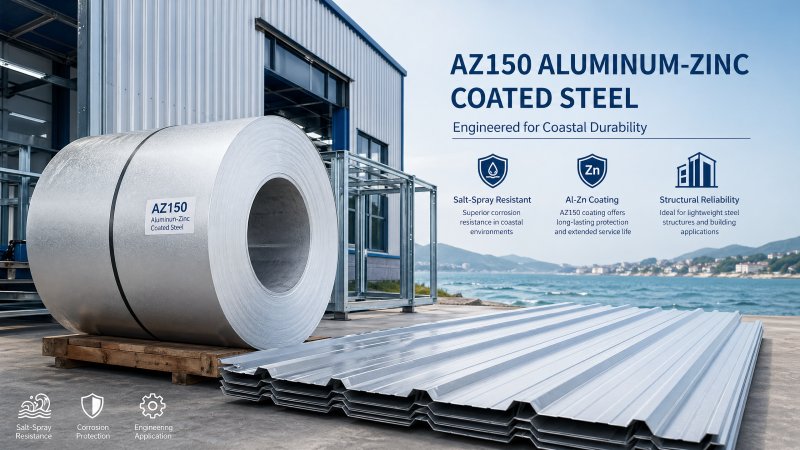
AZ150 Galvalume Steel Coil usually refers to a steel substrate coated with an aluminum-zinc alloy layer at about 150 g/m² total coating mass. In practical terms, this coating is often selected for roofing, wall cladding, ducting, light industrial panels, and secondary structural applications where a balance between corrosion resistance and cost is required.
The aluminum content helps provide barrier protection, while zinc contributes sacrificial protection, especially at cut edges and scratched points. In many inland and moderate industrial zones, AZ150 can deliver stable service over 10 to 20 years depending on design, installation, and coating system. In coastal areas, however, chloride deposition accelerates corrosion pressure, especially when salt remains on the surface for long intervals without washing rain.
For sites located 0 to 1 km from the coastline, exposure severity is usually much higher than for sites 5 to 10 km inland. The closer the structure is to sea spray and prevailing onshore winds, the more attention must be paid to cut edges, perforations, overlaps, and fastener zones. These are the first places where underfilm attack, red rust, or white corrosion products may appear if the detailing is poor.
Another important point is that AZ150 is a coating designation, not a complete performance guarantee. Base steel quality, passivation condition, paint system if prepainted, installation slope, and drainage all matter. A well-designed roof with a proper pitch and minimal salt accumulation can outperform a poorly designed façade even when both use the same coil grade.
What coastal buyers should evaluate first
Before approving AZ150 for a coastal project, technical teams should check at least 5 points: distance from the sea, whether the component is enclosed or exposed, frequency of wash-down or natural rain cleaning, expected service life such as 8, 15, or 25 years, and whether edges or holes will be created during site fabrication. These factors often influence performance more than the headline coating type alone.
- Within 1 km of open sea exposure, use a stricter material review and consider heavier protection systems.
- For enclosed but humid spaces, trapped condensation can be as damaging as direct spray.
- If the design includes punched holes, laps, or unsealed cut edges, corrosion risk rises materially.
- Maintenance access should be planned from day 1, not after corrosion has already started.
AZ150 vs DX53D Galvalume Steel Coil: What Really Matters
Many buyers compare AZ150 with DX53D Galvalume Steel Coil as if they are direct substitutes, but they refer to different aspects of the product. AZ150 mainly describes coating mass, while DX53D generally refers to a more formable base steel grade under EN-related designation practice. One identifies the protective layer level; the other highlights substrate formability.
This distinction is important when the application includes deep bending, roll forming, corrugation, or tight-radius shaping. A coil with the right coating but the wrong formability may crack at bends or lose edge integrity. Conversely, a highly formable substrate still needs sufficient metallic coating and suitable post-fabrication protection for coastal duty.
For procurement teams, the practical question should be: what combination of substrate grade, coating mass, surface condition, and fabrication method meets the real exposure requirement at the lowest total ownership cost over 10 to 20 years? That is a much better decision framework than choosing only by headline price or a single code in the quotation sheet.
The table below helps separate these factors and clarifies when AZ150 can be enough and when a more conservative system should be reviewed.
The key conclusion is that these are not competing labels in the same category. In many projects, buyers actually need both: a suitable formable substrate and an adequate protective coating. When exposure is aggressive, the decision may also need paint systems, thicker coatings, or design changes that reduce salt retention.
A practical selection rule
If the application is mainly cladding or roofing with moderate forming, start by defining the corrosion exposure class and service life target. If the application requires frequent punching, complex bends, or profile forming, then verify mechanical grade, elongation, and bend performance in addition to coating mass. In many RFQs, these details should be locked before price comparison begins.
Where AZ150 Is a Good Fit and Where It Is Not
AZ150 Galvalume Steel Coil can be a good fit in coastal regions when the design limits direct salt accumulation and the component is not continuously soaked by seawater or severe splash. Typical acceptable uses may include roofing with proper slope, wall cladding above splash zones, equipment housings, interior liners in ventilated buildings, and secondary fabricated items with planned inspection cycles every 6 to 12 months.
It is usually a weaker choice for severe marine exposure such as structures very close to breaking surf, poorly ventilated covered areas with condensation, unwashed canopy undersides, fishery processing environments, and components with persistent wet deposits. In these cases, lifecycle cost can rise quickly if corrosion forces early repairs within 3 to 7 years.
This is also where structural steel details become relevant. A project may use coated coil for cladding while relying on hot-rolled structural members, galvanized profiles, and custom fabricated supports in other zones. In mixed systems, material compatibility and drainage should be coordinated early to avoid galvanic or staining problems between adjacent components.
For secondary framing and support applications, some buyers combine cladding systems with galvanized profile products such as C Channel Beam. This type of member is commonly used in steel structure buildings and mechanical light industry manufacturing, with thickness from 1 mm to 12 mm and standard lengths of 6 m, 9 m, and 12 m. Materials such as Q195, Q235, Q345, A36, SS400, and S235JR allow matching to different load and fabrication needs.
How inserted structural products support coastal projects
When specified correctly, galvanized C-shaped sections can serve as purlins, wall beams, roof brackets, and light framing supports. Buyers should verify whether the section is perforated, what surface treatment is selected, and whether processing services such as bending, punching, welding, decoiling, or cutting are required before shipment. Tolerance around ±1% and delivery time of about 15 to 20 days can be practical planning references for many export projects.
For project managers, the benefit is not simply product variety. It is supply chain integration. Sourcing coils, beams, channels, and custom fabricated parts from one controlled manufacturer can reduce drawing mismatch, packaging errors, and handover delays, especially when projects are running under FOB, CFR, or CIF terms with tight installation windows.
The main takeaway is that suitability depends on the exact location, design, and maintenance plan. AZ150 can be a cost-effective and reliable choice in many coastal projects, but it should not be treated as a universal solution for every marine exposure condition.
How to Judge Whether Cheap Steel from China Is Reliable
Price-sensitive sourcing is common, but low price should trigger verification, not automatic rejection. Reliable Chinese steel suppliers can be highly competitive because of scale, process efficiency, and integrated production. The real issue is consistency: can the supplier maintain substrate quality, coating control, dimensional tolerance, traceable inspection, and dependable packing over repeated orders?
A sound evaluation process should include both commercial and technical checks. Commercially, teams should confirm lead time, payment terms, shipping method, and claim handling procedure. Technically, they should review material standards, certificate availability, coating inspection method, thickness tolerance, and how the supplier manages slitting, edge damage, and export packaging for sea freight that may last 20 to 45 days.
Hongteng Fengda focuses on structural steel manufacturing and export with products aligned to common international standards including ASTM, EN, JIS, and GB. For overseas buyers, this matters because documentation compatibility simplifies technical review across North America, Europe, the Middle East, and Southeast Asia. It also helps distributors and project owners compare bids on a more consistent basis.
The procurement team should also ask whether the supplier can support OEM dimensions, custom lengths, punching or fabrication, and coordinated shipments of related steel products. A supplier that can support both standard specifications and project-specific adjustments often reduces total project friction, even if the unit price is not the absolute lowest on paper.
6-point reliability checklist for overseas steel sourcing
- Confirm applicable standard such as ASTM, EN, JIS, or GB before quotation approval.
- Verify coating mass, thickness range, and tolerance on the purchase order.
- Request mill test documents and quality certificates where required.
- Check packaging method for export humidity and salt-air transit conditions.
- Align delivery schedule, usually 15 to 20 days for some fabricated items, with site sequence.
- Clarify claim response process before deposit payment or LC issuance.
For finance approvers and senior decision-makers, the right benchmark is not the lowest ex-works figure. It is the total landed and installed cost, plus the probability of rework, claim delays, and early corrosion. A slightly higher but controlled supply may save far more over a 12- to 24-month project cycle.
Implementation, Maintenance, and Common Mistakes
Even a correctly selected AZ150 Galvalume Steel Coil can underperform if the site practices are poor. One of the most common failures is damage during storage. Coils or sheets left wet under wrapping, stacked on uneven ground, or exposed to trapped condensation can begin to stain or corrode before installation. Good practice is to keep materials dry, ventilated, and elevated from the ground, and to install them as soon as practical after delivery.
The second frequent mistake is ignoring cut edges and penetrations. In coastal projects, drilled holes, trimmed edges, and fastener points should be treated as high-risk zones. If the system includes frequent field cutting, buyers should plan edge protection, compatible sealants where needed, and inspection after installation. These details are especially important during the first 6 to 12 months of service.
The third issue is design geometry. Flat ledges, poorly drained laps, and enclosed pockets collect salt and moisture. A change as small as improving runoff angle or opening ventilation paths can significantly reduce time-of-wetness. Engineers and site supervisors should treat water management as part of corrosion control, not as a separate architectural issue.
Maintenance should be planned by exposure severity. In moderate coastal exposure, a visual check every 12 months may be enough. In high chloride or industrial-marine mixed zones, every 3 to 6 months is often more realistic, especially for canopies, roof edges, and sheltered areas that rain does not wash naturally.
Recommended maintenance plan
The following framework can help operations teams set practical inspection and cleaning routines for coated steel used near the sea.
A disciplined inspection routine usually costs far less than unscheduled repair. For facility managers and quality teams, the goal is early intervention while issues remain localized. That is often the difference between minor maintenance and major replacement.
FAQ for buyers and engineers
Is AZ150 enough for all coastal buildings?
No. It can be suitable for many coastal applications, but not all. The decision depends on distance from the sea, direct salt exposure, cleaning conditions, shape complexity, and service life expectations. Projects within 0 to 1 km of harsh surf exposure often require a more conservative review.
Does cheaper steel from China always mean lower quality?
Not necessarily. Lower pricing may come from manufacturing scale, raw material access, or process efficiency. Quality depends on process control, standards compliance, coating consistency, packaging, and documentation. Supplier evaluation should be evidence-based rather than assumption-based.
What should purchasers ask before placing an order?
At minimum, confirm 6 items: applicable standard, base steel grade, coating mass, thickness tolerance, inspection documents, and delivery schedule. If fabrication is included, also check bending radius, punching quality, cut length tolerance, and export packing method.
How long can coastal coated steel last?
There is no universal number. In moderate exposure with proper design and maintenance, service can extend well beyond 10 years. In severe marine conditions with trapped salt and poor detailing, visible problems can appear much earlier. Lifecycle depends on exposure, design, coating, and maintenance together.
AZ150 Galvalume Steel Coil can be a good fit for coastal areas when the exposure is properly defined and the project includes sound detailing, installation, and maintenance. It is most effective when buyers evaluate coating mass together with substrate grade, fabrication requirements, and service life target rather than relying on one specification alone.
For contractors, distributors, and project owners looking for dependable structural steel supply from China, Hongteng Fengda supports global projects with standard and customized steel solutions, controlled manufacturing, and practical delivery coordination. If you need help comparing steel coil options, galvanized structural sections, or custom steel components for marine or near-coastal use, contact us now to get a tailored solution, detailed product information, and sourcing support for your project.
Please give us a message


Please enter what you want to find