Choosing the right frame material affects strength, cost, and long-term performance. For buyers comparing 2 tube steel with options like stainless steel square pipe, seamless steel tube, and Q235 steel, understanding load capacity, weldability, and corrosion resistance is essential. This guide explains whether 2 tube steel is a good fit for frames and how to evaluate it for construction, fabrication, and industrial applications.
In most cases, 2 tube steel is a good fit for frames when you need a practical balance of strength, fabrication efficiency, and cost. It is widely used for equipment bases, support frames, trailers, worktables, guards, light structural assemblies, and many welded fabrications. But it is not automatically the best choice for every project. The right decision depends on wall thickness, steel grade, loading conditions, connection design, environment, and whether corrosion protection is required.
For technical evaluators, buyers, and project decision-makers, the key question is not simply “Is 2 tube steel good?” but rather “Is it strong enough, easy enough to fabricate, and cost-effective enough for this specific frame?” That is the question this article answers.
When is 2 tube steel a good choice for frames?
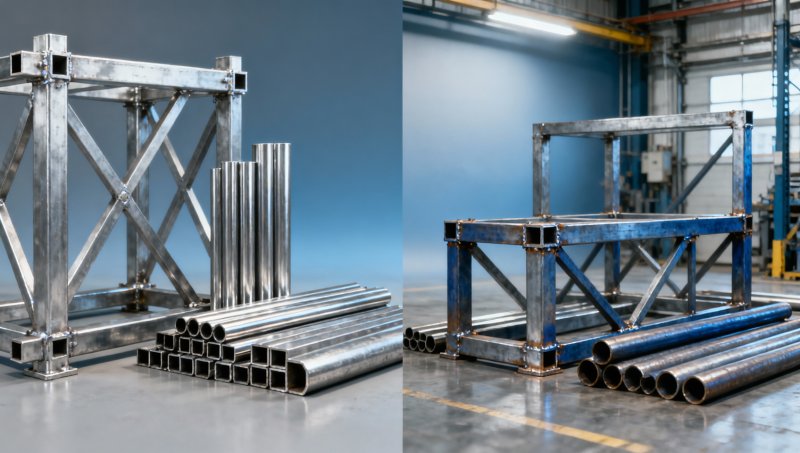
2 tube steel is usually a strong candidate when a frame needs moderate to high rigidity without the cost of heavier structural sections. In fabrication shops and industrial projects, it is often selected because it offers a clean geometry, consistent dimensions, and good weldability. Square and rectangular tube profiles also make layout, cutting, and assembly easier than many open sections.
It tends to be a good fit in these situations:
- Welded frames for machinery, platforms, racks, carts, and guards
- Building support components where compact section geometry matters
- Projects that need reasonable strength-to-weight performance
- Applications requiring easier handling than larger beams or channels
- Fabrications where appearance and dimensional neatness are important
If the frame is subject to straightforward static loads and normal indoor service conditions, 2 tube steel is often one of the most economical and practical options. It becomes especially attractive when compared with stainless steel square pipe, which usually costs more and is often unnecessary unless corrosion resistance or hygiene requirements justify the premium.
What matters more than the “2 tube” size itself?
One of the most common buying mistakes is focusing only on outside dimensions. In reality, frame performance depends heavily on factors beyond the 2-inch size.
The most important variables include:
- Wall thickness: A 2-inch tube with a thicker wall can perform very differently from one with a lighter wall.
- Steel grade: Materials such as Q235, Q345, A36, SS400, or S235JR can affect yield strength, formability, and suitability for different standards.
- Section shape: Square tube and rectangular tube behave differently under bending and torsion.
- Span and support conditions: Frame geometry influences deflection and load path.
- Connection details: Weld length, joint type, holes, and cutouts can significantly affect strength.
- Load type: Static, dynamic, impact, vibration, and fatigue loads require different design margins.
This means two frames made from “2 tube steel” can have very different real-world results. For procurement and approval teams, asking only for size is not enough. A useful specification should include section dimensions, wall thickness, material grade, tolerances, surface treatment, and applicable standard.
How does 2 tube steel compare with stainless steel square pipe and seamless steel tube?
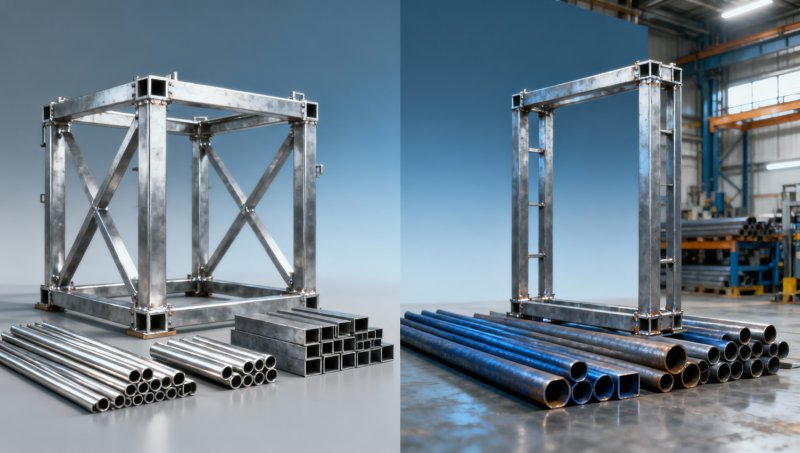
Many buyers compare these products because they appear similar in shape or function, but they solve different problems.
Compared with stainless steel square pipe:
2 tube carbon steel is usually more cost-effective for general frames. It is easier to justify when corrosion exposure is limited or when galvanizing, painting, or powder coating can provide adequate protection. Stainless steel square pipe is more suitable for food processing, marine exposure, chemical environments, or projects where appearance and corrosion resistance are critical long term.
Compared with seamless steel tube:
Seamless steel tube is typically chosen for pressure service, high-integrity mechanical applications, or cases where a seamless structure is required by design or code. For most frame applications, seamless tube is often unnecessary and adds cost without delivering proportional value. Welded structural tubing is generally the more practical option for frames.
Compared with Q235 steel in general:
Q235 is a material grade, not a section type. So the comparison is not really “2 tube steel versus Q235 steel.” More accurately, many 2-inch tubes are made from Q235 or equivalent grades. In frame selection, buyers should separate the questions of profile shape, material grade, and surface condition instead of treating them as the same thing.
For most standard frames, a carbon steel tube in a reliable grade such as Q235, A36, SS400, or S235JR is often the most sensible starting point. Then corrosion protection and wall thickness can be adjusted according to the project environment.
How do you judge load capacity and safety for a frame?
Load capacity cannot be judged safely by visual size alone. A 2-inch tube may be more than enough for one frame and totally inadequate for another. Engineers, fabricators, and quality teams should review at least the following:
- Maximum expected load and where it acts on the frame
- Required safety factor
- Length of unsupported members
- Bending direction and torsional effects
- Weld design and heat-affected areas
- Whether holes, slots, or notches reduce section strength
- Risk of buckling, excessive deflection, or fatigue cracking
For buyers without in-house engineering support, the practical approach is to request load-based recommendations from the manufacturer rather than buying by dimension only. This is especially important for lifting frames, moving equipment, outdoor supports, and frames subject to vibration or repeated loading.
Quality-conscious purchasers should also confirm compliance with relevant standards and ask for material certificates, dimensional tolerance control, and coating information where needed.
What about weldability, fabrication speed, and total cost?
One reason 2 tube steel is so widely used is that it is fabrication-friendly. It is generally easy to cut, weld, drill, and fixture, especially in common structural grades. That helps reduce production time and can lower total project cost even when raw material price is not the only factor.
In real purchasing decisions, total cost should include:
- Material cost per ton or per piece
- Fabrication labor
- Welding efficiency
- Surface treatment cost
- Scrap rate and dimensional consistency
- Transport and packing efficiency
- Lead time reliability
For many industrial and construction-related frames, carbon steel tube delivers a strong cost-performance ratio because it is available, versatile, and compatible with common fabrication processes. However, if the environment is highly corrosive, lifecycle cost may favor galvanized, coated, or stainless alternatives despite a higher initial price.
In some frame systems, open structural sections may also be worth considering. For example, when the application involves purlins, wall supports, brackets, or lightweight building components, C Beam Steel can be an efficient alternative or complement to tube sections. With available grades such as Q195, Q235, Q345, A36, SS400, and S235JR, and options including galvanized coated surfaces, perforation, bending, welding, punching, and custom lengths, this type of section is often used in steel structure buildings, lightweight roof trusses, and mechanical light industry manufacturing. In other words, if your “frame” is part of a broader support system, evaluating both tube and C-shaped sections may lead to a better overall design and sourcing outcome.
When should you avoid using 2 tube steel for frames?
Although it is a versatile material, it is not ideal for every application. You should be more cautious when:
- The frame faces severe corrosion and coating protection is uncertain
- The structure carries very heavy loads better suited to larger beams or thicker sections
- Pressure service or code requirements call for seamless tube
- The design includes strong cyclic loading and fatigue risk
- The section may trap moisture internally without proper drainage or sealing
- There is a need for higher structural efficiency in one principal loading direction, where another profile may perform better
In these cases, the decision should be based on engineering review, not habit or price alone. A low initial material cost can become expensive if it leads to overdeflection, rework, coating failure, or premature replacement.
What should buyers ask suppliers before placing an order?
To reduce sourcing risk, buyers and project managers should confirm the following points with suppliers:
- Exact section size and wall thickness
- Steel grade and equivalent international standard
- Manufacturing process and dimensional tolerance
- Surface condition: black, galvanized, or coated
- Weldability and suitability for the intended fabrication method
- Material test certificates and inspection documents
- Length options, cutting service, and custom processing support
- Packing method, shipment terms, and delivery time
This is where an experienced structural steel manufacturer can add real value. Stable quality, standard compliance, consistent lead times, and the ability to support customized processing often matter just as much as the base price, especially for international sourcing.
Final verdict: is 2 tube steel a good fit for frames?
Yes, 2 tube steel is often a very good fit for frames because it combines practical strength, good weldability, clean fabrication, and cost efficiency. For many indoor, general industrial, construction, and manufacturing applications, it is one of the most sensible frame materials available.
But the correct answer depends on the actual use case. Wall thickness, steel grade, load condition, connection design, and corrosion exposure determine whether it is merely acceptable or truly optimal. Buyers who evaluate those factors carefully will make better technical and commercial decisions than those who choose by size alone.
If you are comparing frame materials, the best approach is to define the load, environment, fabrication method, and service life requirement first. Once those are clear, it becomes much easier to judge whether 2 tube steel, stainless steel square pipe, seamless steel tube, or another structural section will deliver the best value.
Please give us a message


Please enter what you want to find