Choosing the right structural steel manufacturer can directly affect project quality, cost, and delivery. From understanding structural steel properties and structural steel connection requirements to comparing H-beam steel price and galvanized sheet thickness, buyers need reliable information and supply support. This guide explains how a trusted structural steel supplier helps global projects reduce risk, improve efficiency, and secure consistent product performance.
For engineers, purchasers, distributors, project managers, and quality teams, the manufacturer is not only a source of steel sections. It is also a technical partner that influences specification accuracy, fabrication feasibility, compliance, and delivery continuity. In cross-border sourcing, these factors become even more important because errors in grade, tolerance, or shipment timing can affect an entire construction schedule.
Hongteng Fengda, a structural steel manufacturer and exporter from China, supports global construction and industrial buyers with angle steel, channel steel, steel beams, cold formed steel profiles, and customized structural steel components. With production aligned to ASTM, EN, JIS, and GB standards, the company helps buyers balance cost control with quality assurance for projects across North America, Europe, the Middle East, and Southeast Asia.
Why the Manufacturer Matters in Structural Steel Sourcing
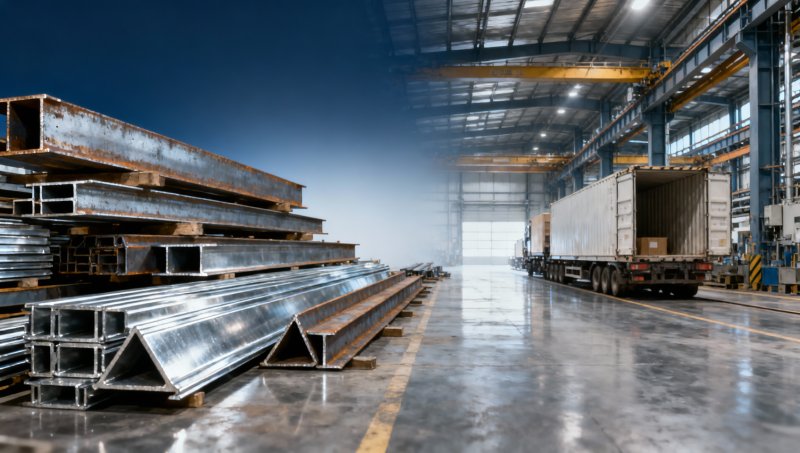
A structural steel manufacturer affects much more than the purchase price per ton. In most projects, steel procurement touches at least 4 core targets: load-bearing safety, fabrication compatibility, delivery schedule, and total installed cost. If any one of these is not controlled early, the result may be rework, welding adjustments, delayed assembly, or unplanned replacement orders.
For technical evaluators, material consistency is a major concern. Steel beams, channels, and angle sections must match the required grade, shape, and dimensional tolerance. A deviation of even ±1% can influence fit-up in pre-engineered structures, especially when components are combined with plates, bolted connections, and cold formed sections in modular or industrial frames.
For procurement teams, supply reliability is often the deciding factor. A low quoted price may seem attractive, but if lead time moves from 3 weeks to 7 weeks, project costs can rise quickly through labor idle time, site coordination loss, and shipping rescheduling. A capable exporter reduces this risk through stable production planning, inspection control, and clearer documentation.
For business decision-makers, the right supplier also improves long-term sourcing efficiency. Instead of buying from multiple traders for each product type, they can consolidate sourcing under one manufacturer that supports standard sections and OEM customization. This simplifies communication, quality approval, and claim handling over a 6-month to 24-month procurement cycle.
Core Value Areas Buyers Should Review
Before selecting a structural steel supplier, buyers should compare not only the catalog but also the support capability behind the product. The following table shows the main evaluation areas and their project impact.
The key takeaway is that price should be evaluated together with compliance, fabrication suitability, and delivery execution. In structural steel procurement, the cheapest quote is not always the lowest total project cost.
How a Trusted Supplier Reduces Technical and Commercial Risk
Structural steel projects typically involve 3 layers of risk: technical mismatch, commercial uncertainty, and logistics disruption. A professional manufacturer reduces technical mismatch by confirming grade, profile dimensions, tolerances, and surface treatment before production starts. This is especially important when a project includes a mix of hot rolled beams, channels, galvanized sections, and custom fabricated members.
Commercial risk often appears in hidden areas. Examples include unclear quotation scope, inconsistent packing, extra charges for secondary processing, or changing payment conditions. When the manufacturer provides clear terms such as 30% TT advance plus 70% balance or LC at sight, along with defined processing services and packing options, buyers can compare offers more accurately and avoid later disputes.
Logistics risk matters because structural steel is bulky, heavy, and schedule-sensitive. A delay of 10 to 14 days may interrupt crane booking, site preparation, or subcontractor sequencing. Manufacturers with export experience usually provide more dependable shipment planning, bundle marking, and document coordination for customs and destination handling.
Quality teams and safety managers also benefit from a supplier that understands inspection requirements. Mill certificates, dimensional checks, surface condition records, and standard references are not paperwork extras; they are part of practical risk control for bridges, workshops, warehouses, public facilities, and heavy-duty support systems.
Common Risk Points in Global Steel Purchasing
- Incorrect grade substitution, such as using a lower-strength material where a higher load requirement applies.
- Dimension inconsistency between ordered sections and connection drawings, leading to fit-up problems on site.
- Inadequate surface treatment for outdoor or humid environments, shortening service life.
- Poor export packing that causes deformation, corrosion, or identification confusion during transport.
- Lead time promises not backed by actual production capacity, especially for mixed orders or OEM items.
A Practical 5-Step Risk Control Process
- Confirm standards and grades before quotation.
- Review drawings, connection details, and section sizes.
- Lock in processing scope, tolerance, and surface treatment.
- Verify production and shipment schedule in writing.
- Check inspection documents before dispatch.
When these 5 steps are followed consistently, buyers reduce both procurement uncertainty and site installation problems. The manufacturer becomes part of project execution rather than only a price source.
Product Range and Mid-Project Material Integration
Many projects do not rely on a single steel item. A warehouse, industrial plant, bridge approach, or public infrastructure package may combine primary structural sections with reinforcement and processed auxiliary materials. That is why a structural steel manufacturer with broader supply capability can help simplify procurement planning and reduce coordination across multiple vendors.
In addition to angle steel, channel steel, steel beams, and cold formed profiles, some projects require rod-based materials for reinforcement, fabrication, or downstream conversion. For buyers managing foundations, slabs, columns, beams, culverts, tunnels, highways, and rail-related works, integrating such materials into the sourcing plan can save time in scheduling and inspection.
A relevant example is Wire rod, which is used in civil engineering construction and public facilities. Typical models include HRB335, HRB400, and HRB500, with common specifications from 6mm to 50mm and length options such as 5.8m, 6m, 9m, 12m, and 10m–12m. Available materials may include Q195, Q235, Q345, ASTM A53 GrA, GrB, ST37, ST52, STKM11, and 16Mn, depending on application and processing route.
From a supply-chain perspective, this kind of material support is useful when a buyer wants one partner to coordinate structural members and related steel products under aligned documentation, packing, and shipment planning. Processing services such as bending, welding, decoiling, cutting, and punching can also reduce downstream handling time in fabrication shops or project staging yards.
Typical Material Selection Factors for Mixed Steel Orders
The table below shows how buyers often compare steel products by use, specification range, and compliance needs in one project package.
The main advantage of integrated sourcing is better coordination. Instead of validating 3 to 5 suppliers separately, project teams can standardize reviews around one qualified manufacturing partner and focus on execution quality.
What Buyers Should Evaluate Before Placing an Order
A good purchasing decision combines engineering logic with commercial discipline. Technical teams usually focus on section properties, connection compatibility, and standard compliance. Procurement and finance teams look more closely at quote clarity, payment terms, packaging, and shipping milestones. Both sides need the same supplier information, but they read it from different angles.
One common mistake is to compare offers only by unit price. In structural steel, buyers should evaluate at least 6 factors together: grade, dimensional tolerance, processing scope, coating or surface treatment, packing method, and lead time. If one quotation excludes hole making, cutting, or galvanized finish, the apparent price advantage may disappear after downstream processing is added.
Another practical issue is specification alignment. For example, when buyers compare H-beam steel price, they should also check section weight, grade, and whether the offered beam follows the requested standard. The same principle applies to galvanized sheet thickness or cold formed steel profiles, where coating and tolerance directly affect service performance and fabrication quality.
For long-term buyers, supplier responsiveness matters as much as the product itself. Questions about drawings, substitutions, packing marks, or shipment updates often require replies within 24 to 48 hours. Delayed communication can be manageable in stock trading, but it becomes costly in project supply.
Buyer Checklist for Technical and Commercial Review
- Confirm the requested material standard, such as ASTM, EN, JIS, or GB, before production release.
- Check if tolerance is clearly stated, especially for critical fit-up parts and prefabricated assemblies.
- Verify whether the quote includes cutting, welding, punching, galvanizing, or custom packaging.
- Ask for expected production and shipment timing, such as 2–4 weeks for standard items or longer for customized lots.
- Review payment structure, document requirements, and claim procedure before confirming the order.
How Different Stakeholders Prioritize the Same Order
Different departments often judge the same supplier in different ways. The following table helps align internal decision-making before purchase approval.
When these review points are discussed early, companies avoid a frequent problem in steel purchasing: technical approval arrives after commercial commitment, which increases change costs and slows execution.
Delivery, Quality Control, and Long-Term Project Support
A structural steel manufacturer adds value after the order is placed, not only before it. The best results come when production, inspection, packing, and shipping are treated as one coordinated chain. For export projects, this chain is especially important because replacement cycles are longer and site teams may be working under fixed installation windows.
Quality control starts with material confirmation and continues through dimension checks, surface review, and packing verification. In many steel products, a practical control target includes correct section shape, acceptable tolerance, and visible surface condition suitable for the final environment. For coated items, buyers should also confirm whether galvanized, black, PVC, transparent oil, or anti-rust oil treatment matches storage and end-use conditions.
Delivery reliability also depends on communication discipline. For example, a project team may need weekly production updates over a 3-week to 5-week manufacturing period, followed by shipping confirmation and document release before vessel departure. This level of visibility helps project managers plan unloading, erection sequencing, and subcontractor mobilization more effectively.
After-sales support matters when the order includes mixed specifications or custom fabricated parts. Questions may arise around installation fit, quantity reconciliation, or replacement planning. A dependable manufacturer supports these issues with traceable records and practical follow-up instead of leaving the buyer to manage the problem alone.
FAQ for Global Structural Steel Buyers
How long does structural steel delivery usually take?
Standard sections often require about 2 to 4 weeks for production, while customized structural steel components may take 4 to 8 weeks depending on drawing complexity, processing steps, and order volume. Shipment time varies by destination, so buyers should confirm both production lead time and transit schedule.
What standards should buyers check first?
The first priority is alignment with the project specification, such as ASTM, EN, JIS, or GB. After that, buyers should verify grade, section dimensions, tolerance, and any surface treatment or processing requirements. Standard names alone are not enough if the detailed grade or size is not clearly matched.
How can purchasers reduce sourcing risk from overseas suppliers?
Use a structured review process: confirm technical specifications, request inspection documents, define processing scope, lock in delivery milestones, and clarify claim handling before payment release. It is also useful to consolidate multiple steel items with one capable manufacturer when possible to reduce coordination gaps.
Which projects benefit most from a manufacturer with customization capability?
Industrial buildings, infrastructure works, OEM fabrication programs, and modular construction projects benefit the most. These applications often involve non-standard hole positions, cut lengths, welded assemblies, or mixed product packages that are easier to manage through one manufacturing partner.
Choosing the right structural steel manufacturer is a practical decision that affects specification accuracy, installation efficiency, quality consistency, and commercial control. For buyers who need standard sections, customized components, and dependable export support, a manufacturer with stable capacity, clear standards alignment, and responsive service can reduce risk across the full project cycle.
Hongteng Fengda supports global customers with structural steel products, OEM solutions, and export-focused coordination for construction, industrial, and manufacturing applications. If you are comparing suppliers, planning a new project package, or reviewing technical and commercial requirements, contact us to get product details, discuss your specifications, and request a tailored steel supply solution.
Please give us a message


Please enter what you want to find