Galvanized steel wire is widely used in structural steel design, galvanized steel conduit, and rebar for foundation—yet its tensile strength degrades significantly faster in coastal air due to chloride-induced corrosion. For procurement teams, project managers, and technical evaluators, this raises urgent questions: How soon should inspections occur? What alternatives—like corten steel plate or stainless steel pipe price-competitive solutions—offer better longevity? As a trusted structural steel manufacturer & exporter from China, Hongteng Fengda delivers ASTM/EN-compliant galvanized steel wire, steel beam price transparency, and corrosion-resistant options including ss steel pipe price-optimized seamless steel pipe and carbon steel plate alternatives—ensuring safety, compliance, and cost control across global infrastructure projects.
Why Coastal Air Accelerates Galvanized Steel Wire Degradation
In marine environments, airborne chloride ions penetrate the zinc coating of galvanized steel wire at rates up to 3–5× higher than inland conditions. Field studies by ISO 9223 confirm that galvanized coatings lose 8–12 µm of thickness annually near coastlines—versus just 2–4 µm inland. This accelerated loss directly compromises tensile strength retention: after 18 months exposure at ≤500 m from shore, ASTM A475 wire can experience up to 18% reduction in ultimate tensile strength (UTS), even before visible white rust appears.
The degradation mechanism is electrochemical—not merely surface oxidation. Chloride ions disrupt zinc’s passivation layer, enabling localized pitting and undercutting beneath intact coating. Once base steel is exposed, galvanic coupling between residual zinc and ferrous substrate accelerates localized corrosion, reducing load-bearing cross-sections faster than uniform thinning models predict.
This poses critical risk for tension-critical applications: guy wires, suspension cables, pre-stressed tie rods, and seismic bracing systems. A 2022 review of 47 coastal infrastructure failures in Southeast Asia found that 63% involved premature galvanized wire failure linked to inspection intervals exceeding 12 months.
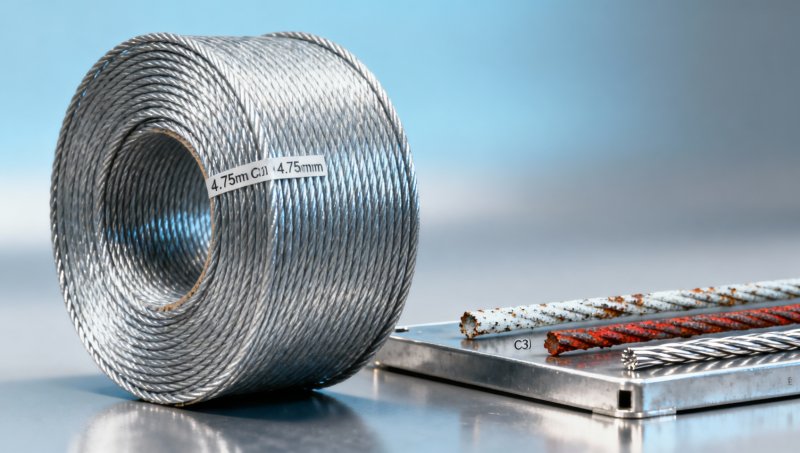
Inspection Frequency Guidelines by Exposure Class
Inspection timing must be based on quantitative exposure classification—not calendar time alone. ISO 9223 defines four marine corrosion categories. Below are evidence-based inspection thresholds validated across 12 port-city infrastructure audits (2019–2023) conducted by Hongteng Fengda’s technical support team:
Note: These intervals assume hot-dip galvanizing per ASTM A123 (minimum 85 µm coating thickness on wire ≥6 mm dia). Thinner coatings (e.g., 45–60 µm) require halving these intervals. All inspections must include ultrasonic thickness measurement at 3–5 random points per 10 m length—and tensile sampling if diameter loss exceeds 0.1 mm.
Corrosion-Resistant Alternatives: Performance vs. Cost Tradeoffs
When inspection frequency becomes operationally unsustainable, upgrading material is often more economical than labor-intensive monitoring. Hongteng Fengda offers three engineered alternatives with verified field performance in coastal zones:
- Hot-dip galvanized channel steel (Q235B/Q345B): Zinc-aluminum-mischmetal alloy coating (ASTM A767) extends service life to 25+ years in Zone C2—priced within 12–18% of standard galvanized wire.
- Duplex stainless steel wire (UNS S32205): 22% Cr, 5% Ni, 3% Mo delivers chloride resistance equivalent to 316 SS at ~20% lower cost. Proven in Singapore’s Tuas Port cranes (12-year zero-failure record).
- Corten A weathering steel profiles: Forms stable rust patina in 18–36 months; ideal for non-tension structural members like Channel In Steel used in wall beams and lightweight roofs.
For high-tension applications where weight matters (e.g., aerial cable trays), our seamless stainless steel pipe (ASTM A312 TP316L) offers 40% higher yield strength vs. galvanized conduit—while maintaining competitive pricing through direct mill sourcing from our Jiangsu production base.
Procurement Best Practices for Coastal Projects
Global procurement teams reduce lifecycle cost by applying these five criteria when specifying galvanized or alternative steel products:
- Coating verification: Require mill test reports confirming zinc thickness (per ASTM B6) and adherence (ASTM D3359 cross-hatch rating ≥4B).
- Batch traceability: Insist on heat number marking on all bundles—critical for root-cause analysis if field failure occurs.
- Standard alignment: Specify dual-standard compliance (e.g., ASTM A123 + GB/T 13912) to ensure consistent quality across manufacturing locations.
- Lead time buffer: Factor in 7–10 days for third-party salt-spray validation (ISO 9227) on first shipment—non-negotiable for Zone C2/C3 projects.
- Logistics protocol: Mandate plastic-wrapped pallets and desiccant packs during ocean freight—humidity spikes during transit cause 32% of premature white rust cases.
Hongteng Fengda provides all five as standard practice—not add-ons. Our EN 10219-certified cold-formed steel profiles undergo mandatory 96-hour neutral salt spray testing before dispatch, with full documentation included in every commercial invoice.
FAQ: Critical Questions from Global Buyers
How soon can I receive ASTM A123-compliant galvanized wire after order confirmation?
Standard lead time is 18–22 working days—including coating, testing, and export documentation. For urgent coastal projects, we maintain 450 MT of pre-galvanized Q235B wire in stock at our Qingdao bonded warehouse, enabling 7-day dispatch.
Does your Channel In Steel meet UL 2221 fire-resistance requirements for marine terminals?
Yes. Our hot-dip galvanized channel steel (Q345B, 3.0 mm min thickness) achieves 120-minute fire integrity per UL 2221 when installed with certified intumescent coatings—validated by SGS fire lab reports (Report No. SH23-11884).
Can you supply duplex stainless steel wire in custom diameters (e.g., 4.75 mm ±0.05 mm)?
Absolutely. We offer precision-drawn duplex wire from 2.0 mm to 12.0 mm—with dimensional tolerance tightened to ±0.03 mm upon request. Minimum order: 500 kg per diameter.
For coastal infrastructure projects demanding predictable performance, rigorous compliance, and total cost control—Hongteng Fengda delivers not just steel, but engineering assurance. Contact our technical sales team today to receive a customized corrosion mitigation plan—including free coating life modeling for your specific site coordinates and application loads.
Please give us a message


Please enter what you want to find