When evaluating galvanized sheet thickness, many buyers assume thicker always means better. In reality, once coating and base metal exceed project requirements, added thickness can raise costs, increase weight, and reduce overall sourcing efficiency without delivering proportional value. For decision-makers in construction and manufacturing, understanding where performance ends and overspecification begins is essential to balancing durability, compliance, and budget.
Why galvanized sheet thickness is becoming a sharper strategic question
In the steel industry, the discussion around galvanized sheet thickness has shifted. A few years ago, many procurement teams focused mainly on corrosion resistance and defaulted to thicker material as a safety margin. Today, cost pressure, transport efficiency, project scheduling, and stricter technical review have changed the conversation. Buyers are no longer asking only how thick a galvanized sheet should be; they are asking when additional thickness stops improving real-world performance.
This shift is especially visible in construction, equipment manufacturing, ducting, light structural applications, and fabricated components that must meet ASTM, EN, JIS, or GB-based requirements. In many of these sectors, the acceptable range may be narrow: for example, a base metal thickness difference of 0.10 mm to 0.30 mm or a zinc coating range of 60 g/m² to 275 g/m² can materially affect forming behavior, welding preparation, weight, and total delivered cost. That means decision-makers need more than a simple “thicker is better” rule.
Another change is that downstream users now compare lifecycle value more carefully. If a project only requires moderate atmospheric protection over 10 to 15 years in a low-corrosion environment, heavy galvanizing or excessive sheet thickness may offer little commercial return. On the other hand, infrastructure near coastal or industrial zones may justify thicker substrate or higher zinc coating. The key trend is not reduced demand for galvanized steel, but more precise demand for the right thickness in the right environment.
Signals buyers are watching more closely
Several signals explain why galvanized sheet thickness has become a boardroom topic rather than just a technical detail. Freight rates and container loading efficiency matter more when steel prices fluctuate. Fabricators also want material that runs smoothly through punching, bending, profiling, or roll forming lines with fewer adjustments. In many cases, moving from an overbuilt specification to a fit-for-purpose range can improve throughput across 2 to 4 production stages.
- Higher raw material sensitivity means every 0.1 mm of unnecessary thickness can accumulate into a meaningful annual cost increase.
- Projects with fixed load limits increasingly review dead weight, especially in modular, prefabricated, and transport-sensitive applications.
- International buyers are requesting tighter specification alignment instead of broad safety margins that hide inefficient sourcing.
- More technical reviews now separate base metal thickness from zinc coating mass, rather than treating them as one combined quality indicator.
For steel suppliers and exporters, this trend favors manufacturers that can provide stable production, consistent tolerances, and practical selection guidance. That is particularly relevant for companies like Hongteng Fengda, which serve global construction and industrial buyers who need compliant steel products, cost control, and dependable lead times rather than generic thickness recommendations.
What is driving the move away from automatic overspecification
The market is not rejecting heavy-duty galvanized material. Instead, it is becoming more selective about where extra thickness adds measurable value. Three forces are driving this change: project economics, technical optimization, and supply chain discipline. Together, they are encouraging a more evidence-based approach to galvanized sheet thickness.
First, project economics have tightened. In multi-ton purchases, a small increase in nominal thickness can translate into a significant material weight increase. Depending on coil width, length, and order volume, an extra 5% to 12% in steel weight may not deliver an equivalent 5% to 12% gain in service life. When multiplied across large tenders or recurring supply contracts, that mismatch directly affects margin, cash flow, and competitiveness.
Second, fabrication and assembly requirements are becoming more specific. Some applications benefit from a balanced design using optimized substrate thickness plus appropriate zinc coating rather than maximum values on both. Overly thick galvanized sheet can increase forming resistance, tool wear, and handling difficulty. In operations with repeated bending, cut-to-length processing, or automated assembly, that can create hidden costs over weeks or months of production.
A practical view of the trend
The following table shows how the market conversation around galvanized sheet thickness is evolving across common purchasing priorities.
This change does not mean buyers should reduce galvanized sheet thickness indiscriminately. It means they should separate required performance from assumed performance. In many steel procurement decisions, the better question is not “What is the maximum thickness available?” but “What thickness range protects the project without locking in avoidable cost or weight?”
The most common drivers behind thickness review
- Higher scrutiny on project budgets over 6-month to 18-month delivery cycles.
- Broader use of prefabrication, where transport weight and assembly speed affect profitability.
- Improved specification discipline from engineering, procurement, and quality teams.
- Greater awareness that zinc coating level and base steel thickness solve different problems.
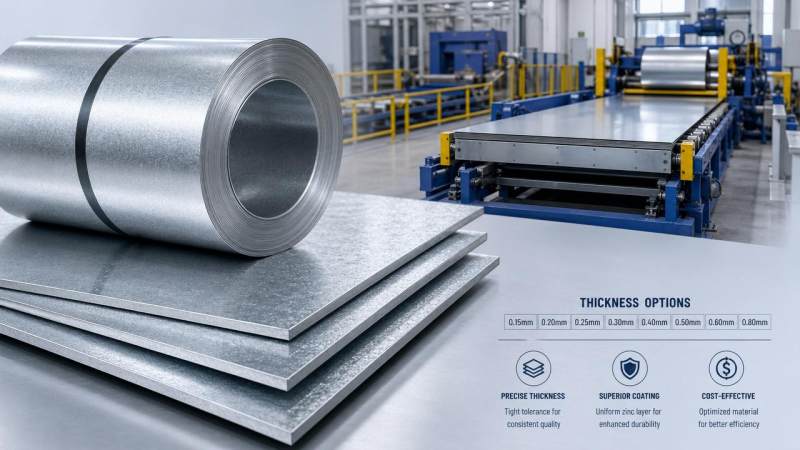
Where thicker still matters—and where it often stops adding value
For enterprise buyers, the important judgment is contextual. Galvanized sheet thickness remains essential in load-bearing systems, external cladding exposed to severe weather, agricultural structures with high moisture cycles, and industrial environments with chemical exposure. In these cases, both substrate thickness and coating mass may need to move upward together. However, in indoor enclosures, light fabrication, duct systems, appliance housings, and some OEM parts, excessive thickness may create more cost than benefit.
A useful rule is to review four variables at the same time: service environment, required design life, mechanical load, and downstream processing method. If only one of these variables is severe, it may not justify a major thickness increase. For example, a product may need moderate corrosion resistance but high formability. In that case, a balanced specification can outperform a heavier one that creates production inefficiencies.
Many procurement teams also overlook the distinction between coating thickness and sheet thickness. A galvanized sheet with a heavier zinc coating may perform better in a corrosive atmosphere than a thicker base sheet with a lower coating mass, depending on the application. That is why specification review should include both g/m² coating targets and dimensional tolerances, not just nominal steel thickness.
Application-based decision logic
The table below provides a practical comparison for business decision-makers evaluating galvanized sheet thickness by use case.
This comparison illustrates a larger market trend: value now comes from specification precision. In many projects, the highest-performing sourcing strategy is neither the thinnest nor the thickest option, but the thickness band that aligns with actual operating conditions, fabrication steps, and cost targets.
Decision checkpoints for procurement teams
- Confirm whether corrosion risk is atmospheric, chemical, intermittent moisture, or continuous outdoor exposure.
- Separate base metal thickness requirements from zinc coating requirements during technical review.
- Check whether higher thickness affects bending radius, punching accuracy, or weld preparation.
- Estimate transport and handling impact across full order volume, not only per sheet or per coil.
These checkpoints often reveal where galvanized sheet thickness is solving a real engineering problem and where it is simply carrying legacy assumptions from older specifications.
How adjacent galvanized steel products reflect the same market direction
The same selection logic can be seen beyond sheet products. Across the steel supply chain, buyers are increasingly choosing galvanized materials based on application-specific mechanical performance, coating range, and process efficiency rather than broad overdesign. This is relevant for wire, profiles, beams, channels, and cold formed components as much as for sheet.
A useful example is Premium Galvanized Cold Drawn Steel Wire Rod (1.6mm - 6mm). In practical sourcing, buyers do not simply request the largest diameter or heaviest zinc coating available. They typically match diameter ranges such as 1.6 mm, 2.0 mm, 3.0 mm, 4.0 mm, or 6.0 mm to the end use, whether that is construction, agriculture, fasteners, household goods, or telecommunications. The same applies to tensile strength, which may range from 350 MPa to 900 MPa depending on temper.
This product logic mirrors the broader galvanized sheet thickness trend. A customizable zinc coating of 40 g/m² to 300 g/m², soft or hard temper options, precision dimensional tolerance, and surface consistency all matter because modern buyers want fit-for-purpose performance. In other words, the market is rewarding accurate selection, not automatic excess. That is a meaningful signal for decision-makers building long-term sourcing strategies across multiple galvanized steel categories.
What this means for steel sourcing strategy
For structural steel manufacturers and exporters, the implication is clear: the ability to customize specifications and maintain stable quality is becoming more valuable than offering a one-directional “heavier is stronger” sales argument. Buyers want product options that are technically matched to project needs, supported by mill test documentation, and delivered with consistent production planning.
Hongteng Fengda operates in exactly this environment. As a China-based structural steel manufacturer and exporter supplying angle steel, channel steel, steel beams, cold formed steel profiles, and customized steel components, the company serves buyers who need compliance with standards such as ASTM, EN, JIS, and GB while keeping sourcing risk under control. In a market where galvanized sheet thickness and related product specifications are being reviewed more carefully, dependable manufacturing discipline has become a competitive advantage.
This matters even more when projects span North America, Europe, the Middle East, or Southeast Asia, where local environmental conditions and project standards can differ. The best sourcing partner is not the one that pushes the thickest material across every application, but the one that helps buyers identify a balanced specification with reliable delivery over 3-week to 8-week planning windows, depending on product type and customization level.
What decision-makers should review now before locking in galvanized sheet thickness
If galvanized sheet thickness is being specified for a new project, re-bid package, or annual procurement contract, business leaders should treat it as a commercial and technical review point. The objective is not simply to lower thickness, but to confirm whether the current specification still reflects actual risk, actual performance needs, and current cost conditions.
In many organizations, the original specification may have been copied across multiple tenders without adjustment. Over time, this can produce overengineering. A useful review cycle is every 12 months or at each major project phase, especially if the application environment, fabrication route, or export destination has changed. Even a modest specification optimization can improve budget efficiency without weakening compliance.
The most effective reviews are cross-functional. Engineering can confirm structural or durability thresholds, procurement can evaluate supplier consistency and cost impact, and operations can assess forming or installation performance. When these functions review galvanized sheet thickness together, the result is usually more accurate than a single-department decision.
A focused checklist for thickness evaluation
- Define the real service life target in years rather than using a vague durability label.
- Confirm whether load, corrosion, impact, and fabrication all require the same thickness direction.
- Review whether coating mass, substrate thickness, and tolerance are all specified clearly in purchase documents.
- Check if reducing unnecessary thickness could improve shipping efficiency or installation handling.
- Ask suppliers for practical recommendation ranges instead of only quoting a single heavy option.
Key review outcomes to compare
Before final approval, many buyers find it useful to compare two or three specification paths side by side. The table below shows a simple decision framework.
For most enterprise projects, the second path is where the market is moving. It aligns technical compliance with procurement efficiency and supports better long-term sourcing discipline.
Why choosing the right steel partner matters more as specifications become more precise
As the market becomes more disciplined about galvanized sheet thickness, the value of a capable steel supplier increases. Buyers need more than product availability. They need a partner that understands how thickness, coating, tolerances, application conditions, and delivery planning interact. This is especially important in international trade, where mistakes in specification can affect compliance, fabrication schedules, and landed cost at the same time.
Hongteng Fengda supports this kind of decision-making through stable manufacturing capacity, strict quality control, and customized structural steel solutions for global construction, industrial, and manufacturing projects. Whether the requirement involves angle steel, channel steel, beams, cold formed steel profiles, or related galvanized products, the practical goal is the same: provide material that meets project needs without pushing unnecessary weight, cost, or sourcing risk into the order.
If your team is reviewing galvanized sheet thickness, this is a good time to confirm several points before procurement is finalized: required thickness range, zinc coating target, applicable standard, expected service environment, fabrication method, delivery schedule, and documentation needs. These factors are where real savings and real risk control are usually found.
Contact us for practical specification support
If you want to determine whether your current galvanized sheet thickness is creating value or simply adding cost, we can help you review the specification in a practical way. You can contact us to discuss parameter confirmation, product selection, coating range, compliance with ASTM, EN, JIS, or GB references, delivery lead time, OEM customization, mill test report expectations, sample support, and quotation planning.
For buyers comparing multiple galvanized steel options, we can also support broader sourcing discussions across structural steel sections, cold formed profiles, and application-matched galvanized products. The objective is straightforward: help your business choose the right specification for the right project, with dependable manufacturing and export coordination from China.
Why choose us: we focus on reliable steel products, controlled production quality, customized solutions, and stable export service for global buyers. If you are evaluating galvanized sheet thickness for cost, durability, or compliance reasons, contact us with your drawings, target standards, thickness range, coating expectations, and project timeline to start a more accurate quotation and selection process.
Please give us a message


Please enter what you want to find