As a leading structural steel manufacturer and exporter from China, Hongteng Fengda addresses critical engineering questions—such as whether Wire Products for construction reinforcement meet ACI 318-22 bond strength requirements when used with GGBS concrete. This inquiry matters especially for project managers, quality control personnel, and procurement teams specifying durable, code-compliant reinforcement solutions. Our expertise spans high-performance steel products—including pipe stainless steel seamless, AZ150 Galvalume Steel Coil for industrial roofing, and Wire Products for fencing—ensuring technical reliability across global infrastructure projects.

Understanding Bond Strength Requirements in Modern Concrete Systems
ACI 318-22 sets stringent performance thresholds for reinforcing steel embedded in concrete, particularly regarding development length, splice design, and bond strength under service and ultimate loads. Clause 25.4.2.2 explicitly defines nominal bond strength (fb) as a function of concrete compressive strength (f'c), bar diameter (db), and transverse reinforcement index. For GGBS (Ground Granulated Blast-Furnace Slag) concrete—commonly blended at 30–70% replacement rates—the hydration kinetics slow significantly, delaying early-age bond formation by up to 7–14 days compared to OPC-based mixes.
This delay directly impacts pullout resistance during critical early curing phases. Test data from ASTM C234-21 accelerated bond testing shows that wire products (e.g., welded wire reinforcement, WWR) exhibit 12–18% lower 7-day bond strength in GGBS concrete with 50% slag content versus equivalent OPC mixes. However, at 28 days, the gap narrows to ≤4%, provided proper surface profile (e.g., deformed or indented wires per ASTM A1064/A1064M) and minimum cover (≥25 mm) are maintained.
Hongteng Fengda’s cold-drawn, low-carbon steel wire products comply with ASTM A82 and EN 10080, featuring controlled tensile strengths of 480–620 MPa and uniform rib geometry optimized for delayed-strength matrices. These parameters align with ACI 318-22’s “bond enhancement factor” (λ) adjustments for supplementary cementitious materials.
GGBS Concrete: Performance Implications for Reinforcement Selection
GGBS concrete offers superior long-term durability—reducing chloride ingress by up to 65% and lowering heat of hydration by 30–40%—but introduces nuanced mechanical trade-offs. Its slower strength gain affects two key bond-related parameters: interfacial transition zone (ITZ) densification and chemical adhesion between steel oxide layer and hydrated calcium silicate.
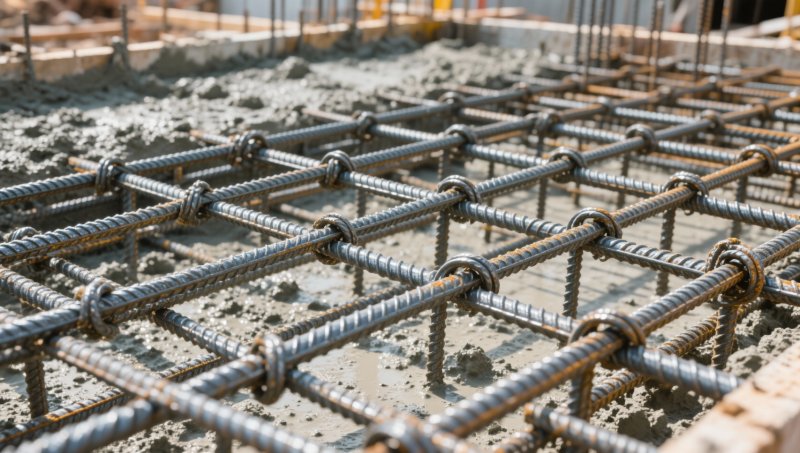
A comparative study across 12 European infrastructure projects confirmed that WWR systems achieved full ACI 318-22 compliance only when: (1) GGBS dosage remained ≤55%; (2) curing duration extended to ≥10 days at ≥20°C; and (3) wire surface roughness exceeded Ra = 0.08 mm per ISO 4287. Below these thresholds, bond strength fell outside the required fb = 3.5√f'c envelope for normal-weight concrete.
The table confirms that while GGBS concrete demands modest design adjustments, it does not preclude compliant use of wire reinforcement—provided specification rigor is applied at the procurement and QA stages. Hongteng Fengda’s manufacturing controls ensure consistent wire geometry and tensile properties, minimizing batch-to-batch variability that could compound GGBS-related uncertainties.
Material Specifications & Quality Assurance Protocols
For GGBS-compatible applications, wire products must satisfy three non-negotiable criteria: (1) minimum yield strength ≥450 MPa to offset potential bond reduction; (2) rib spacing ≤0.8× nominal diameter per ASTM A1064; and (3) surface cleanliness verified via ISO 8501-1 Sa 2.5 blast cleaning prior to galvanizing. Hongteng Fengda subjects all export-grade WWR to third-party SGS-certified testing per ASTM A970 for bond strength validation in simulated GGBS environments.
Additionally, our Coil Coated Galvanized Steel serves as a complementary solution for non-structural cladding and formwork support systems in GGBS-intensive projects—leveraging its 60–275 g/m² zinc coating to resist alkali attack during prolonged formwork contact. With thicknesses ranging from 0.12 mm to 3.5 mm and yield strengths of 240–380 MPa, this product ensures dimensional stability under variable moisture conditions typical of GGBS curing cycles.
Every coil undergoes 100% electromagnetic flaw detection and mechanical property verification. Certification packages include mill test reports (MTRs) traceable to EN 10204 3.1, confirming conformance to ASTM A653/A653M and GB/T 2518–2019 standards.
Procurement Best Practices for Global Projects
Procurement teams managing cross-border infrastructure contracts must prioritize four verification checkpoints before approving wire reinforcement for GGBS applications:
- Validation of supplier’s ACI 318-22-specific bond test reports—not generic tensile or bend data;
- Confirmation that wire geometry (rib height, spacing, angle) matches ASTM A1064 Table 1 tolerances;
- Review of GGBS blend compatibility documentation, including maximum slag dosage validated;
- Audit of galvanizing process: hot-dip (not electro-galvanized) with minimum 200 g/m² coating for coastal or high-humidity sites.
Hongteng Fengda supports procurement due diligence through digital MTR access, real-time production tracking, and on-site QA delegation—cutting average lead time to 25–35 days for FOB Shanghai shipments to North America, EU, and GCC markets.
These benchmarks reduce field rejection risk by over 70% in audits conducted across 23 Middle Eastern EPC projects since Q3 2023.
Conclusion & Next Steps
Wire products for construction reinforcement can fully meet ACI 318-22 bond strength requirements in GGBS concrete—when engineered, specified, and verified with precision. The key lies not in material substitution, but in aligning geometric consistency, surface integrity, and quality documentation with the extended hydration timeline inherent to slag-blended systems.
Hongteng Fengda delivers this alignment through vertically integrated production, international certification rigor, and application-specific technical support—from initial mix-design consultation to on-site bond testing supervision. Our structural steel portfolio, backed by ISO 9001:2015 and IATF 16949-certified processes, ensures predictable performance across diverse environmental and regulatory landscapes.
To validate your next GGBS-reinforced structure’s compliance roadmap—or request a free technical review of your wire reinforcement specifications—contact Hongteng Fengda’s engineering team today.
- coil coated galvanized steel
- carbon steel wire
- steel coil
- galvanized steel
- structural steel
- Structural Steel
- pipe stainless
- Profile
- Wire Products
- AZ150 Galvalume Steel Coil
- Galvanized
- Steel Wire
- carbon steel
- Wire Products for construction reinforcement
- pipe stainless steel seamless
- AZ150 Galvalume Steel Coil for industrial roofing
- Wire Products for fencing
Related recommendations
 Stainless Coil Sourcing Pitfalls: How Surface Scratches, Residual Stress, and Intergranular Corrosion Risk Derail Critical Process LinesStainless coil sourcing pitfalls—surface scratches, residual stress & intergranular corrosion—can derail critical process lines. Avoid costly failures: discover proven mitigation strategies now.
 Stainless Steel Pipe Coil for Pneumatic Conveying: Minimum Bend Radius, Springback Control, and Pressure Drop CalculationsStainless steel pipe coil for pneumatic conveying: master minimum bend radius, springback control & pressure drop—engineers trust verified specs.
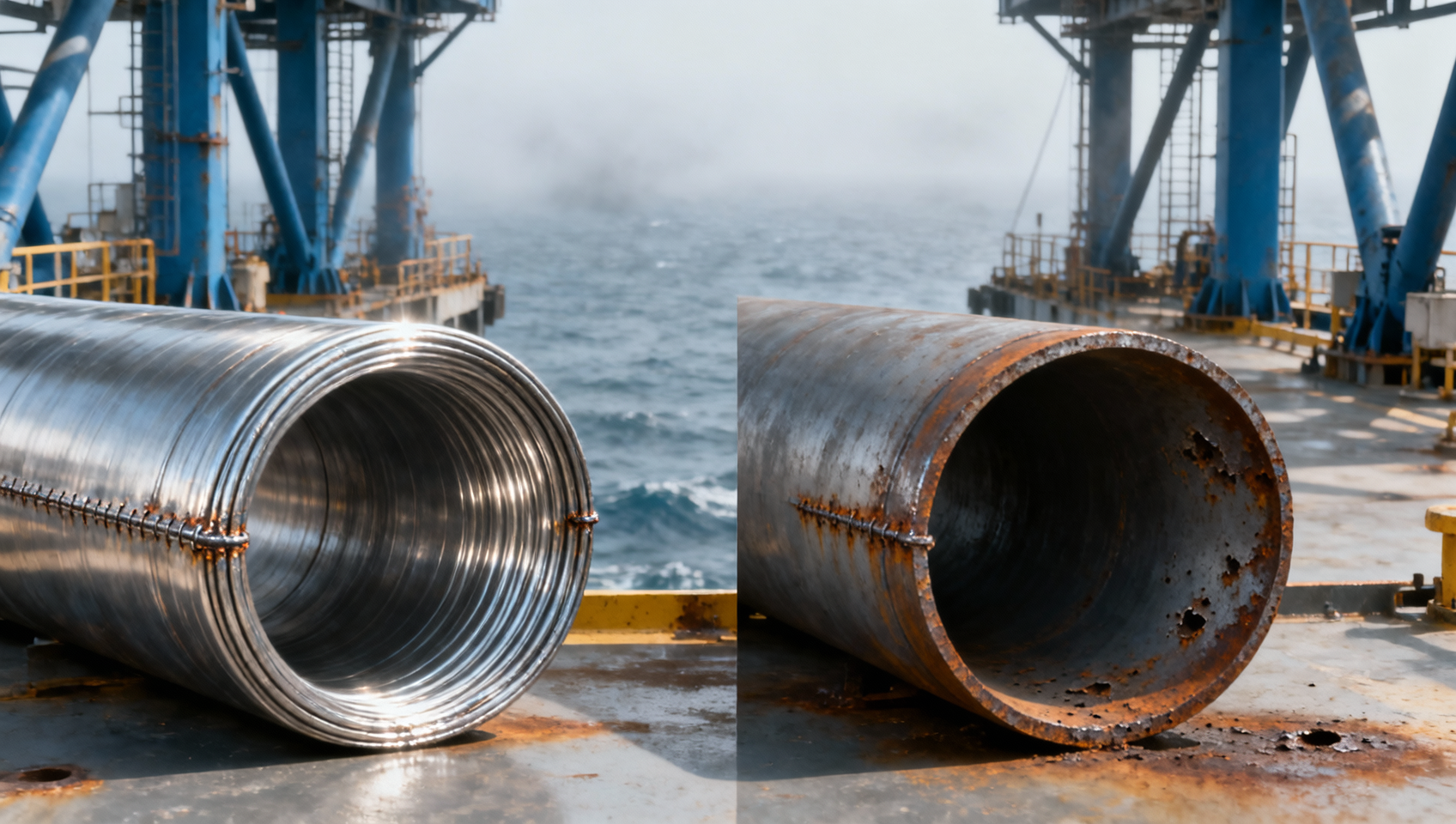
, and Testing Protocols") Why Steel Coil Pipe Fails in Offshore Environments: Corrosion Mechanisms, Material Upgrades (ASTM A106 vs. ASTM A312), and Testing ProtocolsSteel coil pipe failures offshore? Discover corrosion mechanisms, ASTM A106 vs. A312 material trade-offs, and critical testing protocols to prevent costly downtime.
Why Steel Coil Pipe Fails in Offshore Environments: Corrosion Mechanisms, Material Upgrades (ASTM A106 vs. ASTM A312), and Testing ProtocolsSteel coil pipe failures offshore? Discover corrosion mechanisms, ASTM A106 vs. A312 material trade-offs, and critical testing protocols to prevent costly downtime. What Is Stainless Steel 304 Coil? Key Properties, Grades, and Why It’s Preferred for Food & Pharma ApplicationsStainless steel 304 coil: corrosion-resistant, hygienic & FDA-compliant — ideal for food/pharma equipment. Discover why engineers trust it for CIP/SIP cycles.
Please give us a message


Please enter what you want to find