In any structural project, understanding the angle vs channel steel weight comparison is more than a technical detail—it directly affects load capacity, material cost, fabrication efficiency, and transport planning.
For steel selection, weight influences section performance, handling methods, welding time, and shipping budgets. A small difference per meter can become significant across large-volume orders.
This is why the angle vs channel steel weight comparison remains important in construction, machinery, infrastructure, and export sourcing.
Basic section definitions and why weight differs
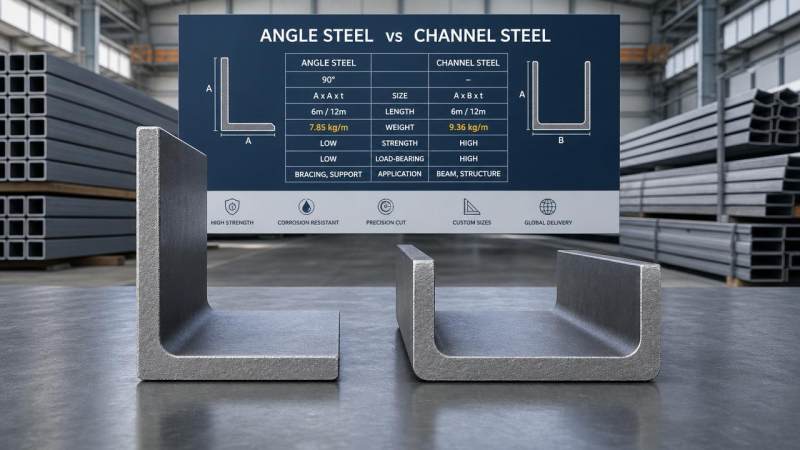
Angle steel is an L-shaped section. It usually has two legs, equal or unequal, joined at a right angle.
Channel steel is a C-shaped or U-shaped section. It includes a web and two flanges, creating a deeper structural profile.
The angle vs channel steel weight comparison starts with geometry. Section shape determines cross-sectional area, and area directly affects theoretical weight per meter.
Channel sections often weigh more than angle sections of similar nominal size. They contain more steel in the web and flange arrangement.
However, this is not always true. A heavy-duty angle can outweigh a light channel if thickness and dimensions differ.
Weight should never be judged by shape name alone. Actual dimensions, thickness, standard, and tolerance define real mass.
Key factors behind weight variation
- Leg size or flange width
- Web depth
- Section thickness
- Rolling standard
- Length requirement
- Density assumptions in calculation
In practice, the angle vs channel steel weight comparison should use certified mill data, not rough visual estimates.
Industry context behind the growing focus on section weight
Weight has become a stronger decision factor because project budgets are tighter, freight costs fluctuate, and installation efficiency matters more than before.
For exported structural steel, section weight affects container loading, port handling, customs declarations, and total landed cost.
This wider context explains why the angle vs channel steel weight comparison is now part of both engineering review and sourcing evaluation.
Reliable suppliers usually support buyers with section tables, tolerance guidance, and compliance with ASTM, EN, JIS, or GB standards.
Hongteng Fengda, as a structural steel manufacturer and exporter from China, supplies angle steel, channel steel, beams, cold formed profiles, and custom components for global projects.
With modern production facilities and strict quality control, stable specifications help reduce sourcing risk when section weight is critical.
How angle and channel steel weight affects practical project value
The angle vs channel steel weight comparison matters because weight is connected to more than raw material quantity.
1. Structural efficiency
A heavier section may provide stronger load performance, but only when its geometry matches the structural demand.
Channel steel often offers better bending resistance in one direction. Angle steel can work well in bracing, frames, and connection members.
2. Fabrication and welding
Heavier sections usually require more cutting energy, welding input, and handling support. This increases shop time and may affect delivery schedules.
3. Transport and handling
The angle vs channel steel weight comparison also changes loading plans. Per-bundle weight affects crane use, forklift limits, and truck utilization.
4. Total procurement cost
Lower unit weight may reduce material spending, but a lighter section is not always the economical solution if reinforcement is needed elsewhere.
Mid-project selection often includes complementary materials. For anti-slip working platforms or equipment surroundings, 235JR Patterned steel plate can be integrated with structural sections.
This product supports transportation, construction, decoration, machinery, shipbuilding, and floor areas around equipment.
Typical specifications include thickness from 2mm to 8mm, width from 600mm to 1800mm, and length from 2m to 12m.
Its patterned surface improves anti-skid performance while maintaining good bending resistance and practical steel-saving value in selected applications.
Typical application scenarios for angle and channel steel
The angle vs channel steel weight comparison becomes more useful when linked to actual use conditions.
Angle steel is often efficient for connections, braces, towers, and compact framing where simpler geometry helps assembly.
Channel steel is frequently selected for rails, supports, machine frames, trailers, and structural members needing directional stiffness.
Therefore, the angle vs channel steel weight comparison should be tied to span, orientation, connection detail, and service load.
Practical methods for comparing section weight accurately
A reliable comparison starts with standard section tables. Do not compare only by height or flange size.
Useful checking steps
- Confirm the exact grade and standard.
- Check section dimensions and thickness.
- Review theoretical weight per meter.
- Include tolerance and coating effects if needed.
- Estimate total project tonnage by actual cut length.
- Compare freight and fabrication costs, not steel weight alone.
This method makes the angle vs channel steel weight comparison more useful for both technical review and cost planning.
It also prevents underestimating hidden costs such as extra welding, added bracing, more difficult packing, or reduced installation speed.
Common mistakes to avoid
- Assuming the lighter section is always better
- Ignoring section orientation and bending direction
- Comparing unequal standards without conversion
- Using nominal size instead of actual mass data
- Overlooking shipment weight limits
Selection guidance for better steel sourcing decisions
The best choice is rarely based on one parameter. The angle vs channel steel weight comparison should support a broader selection process.
Review structural purpose first, then compare weight, stiffness, fabrication complexity, and total logistics impact.
When custom dimensions or export delivery are involved, stable production capacity and quality consistency become especially important.
A qualified structural steel partner can provide standard compliance, OEM support, clear weight data, and dependable lead times across global markets.
In summary, the angle vs channel steel weight comparison matters because it directly shapes structural efficiency, fabrication effort, transport planning, and final project cost.
For the next step, prepare exact section requirements, target standards, and application details, then compare certified weight data before procurement or production begins.
Please give us a message


Please enter what you want to find