In real construction and industrial projects, understanding angle steel vs channel steel differences is essential for making the right structural choice. Although both are widely used, their load behavior, installation methods, and cost efficiency can vary significantly depending on the application. For project managers and engineering leaders, selecting the proper steel profile can directly affect project safety, fabrication speed, and overall budget control.
For buyers managing industrial buildings, equipment platforms, support frames, racks, and infrastructure packages, the decision is rarely just about section shape. It usually involves 4 linked factors: load path, fabrication complexity, site installation speed, and total delivered cost. A profile that looks cheaper per ton may still raise welding hours, connection difficulty, or reinforcement requirements.
This article explains the practical differences between angle steel and channel steel from a project execution perspective. It focuses on real selection logic, common use cases, risk points, and procurement advice relevant to B2B construction and manufacturing teams sourcing structural steel internationally.
How Angle Steel and Channel Steel Differ in Structural Behavior
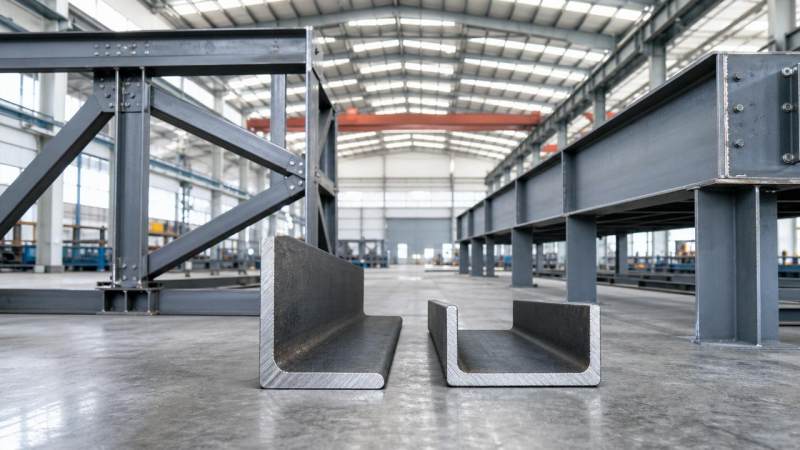
At a basic level, angle steel has an L-shaped cross-section, while channel steel has a U-shaped or C-shaped section. That geometric difference directly changes stiffness, connection options, and how each profile performs under bending, compression, and eccentric loading.
In many real projects, angle steel is preferred for bracing, secondary framing, tower members, edge reinforcements, and light-duty supports. Channel steel is more commonly selected for purlin-like members, machine frames, platform beams, trailer structures, and support systems that need stronger bending resistance in one principal direction.
Load Distribution and Section Efficiency
One key point in angle steel vs channel steel differences is section efficiency. A channel section generally provides better bending performance than an equal-mass angle section when the load is aligned with its stronger axis. In practical terms, this can reduce deflection across spans of 2 m to 6 m in light and medium structural applications.
Angle steel, however, can be highly efficient in truss systems and bracing members where axial force is the main design driver. For tension bracing, single angles and double angles remain widely used because they are easy to source, cut, drill, and connect with gusset plates.
Typical Mechanical Selection Logic
- Choose angle steel when the member mainly carries tension or light compression.
- Choose channel steel when one-direction bending stiffness is more important.
- Use engineering checks for torsion if the section is loaded eccentrically.
- Review local buckling risk for thin sections, especially in cold formed applications.
The table below compares the two profiles in project-relevant terms rather than purely theoretical definitions. This helps project managers align material choice with fabrication and site realities.
The practical takeaway is simple: angle steel often wins on simplicity and versatility in secondary structures, while channel steel often wins where span stiffness and directional strength matter. The correct choice depends on force type, connection detail, and how the member will actually be installed.
Fabrication and Site Installation Differences
From a project execution viewpoint, angle steel can reduce processing time in small and repetitive components. In many workshops, cutting, punching, and tack assembly of angle sections can be completed in 3 to 5 steps with standard jigs. This is useful for ladder frames, brackets, small supports, and modular assemblies.
Channel steel may require more attention during fit-up because the open section can twist under certain handling conditions, especially in longer lengths such as 6 m to 12 m. However, for support frames and beam-like members, its geometry can simplify alignment and reduce the number of reinforcement plates needed.
Selection by Real Project Application and Cost Control
When reviewing angle steel vs channel steel differences in procurement meetings, project teams should avoid comparing only unit price per metric ton. The better method is to compare total installed cost, which includes material utilization, processing time, connection accessories, transport efficiency, and on-site labor hours.
For example, a lighter angle steel solution may still require 15% to 30% more connection pieces in a complex bracing layout. On the other hand, a channel steel member may reduce deflection-related modifications and field corrections, which can save both schedule and rework cost during erection.
Best-Fit Use Cases for Project Managers
The most effective selection process is to map the profile to the application type. In industrial and construction sourcing, that usually means separating primary load members from secondary support members, then checking whether the section must resist bending, axial load, torsion, or combined actions.
The following table summarizes common scenarios and which section is usually more suitable under standard project conditions. Final design should still be verified according to drawings, codes, and actual loading assumptions.
For project control teams, this comparison helps shorten the early evaluation cycle. Instead of debating only section shape, teams can focus on the 3 most important questions: what load dominates, how the member will connect, and how much field adjustment is acceptable.
Procurement Risks That Often Cause Delays
Several sourcing mistakes appear repeatedly in overseas steel projects. The first is buying by nominal size only, without confirming standard type such as ASTM, EN, JIS, or GB. A 100 mm section from one standard may differ in thickness, radius, and mass from another, which affects connection hole positions and shop drawings.
The second risk is ignoring straightness, twist, and length tolerance. For pre-engineered structures or OEM assemblies, even a tolerance variation of a few millimeters can slow down fit-up. For repeated frame modules, project teams should confirm acceptable tolerance ranges before production starts, not after the first shipment arrives.
The third risk is underestimating coating or surface treatment requirements. Galvanized, primer-coated, or black steel options can change lead time by 7 to 15 days depending on quantity and finishing route. If the steel is for outdoor infrastructure or corrosive environments, surface protection should be part of the first RFQ, not an afterthought.
A 6-Point Review Before Ordering
- Confirm applicable standard and grade.
- Check section dimensions, tolerance, and sectional weight.
- Define cut lengths, hole patterns, and fabrication scope.
- Align coating, packing, and corrosion requirements.
- Verify production lead time, usually 2 to 6 weeks by order complexity.
- Request inspection documents for chemistry, mechanical properties, and dimensional checks.
Mid-Project Material Coordination Beyond Structural Shapes
In many industrial packages, project managers do not source only structural profiles. They also need plate products for cladding details, fabricated covers, equipment guards, decorative panels, or stainless components exposed to hygiene or corrosion-sensitive conditions. This is where coordinated supply can reduce supplier fragmentation.
For example, when a project combines carbon structural members with stainless sheet applications, a product such as 201 Stainless Steel Plate can be useful for architectural decoration, kitchen-related equipment, urban infrastructure, transport components, and industrial hardware where formability and surface finish matter.
Type 201 stainless steel typically offers tensile strength of at least 520 MPa, yield strength of at least 275 MPa, elongation around 55% to 60%, hardness up to 183 HB, and density near 7.8 g/cm³. Available thickness can range from 0.3 mm to 200 mm, with common lengths such as 2000 mm, 3000 mm, 6000 mm, and 12000 mm.
For teams handling mixed-material procurement, this matters because one qualified supplier can support both structural steel sections and stainless-based accessories under recognized standards including ASTM, AISI, JIS, GB, DIN, EN, ISO, SGS, and BV-related inspection expectations. That reduces communication gaps across purchasing, engineering, and logistics.
How to Make the Right Choice in International Steel Sourcing
The best answer to angle steel vs channel steel differences is not universal. It depends on the project’s force conditions, fabrication route, quality control level, and delivery schedule. For international buyers, the supplier’s ability to provide standard sections, custom cutting, OEM fabrication, and reliable documentation is often just as important as the profile choice itself.
A qualified structural steel manufacturer should support at least 3 decision stages: technical confirmation before order, dimensional and quality control during production, and packing plus shipping coordination before dispatch. Missing any one of these stages can create delays that cost more than the original material difference.
What Project Managers Should Ask Suppliers
Before placing an order, ask for the section standard, available size range, production capacity, and whether customization includes drilling, welding, marking, or coating. Also confirm if the supplier can support mixed orders of angle steel, channel steel, beams, cold formed profiles, and fabricated components in one shipment.
For projects across North America, Europe, the Middle East, and Southeast Asia, compliance with ASTM, EN, JIS, and GB is often critical. The supplier should be able to map the requested standard to actual production and inspection practice, not just mention the standard name in a quotation.
Practical Supplier Evaluation Criteria
- Can the supplier maintain stable lead times for both standard and customized orders?
- Do they provide dimensional inspection and material traceability documents?
- Can they handle OEM processing with consistent tolerances across batch quantities?
- Do they understand export packing, port handling, and shipment protection?
Hongteng Fengda focuses on structural steel manufacturing and export from China, supplying angle steel, channel steel, steel beams, cold formed profiles, and customized structural components for global construction and industrial projects. With modern production facilities and strict quality control, the company supports buyers who need dependable quality, stable capacity, and reduced sourcing risk.
If your team is comparing section options for a current project, the right decision should combine engineering suitability with procurement practicality. Angle steel may be the better answer for lightweight bracing and connection-friendly assemblies. Channel steel may be the better answer for supports, frames, and beam-like members where directional stiffness drives performance.
For project managers and engineering leaders, the most efficient path is to review application, load behavior, tolerances, finish requirements, and lead time together before finalizing the order. If you need a customized structural steel solution, product details, or sourcing support for global delivery, contact Hongteng Fengda to get a tailored quotation and discuss the right profile for your project.
Please give us a message


Please enter what you want to find