For project managers under pressure to shorten schedules without sacrificing quality, prefabricated structural steel offers real, measurable advantages. From faster installation and reduced on-site labor to more predictable delivery and quality control, it helps keep complex construction and industrial projects on track. Understanding where these time savings truly come from is key to making smarter sourcing and planning decisions.
What does prefabricated structural steel actually mean in project delivery?
In practical terms, prefabricated structural steel means steel members are cut, drilled, welded, marked, and in many cases trial-fitted in a controlled factory environment before they reach the jobsite. For project managers, this shifts a large share of work from variable site conditions to a planned production workflow. Instead of processing raw sections on site, the site team receives components that are already prepared for assembly.
This matters because time loss in construction rarely comes from one dramatic delay. It usually comes from hundreds of small interruptions: waiting for drawings, correcting dimensions, reworking holes, managing weather disruptions, or coordinating multiple subcontractors in a narrow installation window. Prefabricated structural steel reduces those friction points by moving labor-intensive operations upstream, often 2 to 6 weeks before erection begins.
For industrial plants, warehouses, logistics centers, mezzanines, equipment platforms, and commercial frames, prefabricated structural steel is especially useful because repeated geometry and connection logic create a predictable installation sequence. That predictability is what project leaders value most. Faster crane cycles, fewer field modifications, and clearer material identification can save days on smaller builds and several weeks on larger programs.
How is it different from conventional steel supply?
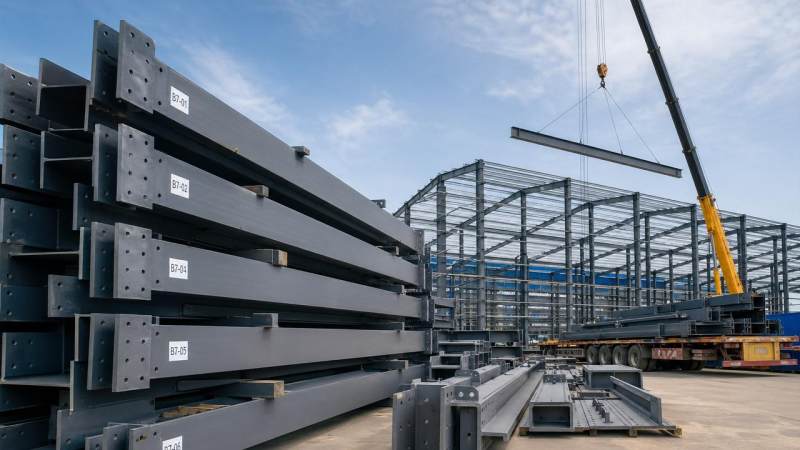
A conventional steel supply model may provide standard beams, channels, angle steel, or plates in stock lengths, leaving more cutting, fit-up, and adjustment to the contractor. By contrast, prefabricated structural steel is delivered as a project-specific package. Members are commonly labeled by erection zone, sequence, or drawing reference, which reduces confusion once unloading starts.
For global buyers working across ASTM, EN, JIS, or GB-based requirements, a capable manufacturer also helps align production tolerances, material traceability, and dimensional checks before shipment. This is one reason many international contractors source from manufacturers with stable fabrication capacity rather than from traders alone. The value is not only in material supply, but in reducing coordination risk.
Hongteng Fengda, as a structural steel manufacturer and exporter from China, supports this model by supplying angle steel, channel steel, steel beams, cold formed steel profiles, and customized structural steel components for overseas projects. For project managers, that combination is useful when standard sections and project-specific fabricated parts need to be controlled under one sourcing plan.
- Factory processing usually includes cutting, drilling, beveling, welding, and member marking.
- Site work is then focused on unloading, positioning, bolting, alignment, and inspection.
- Typical project gains come from fewer field adjustments, better sequence control, and reduced labor overlap.
Where are the real time savings in prefabricated structural steel, and where are they often overstated?
The strongest time savings come from tasks that are repetitive, labor-heavy, or sensitive to site conditions. Hole drilling, end preparation, connection plate welding, and dimensional verification are all faster and more consistent in a factory. On site, crews then install pre-identified members rather than stopping to measure, mark, cut, and correct. In many steel building or industrial support projects, erection productivity improves because crane time is used for assembly, not for waiting on field preparation.
However, prefabricated structural steel does not automatically solve every scheduling problem. If final drawings are late, anchor bolts are misplaced, transportation planning is weak, or the installation team lacks experience, the benefit can shrink quickly. Time savings are real when design freeze, manufacturing release, packing logic, and erection sequencing are aligned. If one of those links is weak, factory speed can simply move the bottleneck somewhere else.
Project managers should therefore evaluate prefabrication as a system, not as a product label. A project with 200 to 800 tons of steel and a 6 to 12 week erection window can gain significantly from off-site processing, but only if the site team receives the right members in the right order with clear identification and complete documentation.
The table below shows where time is commonly saved and where expectations should stay realistic.
The main takeaway is simple: prefabricated structural steel saves the most time in controlled, repetitive work and in installation sequencing. It saves less time when delays are driven by poor engineering coordination, civil errors, or customs and logistics issues that were not addressed in advance.
What are the most common sources of schedule gain?
On many projects, the gains come from 4 practical areas: reduced field fabrication, fewer weather interruptions, lower dependence on scarce skilled site labor, and tighter material identification. A well-packed shipment can allow crews to install by zone or by gridline without repeatedly searching for members. Even a 10% to 15% reduction in erection inefficiency can be valuable when downstream trades depend on structural handover.
Another gain comes from parallel execution. While civil work or foundation curing continues on site, the steel package can already be entering fabrication. This overlap can compress overall project duration by several days or several weeks, depending on project scale. That is one reason prefabricated structural steel is often favored in logistics buildings, workshops, process plants, and export-oriented industrial developments.
Which projects benefit most from prefabricated structural steel?
Not every project benefits to the same degree. The best candidates usually share three traits: repeated structural logic, a strong need for schedule certainty, and limited tolerance for site disruption. Warehouses, factories, pipe racks, conveyor supports, equipment platforms, and modular industrial buildings are typical examples. In these cases, the connection details are often standardized enough for factory preparation to create clear time savings.
For project managers handling remote sites or international EPC coordination, prefabricated structural steel can be even more valuable. If a site is labor-constrained, weather-exposed, or difficult to access, shifting work into a controlled facility can reduce both delay risk and safety pressure. A remote mining support structure or export plant expansion may benefit more than an urban site where labor and equipment are readily available.
The level of prefabrication should still match the project. Some buyers need fully fabricated assemblies. Others prefer a mixed package, such as standard beams and channels with only critical joints or custom brackets prefabricated. A manufacturer that offers both standard structural sections and customized steel components can support that balance more effectively than a one-format supplier.
How can project managers judge fit before ordering?
A simple pre-order review can prevent many problems. The goal is to confirm whether the steel package should be basic supply, partially prefabricated, or highly prefabricated based on site and schedule realities. A project with a 3-shift installation plan, tight lifting windows, or a fixed shutdown period usually deserves deeper prefabrication planning than a flexible low-rise structure.
In some industrial projects, secondary materials are also procured alongside the main frame. For corrosion resistance, hygiene zones, or equipment interfaces, stainless products may be required in selected areas. For example, a buyer comparing sheet materials for chemical, food, transport, or equipment support applications may review 304 Stainless Steel Plate when assessing auxiliary fabrication needs, especially where thickness ranges from 0.3mm to 200mm and standards such as ASTM, JIS, EN, and GB must be considered.
That kind of inserted material decision should not distract from the main structural package, but it does show why integrated sourcing conversations are helpful. If the same procurement cycle involves structural steel, fabricated parts, and corrosion-resistant plate for equipment zones, coordination of lead times becomes more important than unit price alone.
Quick evaluation checklist
- Is the steel frame repetitive enough to justify factory processing beyond basic cutting?
- Will site weather, labor access, or safety restrictions affect installation productivity?
- Are drawing approvals likely to be stable at least 2 to 4 weeks before fabrication starts?
- Can the shipment be packed in erection sequence rather than only by material type?
How should buyers compare suppliers for prefabricated structural steel?
The first mistake is comparing only per-ton pricing. Prefabricated structural steel should be evaluated on total delivery reliability: fabrication scope, drawing review response, quality control steps, packaging logic, traceability, and shipping support. A lower price can quickly lose value if members arrive without proper identification, if bolt holes require correction on site, or if documentation is incomplete for inspection and customs clearance.
Project managers should ask detailed questions about capability. Can the supplier handle angle steel, channel steel, steel beams, cold formed steel profiles, and custom components in one package? Can they work to ASTM, EN, JIS, or GB requirements as needed? Do they have stable output for phased deliveries over 8 to 16 weeks? These are more useful questions than asking only whether the factory can fabricate steel.
It is also important to verify communication discipline. A supplier serving North America, Europe, the Middle East, and Southeast Asia should understand export documentation, packing labels, specification matching, and lead-time commitments. In cross-border procurement, responsiveness over 24 to 72 hours can affect not just purchasing speed, but engineering and logistics decisions as well.
The comparison table below can help project teams screen suppliers more effectively.
This kind of evaluation gives a more accurate picture of project value. In prefabricated structural steel procurement, the best supplier is not always the cheapest tonnage source, but the one that helps the site install faster and with fewer interruptions.
What questions should be asked before PO release?
Before issuing a purchase order, confirm at least five points: approved drawing status, material standard and grade, fabrication scope, inspection checkpoints, and packing sequence. Also confirm whether the supplier will provide project marking, bolt-list coordination, and replacement policy for transit damage or missing items. These details often decide whether prefabricated structural steel performs well on site.
If the project includes stainless auxiliaries, the same review discipline applies. For instance, a second look at 304 Stainless Steel Plate may be relevant when matching finish options such as BA, 2B, NO.1, NO.4, HL, or 8K to equipment or enclosure requirements, but that decision should be tied back to the installation schedule and not handled in isolation.
What mistakes reduce the value of prefabricated structural steel?
The biggest mistake is assuming prefabrication alone guarantees speed. In reality, poor planning can neutralize much of the benefit. If site foundations are not ready, if anchor points vary from drawings, or if shipment arrives without zone-based packing, crews can spend hours repositioning materials and checking dimensions. On a short shutdown project, even a 1-day delay can affect commissioning or equipment installation.
A second mistake is releasing fabrication before drawing coordination is mature enough. Field changes are expensive in any steel project, but they are especially disruptive when members are already processed, coated, packed, and shipped. Project managers should resist rushing fabrication release if key interfaces are still uncertain. A 3-day delay in approval can be less damaging than 3 weeks of downstream rework.
A third mistake is focusing too narrowly on tonnage while ignoring installability. Some packages look competitive on paper but create hidden site labor. Missing member marks, mixed bundle logic, or unclear hole references can force supervisors to spend excessive time sorting and verifying parts. Prefabricated structural steel creates value when it reduces labor at the point of installation, not merely when it leaves the factory faster.
Common misconceptions to avoid
Many buyers believe higher prefabrication is always better. That is not necessarily true. Over-prefabrication can increase transport complexity, lifting limits, or damage risk if assemblies are too large. The right level depends on road restrictions, container or breakbulk strategy, crane capacity, and site access. Sometimes partially prefabricated members are more efficient than large welded assemblies.
Another misconception is that quality issues disappear in factory work. Factory conditions improve consistency, but only if process control is disciplined. Material verification, weld inspection, dimensional checking, and packing review still need to be defined. For global projects, standard alignment across ASTM, EN, JIS, or GB should be discussed early rather than after production starts.
Finally, some teams underestimate communication timing. In international sourcing, a delayed response cycle of even 48 hours on drawing questions can slow production release, shipping booking, and site planning. Reliable suppliers help shorten this loop by offering clear technical communication and realistic lead-time updates.
- Freeze key connection details before fabrication begins.
- Match prefabrication level to transport, lifting, and site constraints.
- Ask for member marking and packing by erection sequence.
- Review standards, tolerances, and inspection points before production release.
How can project managers make prefabricated structural steel work better from planning to installation?
The best results come when procurement, engineering, logistics, and site teams share one installation logic. Prefabricated structural steel performs well when the factory knows the erection sequence, the shipping team knows the unloading plan, and the site team knows how the package is marked. This sounds basic, but on real projects that coordination often separates smooth installation from avoidable delays.
A practical approach is to define 6 checkpoints: drawing freeze, material confirmation, fabrication release, pre-shipment inspection, packing verification, and site receipt review. Even on fast-track projects, these checkpoints can be handled without slowing progress. In fact, they usually prevent larger disruptions later. For a package delivered over 2 to 4 shipments, each checkpoint becomes even more important.
Working with a manufacturer that combines production capacity, customized fabrication, and export experience is often the most efficient route. Hongteng Fengda supports global construction, industrial, and manufacturing buyers with structural sections, cold formed profiles, and customized steel components, helping overseas partners control sourcing risk, manage cost, and maintain dependable lead times.
FAQ summary for quick decision-making
If you need a fast internal review, this condensed FAQ table can support initial discussions with engineering, procurement, and site teams.
This summary reinforces the central point: prefabricated structural steel delivers the most value when it is treated as a coordinated execution method, not just a fabricated material category.
Why choose us or contact us now?
If you are evaluating prefabricated structural steel for an upcoming industrial, commercial, or export construction project, early technical communication can save significant time later. We can support parameter confirmation, section and profile selection, fabrication scope review, standard matching, delivery cycle planning, and customized structural steel solutions based on your drawings and installation sequence.
For buyers who need dependable supply from China, Hongteng Fengda offers structural steel manufacturing and export support with attention to quality consistency, stable production capacity, and practical lead-time management. Whether you are comparing standard angle steel and channels, reviewing custom steel beam fabrication, or checking certification and documentation requirements, a detailed inquiry helps clarify the most efficient procurement route.
Contact us to discuss product selection, drawing review, delivery schedules, OEM customization, certification requirements, sample support, or quotation planning. If you share your project type, target standard, estimated tonnage, and expected installation timeline, we can help you judge where prefabricated structural steel will create real time savings and how to structure supply around that goal.
Please give us a message


Please enter what you want to find