In humid coastal environments, selecting the right galvanized steel wire—electrogalvanized wire or hot-dip galvanized—is critical for long-term corrosion resistance, safety, and project ROI. As a trusted Galvanized Steel Wire Rope supplier and structural steel manufacturer, Hongteng Fengda supports global buyers with ASTM/EN-compliant solutions—from carbon steel pipe for oil and gas to stainless seamless pipe and 304/321 stainless steel pipe. Whether you're a procurement officer evaluating cost vs. durability, an engineer assessing material performance, or a project manager ensuring compliance, this comparison delivers actionable insights backed by real-world coastal exposure data and ISO-certified production.
How Coastal Humidity Accelerates Corrosion — And Why Coating Choice Matters
Coastal zones expose structural components to combined stressors: salt-laden air (NaCl concentrations up to 150 mg/m³), relative humidity consistently above 80%, and frequent temperature fluctuations between 15°C–35°C. In such conditions, unprotected carbon steel corrodes at 5–10× the inland rate. Zinc coatings act as sacrificial anodes—but their effectiveness depends on thickness, adhesion, microstructure, and continuity.
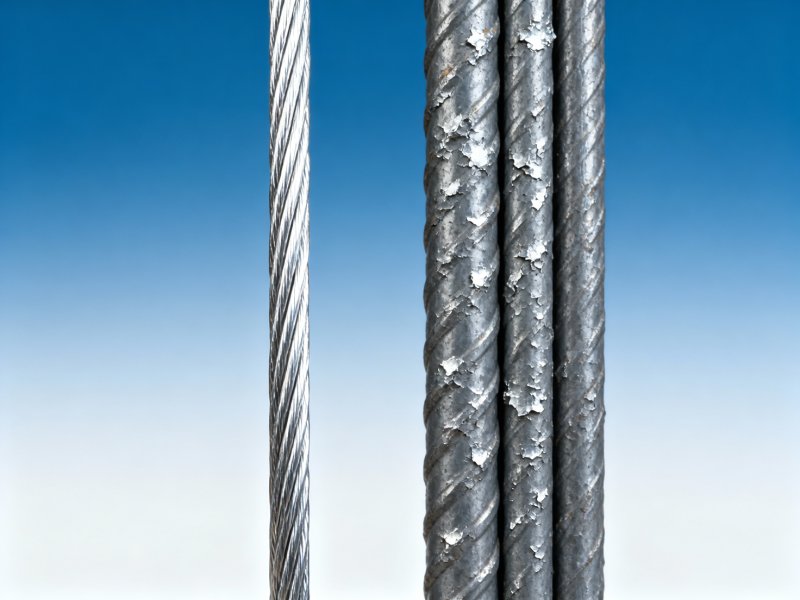
Electrogalvanized wire typically carries a zinc layer of 5–15 µm, applied via electrodeposition under controlled pH and current density. Hot-dip galvanized wire undergoes immersion in molten zinc (450°C), forming a metallurgically bonded coating averaging 45–85 µm—including outer pure zinc and inner Zn-Fe alloy layers. This structural difference directly governs service life in aggressive marine atmospheres.
Field studies across Southeast Asian ports show electrogalvanized wire begins showing red rust after 12–18 months of continuous coastal exposure. Hot-dip galvanized equivalents last 5–8 years before requiring maintenance—provided coating thickness meets ASTM A153 Class D (≥61 µm) or EN ISO 1461 minimum requirements.
Direct Comparison: Performance, Cost & Application Fit
The choice isn’t about “better” in absolute terms—it’s about matching coating properties to functional requirements, lifecycle budget, and installation constraints. Below is a side-by-side technical and operational assessment:
For applications demanding high formability—such as tension cables, guy wires, or fasteners used in modular coastal infrastructure—electrogalvanized wire remains viable if paired with supplementary protection (e.g., polymer overcoating). For primary load-bearing elements like anchor chains, mooring ropes, or structural bracing exposed continuously to sea spray, hot-dip galvanizing delivers proven, maintenance-free longevity. Notably, Hongteng Fengda offers both options with full traceability to ASTM A641 (EG) and ASTM A153 (HDG) standards.
When to Consider Stainless Alternatives — And Where 304 Fits In
In ultra-high-risk zones—offshore platforms, desalination plants, or chemical-handling port facilities—zinc-based coatings may reach their performance ceiling. Here, austenitic stainless steels offer a step-change in reliability. The 304 Stainless Steel Coil stands out for its balanced combination of corrosion resistance, fabricability, and cost efficiency among premium alloys.
With ≥520 MPa tensile strength, ≥275 MPa yield, and ≥55% elongation, 304 stainless performs reliably across temperature ranges from cryogenic to 1000–1200°C intermittent use. Its chromium-nickel composition delivers strong resistance to nitric acid (≤65% concentration, boiling point), alkalis, food-grade organics, and saline fog—making it ideal for ship parts, conveyor belts, and coastal medical equipment housings.
Compared to galvanized alternatives, 304 eliminates coating degradation risk entirely. However, initial cost is 2.5–3.5× higher than hot-dip galvanized wire per kg. That premium pays back in projects requiring >20-year design life without inspection or recoating—especially where access is limited or downtime costly.
Procurement Checklist: What Global Buyers Should Verify
To avoid field failures and warranty disputes, procurement teams must validate five non-negotiable items before placing orders:
- Coating thickness verification: Require certified lab reports (per ASTM E376 or ISO 2178)—not just mill certificates.
- Adhesion testing: For hot-dip products, confirm bend test results (EN ISO 1461, 3× diameter mandrel, zero spalling).
- Zinc purity: Specify minimum 99.99% Zn (ASTM B6) to prevent Fe/Zn ratio imbalances that accelerate white rust.
- Post-treatment confirmation: Chromate passivation (for EG) or quenching (for HDG) must be documented and compliant with REACH/ROHS.
- Batch traceability: Each coil must carry heat number, coating thickness, and test date—critical for audit-ready documentation.
Hongteng Fengda provides all five verification points as standard, with third-party SGS/BV inspection support available upon request. Our lead time for ASTM/EN-compliant galvanized wire and stainless coils remains stable at 18–25 days for standard sizes—regardless of order volume.
Why Partner With Hongteng Fengda for Coastal-Grade Structural Steel?
We’re not just a supplier—we’re your offshore durability partner. With dedicated R&D for marine-grade materials, ISO 9001-certified production lines, and dual-standard compliance (ASTM + EN), we eliminate sourcing friction for global infrastructure projects.
Whether you need hot-dip galvanized wire for harbor cranes, electrogalvanized strands for tensioned façade systems, or 304 Stainless Steel Coil for saline-resistant conveyor frames, our team delivers precise specification alignment—backed by 100% pre-shipment inspection, container-loading supervision, and multilingual technical support.
Contact us today for: coating thickness validation reports, custom length cutting (±0.5 mm tolerance), ASTM/EN certification packages, or comparative lifecycle cost modeling for your specific coastal site conditions. Let’s build resilience—by the meter, by the coil, by the project.
- galvanized steel wire
- galvanized wire
- carbon steel pipe
- seamless pipe
- steel pipe
- hot-dip galvanized
- steel coil
- galvanized steel
- structural steel
- Structural Steel
- 304 stainless steel coil
- 321 stainless steel pipe
- stainless steel pipe
- stainless steel coil
- stainless coil
- ss coil
- ss pipe
- 1 stainless steel pipe
- stainless seamless pipe
- electrogalvanized wire
- Galvanized Steel Wire Rope
- Galvanized Steel Wire Rope supplier
- Galvanized
- Steel Wire
- carbon steel
- steel wire rope
- carbon steel pipe for oil and gas
Related recommendations
 Why do 20 feet square pipe prices vary significantly between inland and port-adjacent warehouses?20 feet square pipe price varies by location—discover why port-adjacent warehouses often deliver better total cost, speed & ROI. Get the finance-approved breakdown.
 Do the advantages of galvanized steel outweigh long-term maintenance costs in humid industrial zones?Advantages of galvanized steel in humid industrial zones? Yes—when engineered right. Discover how proper specification cuts long-term maintenance costs by 2–3×.
 How much longer does galvanized steel sheet for roofing last compared to painted steel in humid tropicsgalvanized steel sheet for roofing lasts 2–3× longer than painted steel in humid tropics—25–40 vs. 10–15 years. Proven durability, zero scheduled maintenance, and lower lifecycle cost.
 Why galvanized steel sheet price per ton fluctuates beyond raw material costsGalvanized steel sheet price per ton fluctuates due to coating specs, order volume, logistics & certifications—not just zinc. Discover actionable cost levers.
Please give us a message


Please enter what you want to find