Choosing between a steel square rod and a round bar affects strength, machining, welding, and total project cost. For buyers comparing Q235 steel, S235JR steel, seamless steel tube, or carbon pipe options, understanding shape performance is essential. This guide explains the practical differences, common applications, and sourcing factors to help engineers, purchasers, and project teams make a reliable decision.
What really changes when you choose a steel square rod instead of a round bar?
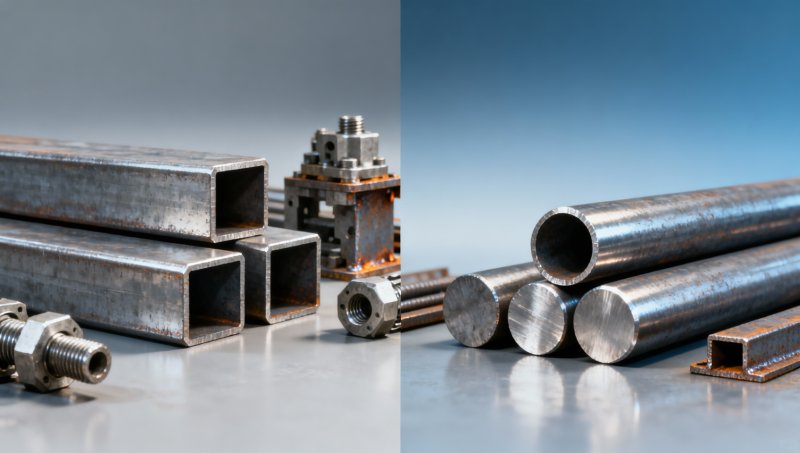
At first glance, both products are simply solid steel bars, but their geometry changes how they behave in fabrication and in service. A steel square rod provides four flat faces and defined corners, which makes it easier to position, clamp, and align in frames, brackets, keys, supports, and welded assemblies. A round bar distributes stress more evenly around its circumference, which often makes it a better choice for shafts, pins, rollers, and machined rotating parts.
For technical evaluators, the decision usually comes down to 3 core questions: will the part rotate, will it be welded into a fixed structure, and how much machining is required after delivery? For procurement teams, another 3 factors matter just as much: material grade availability, dimensional tolerance, and total conversion cost from raw stock to final part. A cheaper bar price can still result in a higher project cost if machining time increases by 10%–20%.
In the steel industry, shape selection is not only a design issue but also a supply chain issue. Square rod and round bar can be supplied in common carbon steel grades such as Q235 steel and S235JR steel, but lead times, mill routing, and downstream fabrication differ by market. For many global buyers, standard lengths are often available faster than custom-cut pieces, while precision tolerance orders may require an additional 7–15 days depending on size range and inspection scope.
Hongteng Fengda supports these decisions from the practical side. As a structural steel manufacturer and exporter from China, we work with international buyers who need standard specifications, OEM processing, and dependable quality control across ASTM, EN, JIS, and GB related requirements. This helps reduce sourcing risk for construction, industrial, and manufacturing projects where material shape directly affects fabrication efficiency and budget control.
Quick functional difference
The simplest way to compare them is this: square rod is usually better when flat contact, anti-rotation behavior, or easy fixture alignment matters; round bar is usually better when turning, drilling, rotation, or smooth load transfer matters. In many workshops, this basic distinction can shorten fabrication planning from 2–3 review rounds down to 1 approved material decision.
- Choose square rod for welded frames, support members, tool components, gates, fixtures, and non-rotating connectors.
- Choose round bar for shafts, axles, pins, bolts, couplings, rollers, and lathe-turned components.
- Review whether the project needs direct load-bearing, torsion resistance, surface machining, or insertion into round holes.
Square rod vs round bar: which performs better in real applications?
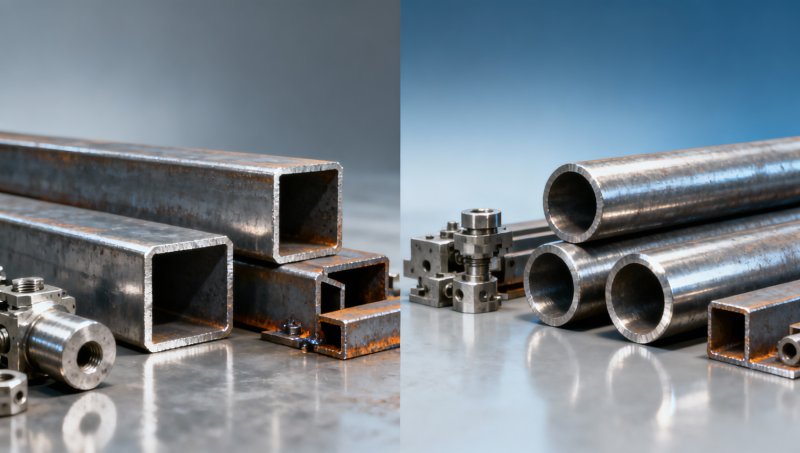
Performance depends on loading direction, fabrication method, and installation environment. Under torsional or rotating service, round bar generally offers more uniform stress distribution and smoother machining. In fixed assemblies, steel square rod often gives better practical usability because its flat surfaces make positioning easier during cutting, drilling, and welding. That is why the same grade, such as Q235 steel or S235JR steel, can behave very differently in production value depending on final use.
For project managers and quality teams, the most useful comparison is not abstract strength alone. It is the combined effect of 5 working variables: dimensional tolerance, weld preparation, machining loss, installation accuracy, and service stability. In many fabrication environments, the ability to hold alignment within a practical workshop range such as ±0.5 mm to ±2.0 mm can matter more than a small theoretical difference in section response.
The table below summarizes how buyers typically compare steel square rod and round bar in B2B purchasing and engineering reviews. These are application-oriented guidelines rather than rigid rules, because grade, size, and process route still need confirmation before final selection.
This comparison shows why “better” depends on the job. A square rod may lower assembly time and reduce welding setup errors. A round bar may reduce machining hours and improve the fit of rotating components. The correct choice is often the one that lowers total process cost across cutting, finishing, inspection, and installation, not simply the one with the lowest per-ton price.
Where each shape is commonly used
Application is the clearest decision filter. Fabricators, distributors, and end users often work backward from the final part rather than from the raw material catalog. This avoids overbuying unnecessary tolerance or buying a shape that creates extra processing waste.
Typical square rod uses
- Support frames, machine guards, gate hardware, welded brackets, and spacer elements.
- Non-rotating keys, stops, hold-down parts, and connection pieces where flat contact matters.
- General structural fabrication where simple measuring and corner alignment save labor time.
Typical round bar uses
- Shafts, anchor rods, pins, rollers, studs, fastener blanks, and turned mechanical parts.
- Forging feedstock and machined components that need concentricity or circular fit.
- Industrial assemblies where the bar enters bushings, bearings, or round bores.
How should buyers evaluate strength, processing, and related steel options?
When buyers compare steel square rod and round bar, they often also review nearby alternatives such as seamless steel tube, carbon pipe, or reinforcing steel depending on load path and installation method. A solid bar is not always the only answer. If the design relies on concrete reinforcement rather than exposed mechanical use, a dedicated rebar specification may be more practical than a general bar product.
For example, in load-bearing, structural, and stirrup scenarios within concrete structures, HPB300 Rebar can be a more suitable option than either a steel square rod or a round bar intended for machining. Its common models include HPB300, HRB300, HRB400, HRB500, A615 GR40, GR60, and BS4449 GR460, with standard yield strength no less than 300 MPa. Typical sizes include 6 mm, 8 mm, 10 mm, 12 mm, 16 mm, 20 mm, 25 mm, 32 mm, 40 mm, and 50 mm.
This does not mean rebar replaces solid bar in every case. It means buyers should match the material form to the actual job. A machine shaft should not be purchased as reinforcing steel, and a concrete reinforcement cage should not be designed around general round bar without proper specification review. Good sourcing starts with function, then checks grade, dimension, certification, and processing route.
For engineering and procurement teams, the next table helps separate these material categories by use logic. This is especially helpful when a project includes structural steel, fabricated parts, and embedded reinforcement in the same purchase package across 2–4 delivery lots.
The buying implication is simple: do not compare all steel products only by unit price. Compare them by function, processing cost, and compliance. In many projects, changing from one material form to another changes the fabrication sequence, inspection method, and even the unloading plan at site. That can influence labor, waste ratio, and approval time across the full supply cycle.
Four technical checks before placing an order
- Confirm material grade first, such as Q235 steel, S235JR steel, or another specified equivalent under ASTM, EN, JIS, or GB.
- Confirm final use: static support, welded part, machined part, rotating part, or embedded reinforcement.
- Confirm dimensional requirements, including diameter or side size, cut length, straightness, and acceptable tolerance range.
- Confirm inspection scope, such as mill test documents, third-party review if needed, and packaging for export handling.
What should procurement and project teams focus on before approval?
Procurement decisions in steel products rarely fail because buyers do not know the shape. They fail because the team does not define the approval checkpoints early enough. For steel square rod and round bar, a practical procurement review should include 5 key items: grade equivalency, tolerance requirement, length and cutting condition, quantity split, and delivery schedule. If one of these is unclear, the risk of rework or claim increases significantly.
For commercial evaluators and financial approvers, cost should be reviewed in 2 layers. The first layer is the ex-works or FOB material cost. The second layer is total usable cost after machining, welding, waste, coating, transport, and inspection. A round bar may cost more per unit in some markets but save 1–2 processing steps. A square rod may reduce jigging time and lower rejection during assembly. These hidden savings often matter more than a narrow price difference.
For quality control and safety managers, the document package is equally important. Depending on project requirements, buyers may request mill test certificates, dimensional inspection records, heat numbers, surface checks, or third-party inspection arrangements. Export projects to North America, Europe, the Middle East, and Southeast Asia often need clear standard references and consistent labeling to support traceability through warehousing and site installation.
Hongteng Fengda supports buyers with stable production capacity, standard specification supply, and customized structural steel solutions. That matters when projects involve mixed items such as angle steel, channel steel, steel beams, cold formed steel profiles, and custom components in the same procurement cycle. Consolidating supplier coordination can reduce communication loss across 3 stages: technical confirmation, production scheduling, and shipment preparation.
A practical supplier review checklist
- Can the supplier clearly confirm whether square rod or round bar is better for your actual fabrication route?
- Can they supply common international standards and explain grade mapping without vague substitutions?
- Can they support OEM cutting, packaging, and mixed-order coordination for structural steel products?
- Can they provide realistic lead time guidance such as 2–4 weeks for standard lots or longer for custom processing?
- Can they maintain consistent quality control for export projects with repeat orders and batch traceability?
Common procurement mistakes
One common mistake is ordering round bar simply because it seems more universal, then discovering that the workshop must add unnecessary anti-rotation fixtures. Another is choosing square rod for a part that will be heavily turned on a lathe, which creates excess material removal and longer machine time. A third mistake is treating seamless steel tube or carbon pipe as direct substitutes for solid bar without recalculating section behavior and fabrication needs.
FAQ: how do engineers, buyers, and distributors make the safest choice?
The questions below reflect common search intent from information researchers, operators, technical reviewers, procurement teams, distributors, and end users. They are especially relevant when projects involve mixed steel items, strict delivery windows, or international sourcing from China.
Is a steel square rod stronger than a round bar?
Not in every sense. Strength depends on grade, section size, and load type. For the same steel grade, a round bar often performs better in rotating or torsional service because stress is distributed more evenly. A steel square rod can be more practical in fixed assemblies because its shape resists rolling and improves contact with flat surfaces. Engineers should compare real section needs, not shape labels alone.
Which one is easier to machine?
If the final part is cylindrical, round bar is usually easier and more economical to machine because less stock is removed. If the final part needs flat surfaces, key-like geometry, or simple welded fit-up, square rod can save time during cutting and holding. For batch production, even a small reduction of 5%–10% in machining time can change the supplier choice.
Can Q235 steel and S235JR steel both be used for square rod or round bar?
They are both commonly referenced structural carbon steel grades, but project suitability still depends on exact specification, mechanical requirements, and applicable standard. Buyers should not assume direct interchangeability without checking grade mapping, chemistry, mechanical properties, and project documents. When export compliance matters, the standard named on the purchase order should match the required market specification.
How long is the usual delivery cycle?
For standard sizes and common grades, many orders move within about 2–4 weeks, while custom cutting, OEM processing, or added inspection can extend the schedule by 7–15 days or more. Shipment mode, destination, and document requirements also affect the total cycle. The safest approach is to confirm quantity split, packaging method, and inspection scope before production starts.
When should I ask for a customized recommendation instead of choosing from stock?
Ask for technical review when your project includes at least 1 of these conditions: mixed standards, fabrication drawings, coated or special packaging needs, repeated batch supply, tight tolerance, or multiple steel product categories in one shipment. This is where a structural steel manufacturer with OEM capability becomes more useful than a stock-only trader, because the decision affects production planning and downstream project execution.
Why work with Hongteng Fengda for structural steel sourcing and project support?
Choosing between steel square rod and round bar is easier when the supplier understands not only material names, but also fabrication logic, project timing, and export execution. Hongteng Fengda is a professional structural steel manufacturer and exporter from China, supplying angle steel, channel steel, steel beams, cold formed steel profiles, and customized structural steel components for global construction, industrial, and manufacturing projects.
Our value for buyers is practical. We help confirm whether the right solution is a square rod, a round bar, a seamless steel tube, carbon pipe, or another structural steel product based on your actual use. We can support standard specifications and OEM requirements while aligning production with common international standards including ASTM, EN, JIS, and GB. This reduces confusion during technical evaluation and speeds up internal approval.
If your team is comparing materials for a current project, you can contact us for 6 concrete topics: material grade confirmation, shape selection, size and tolerance review, estimated delivery cycle, certification and inspection requirements, and packaging or sample support. This is especially useful for distributors, contractors, project managers, and procurement teams handling repeat orders or multi-item export purchases.
Send your drawing, target grade, size list, quantity, destination port, and required standard, and we can help you review the most suitable option for cost, processing, and delivery reliability. Whether you need a standard steel square rod, a round bar for machining, or a broader structural steel package, Hongteng Fengda can support quotation planning and customized supply coordination for your next order.
Please give us a message


Please enter what you want to find