When choosing between prefabricated structural steel and traditional fabrication, project managers must weigh speed, cost control, quality consistency, and on-site efficiency. For global construction and industrial projects, the right fabrication method can directly affect timelines, labor demands, and overall project risk. Understanding the practical differences helps buyers and project leaders make smarter sourcing and execution decisions.
Why a checklist approach works better for this decision
For project managers, the debate is rarely about which method sounds more modern. The real issue is which method reduces risk for a specific job. Prefabricated structural steel can shorten site work and improve consistency, while traditional fabrication can offer flexibility when drawings change frequently or site conditions are uncertain. A checklist-based review helps decision-makers compare both options against schedule, labor, engineering complexity, logistics, and quality requirements instead of relying on assumptions.
This is especially important in cross-border sourcing. When steel components are produced by a structural steel manufacturer and exporter in China for projects in North America, Europe, the Middle East, or Southeast Asia, the cost of a wrong fabrication choice may include shipping delays, installation conflicts, rework, and inspection issues. A structured decision process helps buyers align fabrication strategy with actual project execution needs.
First-check list: what to confirm before comparing fabrication methods
Before deciding whether prefabricated structural steel or traditional fabrication works better, confirm the following items in order. These are the practical checks that should come before supplier negotiation or procurement planning.
- Project schedule: Is fast erection a top priority, or is there enough time for more on-site cutting, fitting, and adjustment?
- Drawing maturity: Are structural drawings final, coordinated, and approved, or are frequent design revisions still expected?
- Site labor conditions: Is skilled fabrication labor available on site, and at what cost?
- Transport constraints: Can large assembled steel members be shipped, unloaded, and lifted safely at the destination?
- Quality requirements: Does the project demand high dimensional accuracy, repeatability, and traceable factory inspection records?
- Installation environment: Is the site crowded, weather-sensitive, high-risk, or difficult for welding and fitting operations?
- Procurement model: Are you buying standard sections, customized structural steel components, or a mixed package?
Core decision guide: when prefabricated structural steel performs better
In many industrial and commercial projects, prefabricated structural steel provides clear operational advantages. However, these advantages appear only when engineering, production, and logistics are managed correctly. Project leaders should prioritize prefabrication when the following conditions are present.
1. The project needs predictable schedules
Prefabricated structural steel is usually manufactured, cut, drilled, welded, and prepared in a controlled factory environment before shipment. This reduces on-site fabrication time and makes installation more like assembly than heavy processing. For projects with tight completion dates, weather exposure, or limited site access windows, that time advantage can be decisive.
2. Quality consistency matters more than field flexibility
Factory fabrication allows stricter dimensional control, repeatable welding procedures, and more reliable inspection records. When a project involves multiple identical bays, industrial frames, mezzanine systems, support structures, or export-compliant assemblies, prefabricated structural steel typically delivers better consistency than site-based methods.
3. The site has labor or safety limitations
If local labor costs are high, qualified welders are scarce, or the construction area has strict safety restrictions, moving more work into the factory is often the better choice. Less on-site cutting and welding usually means fewer hot-work permits, lower congestion, and reduced installation risk.
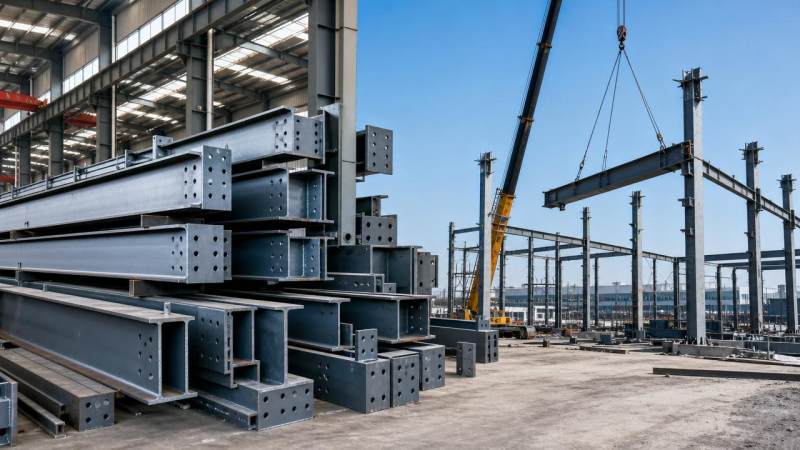
4. Global buyers need stronger supply reliability
For overseas buyers, prefabricated structural steel from a capable Chinese manufacturer can simplify coordination. Companies such as Hongteng Fengda support global construction, industrial, and manufacturing projects with angle steel, channel steel, steel beams, cold formed steel profiles, and customized structural steel components. When production is backed by modern manufacturing facilities, strict quality control, and compliance with ASTM, EN, JIS, and GB standards, buyers gain better control over sourcing risk and lead-time planning.
When traditional fabrication may still be the better option
Traditional fabrication should not be dismissed as outdated. In some cases, it remains the practical choice, especially when flexibility is more valuable than factory efficiency.
- Design changes are still active. If connection details, equipment loads, or interface dimensions are likely to change late, full prefabrication can create rework risk.
- The structure is highly irregular. One-off or field-adapted steelwork may be easier to handle through partial traditional fabrication.
- Transport limits are severe. If roads, ports, or lifting conditions restrict the size of fabricated members, smaller field-fabricated parts may be more practical.
- The project has a strong local fabrication team. Where experienced crews and equipment are already mobilized, traditional methods can still be cost-effective.
Practical comparison checklist for project managers
Use the following matrix to evaluate which option better fits your project. The key is not to look at unit price alone, but to compare total execution impact.
Mid-project sourcing reminder: do not ignore related steel material choices
While evaluating prefabricated structural steel, project managers should also review associated steel materials used for roofing, cladding, enclosure systems, decking, and protective applications. In industrial buildings and export projects, corrosion performance can influence maintenance cost and service life as much as the structural frame itself.
For example, AZ150 Galvalume Steel Coil can be relevant where coated steel is required alongside the structural package. This product is available in grades such as SGCC, SGCD, SGHC, DC51D, DX52D, DX53D, DX54D, and S250GD-S550GD, with width from 30-1500 mm, thickness from 0.125-2.0 mm, and coil weight typically 3-10 tons. Its strong corrosion resistance, paintability, and workability make it useful for projects that also need durable sheet-based components. Buyers should confirm coating range, surface condition, and required performance before integrating such materials into the wider procurement plan.
Key risks that are often missed in prefabricated structural steel projects
Even when prefabricated structural steel is the right direction, execution gaps can reduce its value. These are the issues project teams most often underestimate.
Drawing coordination risk
Factory production starts from approved data. If anchor bolt layouts, equipment interfaces, or MEP penetrations are not coordinated in time, the benefit of prefabrication can quickly turn into fit-up problems on site.
Shipping and lifting mismatch
A member can be perfectly fabricated yet still fail the logistics test. Buyers should confirm maximum transport length, port handling rules, site unloading sequence, and crane capacity before approving fabrication splits.
Inspection scope misunderstanding
Not all suppliers define quality control at the same level. Confirm dimensional tolerance, welding inspection, coating checks, marking system, material traceability, and packing protection in writing.
Comparing price without comparing scope
Some quotations for prefabricated structural steel include drilling, welding, trial assembly, surface treatment, and organized packing, while others cover only base material processing. Scope gaps create misleading cost comparisons.
Scenario-based guidance: which method fits which project type?
To make the decision easier, project managers can map the fabrication method to typical project conditions.
- Standard industrial buildings: Prefabricated structural steel is usually the stronger option because framing is repetitive and schedule-driven.
- Warehouse and logistics facilities: Prefabrication often improves erection speed and labor control, especially for multi-bay layouts.
- Plant expansion projects: Mixed strategy may work best, with prefabricated main members and selective traditional field adjustments.
- Remote or labor-limited sites: Prefabrication generally reduces installation pressure and site uncertainty.
- Renovation or retrofit jobs: Traditional fabrication or hybrid delivery may be safer when existing conditions are hard to verify in advance.
Execution advice: what to prepare before asking for a quotation
If your team is moving toward prefabricated structural steel, the fastest way to get useful quotations is to prepare a complete information package. This improves price accuracy and reduces clarification cycles.
- Provide general arrangement drawings, connection details, and material grade requirements.
- Clarify applicable standards such as ASTM, EN, JIS, or GB.
- List required products, including angle steel, channel steel, steel beams, cold formed steel profiles, or custom assemblies.
- State surface treatment, corrosion protection, and packing expectations.
- Confirm destination port, shipment split preferences, and unloading constraints.
- Specify inspection, documentation, and traceability needs before production starts.
Final decision guide for project leaders
So, prefabricated structural steel or traditional fabrication: what works better? For most new-build industrial, commercial, and export-oriented projects, prefabricated structural steel works better when drawings are stable, installation speed matters, and quality consistency must be controlled across the supply chain. Traditional fabrication remains valuable where field adaptability, late-stage revisions, or transport restrictions dominate the risk profile.
The best decision is not theoretical. It comes from checking schedule pressure, design maturity, labor availability, transport feasibility, inspection requirements, and total installed cost. If you are comparing sourcing options, the next practical step is to discuss project drawings, steel grades, fabrication scope, standards, delivery schedule, and packaging details with a qualified supplier. That conversation will show whether prefabricated structural steel truly fits your project better, or whether a hybrid strategy will deliver the lowest overall risk.
Please give us a message


Please enter what you want to find