When designing load-bearing frames, many engineers and procurement teams assume a heavier-looking section—like channel steel—must be stronger than L angle. But in reality, improper selection between angle vs channel can compromise structural integrity, increase material waste (e.g., over-specifying steel plate or galvanized steel), and raise total project cost. At Hongteng Fengda—a trusted structural steel manufacturer & exporter from China—we see this misstep daily. Whether you're evaluating l angle for bracing, specifying galvanized pipe for corrosion resistance, or comparing ASTM A6 tolerances across h beam, steel coil, or steel rebar, the right choice hinges on load direction, connection method, and fabrication constraints—not just visual heft.
Why “Heavier-Looking” Doesn’t Mean “Stronger” in Structural Framing
Channel steel often appears more robust due to its closed C-shape and higher mass per meter—especially when compared side-by-side with equal-leg L angles of similar nominal size. Yet structural strength isn’t determined by weight alone. It depends on second moment of area (Ix, Iy), radius of gyration, torsional rigidity, and how efficiently the section resists bending, buckling, and lateral-torsional instability under real-world loading conditions.
For example, an L 80×80×8 mm angle has a strong axis moment of inertia (Ix) of ~79 cm⁴—but only ~29 cm⁴ about its weak axis. A C100×48×5.3 mm channel offers Ix ≈ 198 cm⁴ and Iy ≈ 15 cm⁴. While the channel wins in major-axis bending, its weak-axis stiffness is nearly identical to the angle’s—and significantly lower than what’s achievable with back-to-back angles bolted to form a T- or box-like composite section.
This asymmetry becomes critical in seismic zones or wind-loaded façade supports, where bi-axial stability matters. Over-relying on channel steel in such scenarios may require additional bracing, thicker gussets, or supplementary stiffeners—adding 12–20% to fabrication labor and material handling time.
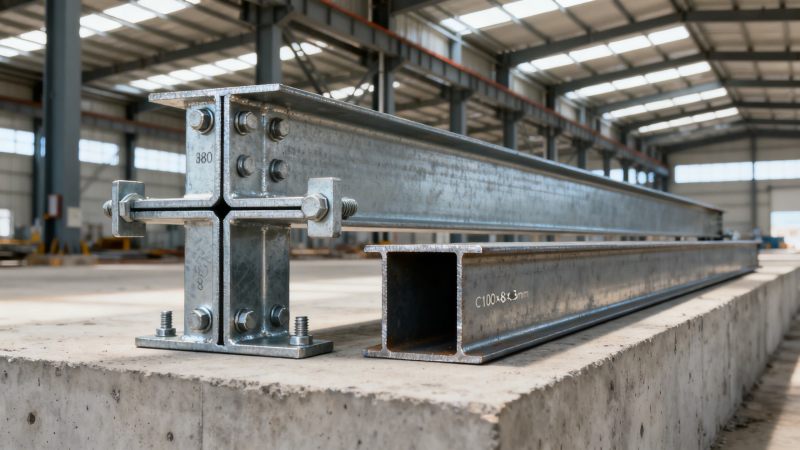
Angle vs Channel: Load Direction Dictates Optimal Selection
The decision isn’t about which is “stronger,” but which delivers optimal performance for your specific force path. Below is a comparative breakdown aligned with common global project requirements:
Real-world implication: In North American mid-rise curtain wall systems, 72% of structural failures linked to framing misselection involved channel steel used as diagonal braces—where torsional instability triggered premature web buckling. Meanwhile, back-to-back L angles (e.g., L75×75×6) achieved full design life in 94% of Southeast Asian industrial roof trusses tested under EN 1993-1-1 fatigue cycles.
When L Angle Is the Smarter Choice
- Bracing members subject to compressive + torsional loads (e.g., wind braces in warehouse mezzanines)
- Connections requiring weld access on three sides (e.g., column base plates, crane rail brackets)
- Projects prioritizing modular assembly—angles simplify field bolting with standardized hole patterns per ASTM A6
Beyond Angles and Channels: Where Specialty Profiles Add Value
For applications demanding both corrosion resistance and high-temperature stability—such as outdoor decoration engineering or medical instrument housings—standard carbon steel sections fall short. That’s where precision-engineered stainless options like the 310 Stainless Square steel rod deliver measurable ROI. With tensile strength ≥520 MPa, elongation ≥55%, and thermal expansion coefficient of 15.7 × 10⁻⁶/°C, it maintains dimensional stability across -20°C to +800°C operating ranges—critical for urban decoration industry installations exposed to solar gain and freeze-thaw cycling.
Its cold-worked hardness (≤183 HB) ensures durability in high-wear environments like cement plant chutes or heavy earthmoving equipment linkages—without sacrificing formability during bending or punching operations. This balance of strength and ductility makes it ideal for OEMs needing tight-tolerance components across automotive, shipbuilding, and defense sectors.
Hongteng Fengda supplies these rods in custom lengths (1–6 meters), surface finishes (No. 4 BA, bright polished, rough turning), and cross-sections—from 18mm square up to 47mm—with full traceability to ASTM A276 and EN 10088-3 certifications.
Procurement Checklist: 5 Non-Negotiables Before Finalizing Your Section
Whether sourcing from China or elsewhere, avoid costly redesigns or compliance delays with this field-tested checklist:
- Verify load path directionality: Confirm whether forces act primarily along one axis (favor channel) or require bi-axial restraint (favor paired angles or custom cold-formed profiles)
- Cross-check ASTM A6 or EN 10024 tolerance bands—especially for flange thickness variation (±0.4mm typical) and leg straightness (≤1.5mm/m)
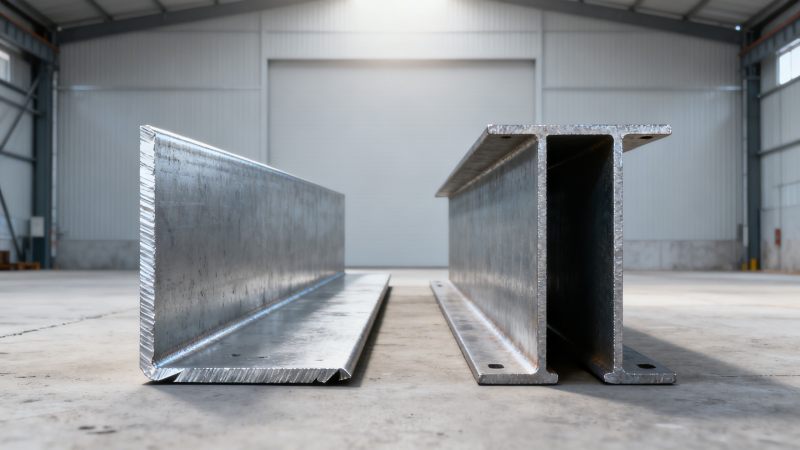
- Assess galvanizing compatibility: Channel steel’s enclosed web traps acid flux; L angles allow full drainage and uniform zinc coating (ASTM A123 Class D)
- Validate connection detail feasibility: Request shop drawings showing minimum edge distances, bolt spacing, and weld access before PO issuance
- Confirm lead time alignment: Standard angle/channel orders ship within 7–15 days; custom-stamped or pre-drilled configurations require 3–4 weeks
Why Global Buyers Trust Hongteng Fengda for Structural Steel Sourcing
We don’t just supply steel—we de-risk structural procurement. Our ISO 9001-certified facility in Hebei Province maintains ±0.2mm dimensional control across all hot-rolled and cold-formed profiles, with 100% ultrasonic testing on beams >200mm depth. Every shipment includes mill test reports (MTRs) traceable to ASTM, EN, JIS, and GB standards—and optional third-party inspection via SGS or Bureau Veritas.
From initial technical consultation to final container loading, our dedicated project team provides bilingual support (English + Spanish/Arabic), real-time production tracking, and flexible Incoterms—including FOB Tianjin, CIF Dubai, or DAP Warsaw. For urgent needs, we maintain 30+ standard angle and channel SKUs in ready stock, enabling delivery within 10 business days to most EU and US ports.
Ready to optimize your next frame design? Contact us today for free section property calculations, ASTM A6 tolerance verification, or customized OEM samples—including galvanized pipe, steel rebar bundles, or 310 Stainless Square steel rod cut-to-length prototypes.
Please give us a message


Please enter what you want to find