Choosing the right rebar for retaining wall performance is critical to strength, durability, and long-term safety. For engineers, buyers, and project managers, understanding structural steel properties helps compare options such as lightweight structural steel and high strength structural steel for different site conditions and load demands. This guide explains the key factors that affect selection, compliance, cost control, and reliable project outcomes.
In practice, rebar selection for a retaining wall is never only about bar diameter. It affects crack control, bending resistance, drainage compatibility, installation speed, inspection acceptance, and long-term maintenance cost. For projects in coastal zones, soft ground, flood-prone areas, or high surcharge conditions, the steel solution must be matched to both structural design and construction reality.
For B2B buyers and technical evaluators, the challenge is often to balance 4 priorities at the same time: compliance with standards, mechanical performance, procurement budget, and dependable delivery. A good selection process reduces site risk, avoids overdesign, and supports stable project schedules from fabrication to final installation.
Understand What the Retaining Wall Must Resist
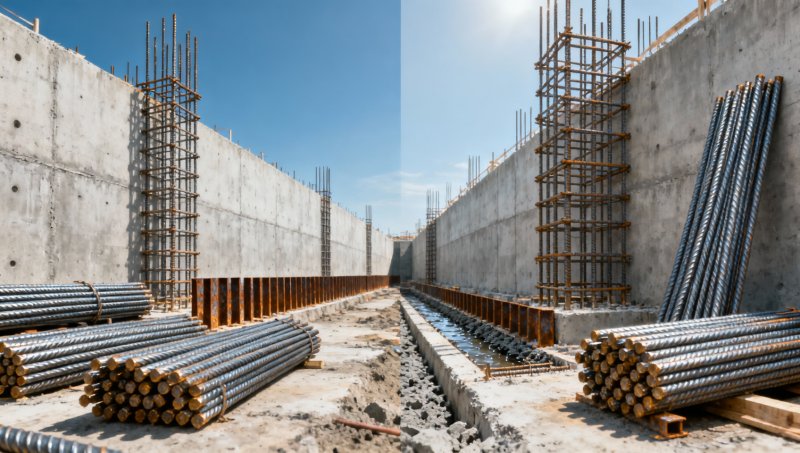
Before choosing rebar, the first step is to define the wall system and the forces acting on it. A retaining wall may resist soil pressure only, or it may also carry traffic loads, nearby foundations, vibration, water pressure, and temporary construction surcharge. In many projects, a 2 m wall and an 8 m wall require very different reinforcement strategies, even if the concrete mix looks similar on paper.
The key design inputs usually include retained height, backfill type, groundwater level, soil bearing capacity, wall geometry, seismic requirement, and service life target. For example, a retaining wall designed for a 50-year service life in a dry inland site may use a different corrosion allowance than one exposed to chlorides in a marine or deicing salt environment.
Rebar works mainly in tension. Concrete handles compression well, but the reinforcing steel controls tensile stress, limits cracking, and improves ductility. If the expected bending moment increases because of higher earth pressure or surcharge, the rebar grade, spacing, and cover depth must be reviewed together rather than as separate items.
For project managers and procurement teams, this means the purchase list should not be finalized until 3 issues are confirmed: actual design load, environmental exposure class, and installation method. A wall built with cast-in-place concrete, precast units, or a sheet pile retaining system will lead to different steel requirements and different delivery priorities.
Main load and exposure factors
The most common load sources can be grouped into permanent loads, variable loads, and environmental actions. Permanent loads include the self-weight of the wall and retained soil. Variable loads may include vehicles, stacked materials, equipment, or nearby structural foundations. Environmental actions include freeze-thaw cycles, sulfate attack, seawater, and repeated wet-dry exposure.
- Retained height of 1.5 m to 3 m often suits lighter residential or landscape applications, but industrial walls commonly exceed 4 m to 6 m.
- Groundwater behind the wall can significantly raise lateral pressure if drainage is poor, increasing demand on reinforcement and waterproofing details.
- Seismic zones may require improved ductility, tighter detailing, and more careful anchorage lengths at critical sections.
The table below helps align design conditions with typical reinforcement decision points during early technical review.
The practical takeaway is clear: the right rebar for a retaining wall depends on force path, exposure, and service conditions. A low wall in dry soil may prioritize cost efficiency, while a higher wall in wet or aggressive environments should prioritize durability and structural reliability over short-term material savings.
Choose Rebar Grade, Size, and Detailing for the Real Site Conditions
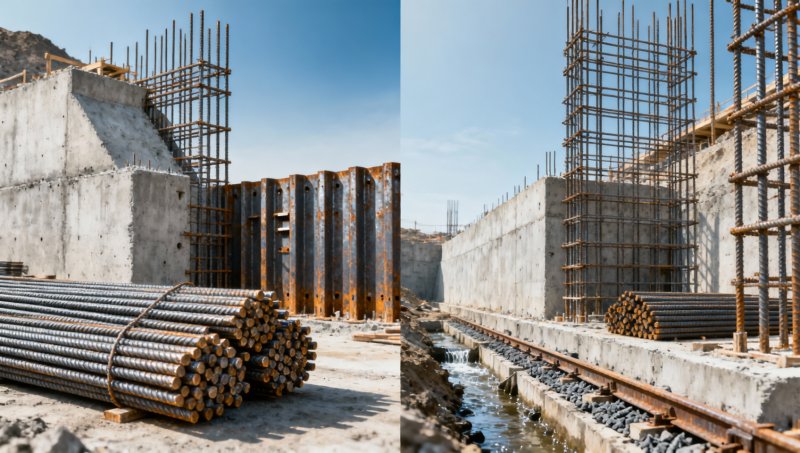
Once the structural demand is defined, the next step is to select rebar grade, diameter, spacing, and detailing. In many markets, common reinforcing grades include yield strengths around 400 MPa to 500 MPa, but the correct choice depends on the applicable code, fabrication capability, and bendability required on site. Higher strength is useful, but it should not be treated as an automatic replacement for good detailing.
Bar diameter and spacing directly affect crack width control. Using fewer large bars can reduce labor in some cases, but closer spacing with moderate diameters may provide better crack distribution and easier concrete consolidation. This matters especially for retaining walls exposed to water, because poor consolidation or oversized bars in congested sections can create voids and long-term durability problems.
Cover thickness is another critical factor. If concrete cover is too small, moisture and chlorides can reach the steel earlier, accelerating corrosion. If cover is excessive without detailing adjustment, crack behavior and section efficiency may suffer. On many projects, cover values in the range of 40 mm to 75 mm are reviewed depending on exposure class, wall type, and code requirements.
Buyers should also pay attention to bending schedules, bar lengths, and lap splice planning. Even a technically correct design can lose efficiency if the supplied rebar lengths do not match site handling conditions. For large infrastructure work, a mismatch between bar stock length and installation sequence can increase cutting waste by 3% to 8%, affecting both cost and site productivity.
Key selection criteria for procurement and technical teams
- Confirm design grade and code compatibility before price comparison.
- Check diameter range, bend radius feasibility, and fabrication tolerances.
- Review corrosion risk based on inland, industrial, marine, or water-retaining service.
- Verify mill test documentation, heat number traceability, and inspection method.
- Coordinate bar lengths with transport limits and lifting capacity on site.
When an alternative steel retaining solution may be more efficient
In some retaining wall projects, especially where excavation support, water cut-off, or rapid installation is required, the engineering team may compare reinforced concrete walls with steel sheet pile systems. This is common in basements, waterfront works, cofferdams, channels, and temporary-to-permanent retaining applications where installation speed and continuous wall performance are key factors.
A practical option in such situations is Hot Rolled Steel Sheet Pile. U Sheet Pile configurations can be freely combined to form a continuous and tight retaining wall or water retaining wall. Available materials include S275, S355, S390, S430, SY295, SY390, and ASTM A690, with production aligned to EN10248, EN10249, JIS5528, JIS5523, and ASTM standards.
For contractors and procurement managers, the value is not only structural performance but also delivery flexibility. Interlock options such as Larssen locks, cold rolled interlock, and hot rolled interlock support different design and site preferences. With single lengths up to over 80 m and customized dimensions in width, height, and thickness, this type of steel solution can simplify construction planning and help reduce total project cost in suitable applications.
The comparison below shows when conventional rebar-based concrete retaining walls and steel sheet pile systems are commonly evaluated side by side.
This does not mean one system is always better than the other. It means engineers and buyers should assess whether the wall is primarily a reinforced concrete structure needing carefully selected rebar, or whether an integrated steel retaining solution can deliver better speed, water control, and cost efficiency under the site constraints.
Check Standards, Quality Control, and Documentation Before Ordering
For technical evaluation teams, compliance is as important as strength. Rebar for retaining walls should be purchased against the required national or project standards, with clear documentation for grade, chemical composition, mechanical properties, and dimensional tolerances. If the project follows ASTM, EN, JIS, or GB references, the procurement package should identify this before quotations are compared.
Mill test certificates are a basic requirement, but not the only one. Quality teams usually also review surface condition, rib geometry, straightness, bundle identification, and traceability by heat number. For critical infrastructure or export projects, pre-shipment inspection and third-party witness checks may be added to reduce downstream claims and installation disputes.
A reliable supplier should be able to support both standard specifications and project-specific processing. This becomes especially important when reinforcement is part of a larger structural steel package. Coordination between rebar supply, steel profiles, embedded items, and construction schedule can prevent delays of 7 to 14 days that often occur when sourcing is fragmented across multiple vendors.
For overseas buyers, manufacturing capability and export discipline matter. Hongteng Fengda, as a structural steel manufacturer and exporter from China, supports global construction, industrial, and manufacturing projects with stable production capacity, strict quality control, and compliance with major international standards including ASTM, EN, JIS, and GB. This matters when purchasers need consistent quality, OEM support, and dependable lead times across multiple project phases.
Quality checkpoints that should not be skipped
- Verify grade and mechanical properties against the approved design documents.
- Confirm dimensional tolerance, bar marking, and traceability on each bundle.
- Check whether storage, loading, and packaging are suitable for export transit of 2 to 6 weeks.
- Review inspection records for rust condition, deformation, and quantity accuracy before dispatch.
The following table can be used as a practical supplier audit checklist during procurement evaluation.
The main conclusion is that correct rebar selection is not complete without supplier qualification and document control. In retaining wall projects, many performance failures start not from design intent but from gaps in specification transfer, traceability, or field execution.
Control Cost Without Sacrificing Safety or Service Life
Cost control should focus on total installed value, not only price per ton. A lower unit price can become expensive if it increases cutting waste, prolongs fixing time, causes inspection rejection, or leads to earlier maintenance. For retaining walls, the commercial decision should combine material cost, fabrication efficiency, transport utilization, installation labor, and expected durability over 20 to 50 years.
One frequent mistake is over-specifying rebar strength without checking whether the design, bending process, and site crew can use it efficiently. Another is underestimating environmental exposure and then facing repair costs from corrosion-related cracking. Even a small reduction in repair risk can be financially important when the wall supports roads, yards, quay areas, or operating facilities where downtime is expensive.
From a sourcing perspective, buyers should compare at least 5 commercial dimensions: base material price, processing scope, MOQ, delivery lead time, inspection support, and claim response. On export projects, shipping mode and packing density can also affect the landed cost by a meaningful margin, especially for mixed containers or multi-item structural steel orders.
Working with a supplier that understands broader structural steel coordination can improve overall efficiency. Hongteng Fengda provides angle steel, channel steel, steel beams, cold formed steel profiles, and customized structural steel components alongside export support. For contractors and distributors, this can reduce supplier fragmentation, improve schedule predictability, and simplify communication across technical and commercial teams.
A practical 4-step decision method
- Lock the design basis first: wall height, load class, exposure, and code.
- Shortlist 2 to 3 material options with equivalent compliance.
- Compare total delivered cost, not only ex-works or raw material price.
- Confirm documentation, lead time, and after-sales response before award.
Common cost-saving opportunities
- Optimize bar lengths to reduce offcuts and site rework.
- Combine structural steel items under one shipment where feasible.
- Use customized fabrication only where it shortens critical path activities.
- Match corrosion protection level to the actual exposure class rather than assuming the highest grade for every zone.
A disciplined procurement process can protect both project budget and structural safety. The best commercial outcome usually comes from accurate specification, controlled QA, and a supplier that can deliver consistent material quality within the agreed schedule.
Common Mistakes, FAQ, and Final Selection Advice
Many retaining wall issues come from avoidable mistakes in selection and execution. Typical examples include choosing bar sizes based only on availability, ignoring groundwater effects, mixing standards within one order, or failing to coordinate rebar placement with drainage outlets, waterstops, and formwork access. These are not minor issues; they can affect crack control, waterproofing, and inspection acceptance from day 1.
Another common mistake is separating purchasing from technical review. When cost teams buy only by tonnage and technical teams review only drawings, specification gaps can remain hidden until site installation. A better approach is a joint review involving engineering, procurement, QA, and project management before issuing the final purchase order.
For distributors, contractors, and end users, the most reliable strategy is to treat retaining wall steel selection as a system decision. Rebar grade, detailing, corrosion resistance, wall type, installation method, and supplier capability should all be aligned. This reduces risk, improves service life, and helps the project stay on schedule.
How do I know if higher-strength rebar is necessary?
Higher-strength rebar is useful when the design requires greater tensile capacity or reduced congestion, but it is not automatically the best option. Check the design code, bending requirements, anchorage length, and crack control criteria. In some walls, better spacing and detailing provide more value than simply increasing yield strength.
What should buyers focus on first when comparing suppliers?
Start with 3 essentials: standard compliance, traceable quality documents, and dependable lead time. After that, compare price, processing scope, packaging, and export support. If the retaining wall is part of a broader steel package, integrated supply capability can save both time and coordination cost.
Is rebar always the best solution for a retaining wall?
Not always. Reinforced concrete walls are widely used, but some projects benefit more from steel retaining systems, especially where water retention, fast installation, or deep excavation support is required. Early comparison of structural options can prevent redesign and improve cost certainty.
Final advice for decision-makers
Choosing rebar for a retaining wall means matching steel performance to height, load, environment, detailing, and execution quality. Review the actual service conditions, confirm the required standards, compare total project cost, and work with a supplier that can provide stable quality and clear documentation. If you need support on structural steel supply, customized retaining solutions, or export coordination, contact Hongteng Fengda to get product details, a tailored recommendation, or a quotation for your next project.
Please give us a message


Please enter what you want to find