When comparing angle iron for construction with tube steel in small frames, the best material depends on load path, connection method, exposure conditions, and fabrication budget. In most small-frame applications, angle iron is often the more practical choice when you need simpler connections, easier field installation, and lower material cost. Tube steel usually performs better when torsional stiffness, cleaner appearance, or closed-section strength is more important. For builders, engineers, buyers, and project managers, the real decision is not which material is “better” in general, but which one delivers the right balance of strength, cost, fabrication efficiency, and long-term service performance.
That is the key search intent behind this topic: people want a clear, usable comparison they can apply to real projects. They are usually trying to decide what to specify or purchase for gates, brackets, light support frames, equipment stands, edge supports, guard structures, and similar small structural assemblies. They also want to avoid common mistakes such as overpaying for unnecessary section performance, choosing a profile that is difficult to weld or maintain, or using the wrong steel product for the surrounding system.
Angle Iron vs Tube Steel in Small Frames: The Short Answer
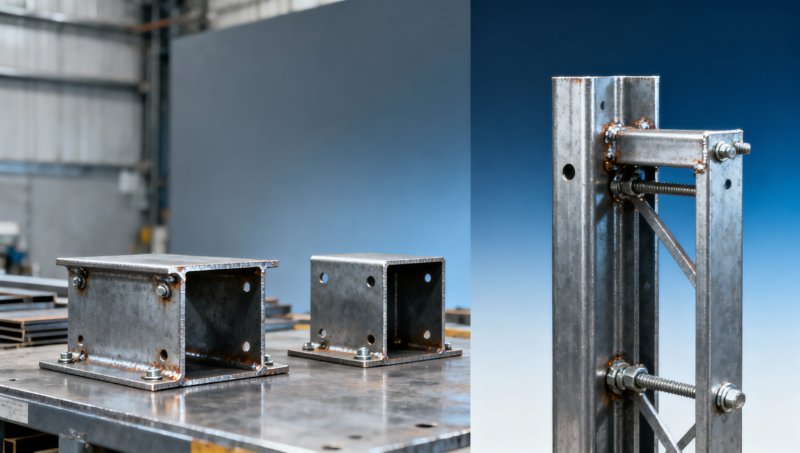
If your small frame needs straightforward fabrication, accessible welding surfaces, easy bolting, and cost control, angle iron for construction is often the stronger commercial choice. If the frame must resist twisting, look more finished, or carry multi-directional loads with a cleaner section shape, tube steel may be the better option.
As a practical rule:
- Choose angle iron for utility frames, bracing, supports, racks, base frames, and installations where open geometry is acceptable and fast fabrication matters.
- Choose tube steel for architectural frames, exposed structures, compact assemblies, and applications where torsional rigidity and appearance matter more.
This distinction matters to multiple decision-makers. Engineers care about section behavior and connection design. Buyers care about tonnage, processing cost, and lead time. Project managers care about install speed and rework risk. Maintenance teams care about drainage, corrosion exposure, and inspection access.
What Buyers and Engineers Usually Care About Most
For this topic, readers are rarely looking for textbook definitions. They usually want answers to five practical questions:
- Which option is strong enough for my frame without unnecessary cost?
- Which one is easier to cut, weld, drill, and assemble?
- How do connections change between angle and tube sections?
- Which material creates fewer long-term maintenance problems?
- Which profile is more available and easier to source consistently?
These are the questions that should drive the decision. In small frames, material price alone does not tell the full story. Labor, connection details, fit-up tolerance, surface treatment, and downstream installation often affect total project cost more than the section itself.
Where Angle Iron for Construction Has Practical Advantages
Angle iron remains a common choice in construction and industrial fabrication because it delivers a useful combination of structural efficiency and simple processing. In small frames, its biggest advantage is not that it always has higher strength than tube steel, but that it often creates a more economical system.
1. Easier connection design and field work
Angle sections provide open legs that are easy to drill, bolt, weld, clip, or overlap. This can reduce shop complexity and improve installation speed on site.
2. Lower fabrication difficulty for simple assemblies
For many support frames, L-shaped sections require less coping and simpler joint preparation than closed hollow sections. That can save labor, especially on low- to medium-volume projects.
3. Better access for inspection and touch-up
Open sections are easier to inspect after fabrication and coating. If paint damage or local corrosion appears later, repairs are often more accessible than with enclosed sections.
4. Good fit for bracing and edge support applications
Angle iron works especially well where loads are mostly in one or two directions, such as edge frames, mounting supports, corner reinforcement, shelving frames, brackets, and light-duty platforms.
5. Often more cost-effective in basic structural use
When appearance is not the top priority, angle iron can deliver lower total cost due to easier processing and simpler joins, even if section selection must be slightly heavier in some cases.
This is why angle iron for construction is still widely specified in practical, budget-sensitive projects: it supports efficient execution, not just acceptable structural performance.
When Tube Steel Is the Better Choice
Tube steel, including square and rectangular hollow sections, can outperform angle iron in applications where the frame experiences twisting, eccentric loading, or visible exposure. Because it is a closed section, it generally offers better torsional behavior and a more uniform response in multiple directions.
Tube steel is often preferred when:
- The frame must look clean and modern
- Loads are not aligned neatly with one leg or one plane
- The assembly is compact and needs better stiffness-to-envelope performance
- The design uses repetitive welded frames in controlled shop fabrication
- User safety or handling favors smoother edges and fewer open corners
However, these benefits come with trade-offs. Tube steel may require more careful end preparation, more controlled welding procedures, and better corrosion planning if moisture can become trapped inside the section.
Strength Is Not Just About Section Type
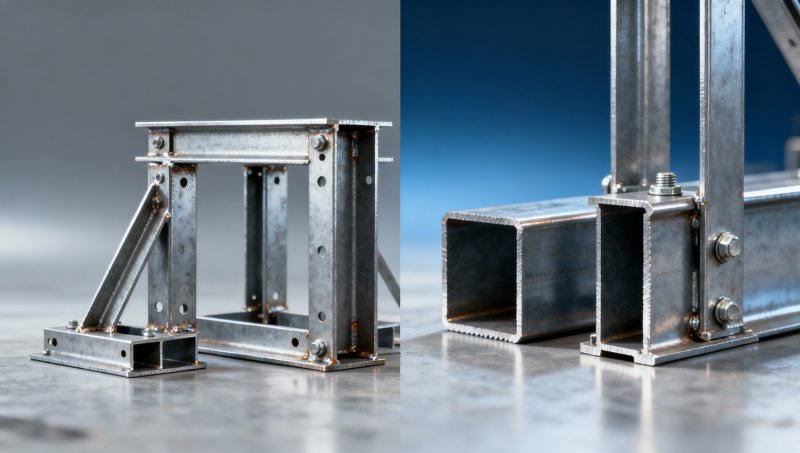
One of the most common mistakes in material selection is assuming tube steel is always stronger, or angle iron is always cheaper and therefore weaker. In reality, frame performance depends on much more than section category.
Key factors include:
- Section size and thickness
- Span and support conditions
- Load direction and eccentricity
- Connection design
- Weld quality and heat input control
- Base anchorage and interaction with concrete or other supports
For example, a poorly connected tube frame can underperform compared with a well-detailed angle iron frame. Likewise, an undersized angle member may deflect too much even if its nominal strength appears acceptable. Small frames should be assessed as systems, not as isolated steel shapes.
This is also where adjacent material decisions matter. If the frame is anchored into a slab or pedestal, the reinforcing design matters as much as the steel shape itself. In many installations, the performance of the support depends on proper coordination with rebar for concrete slab design, anchor layout, and local bearing checks. If the project includes curved or formed components, structural steel bending capability may also influence whether a profile is practical to fabricate at scale.
Cost Comparison: Material Price vs Total Installed Cost
Procurement teams often start with unit price, but total installed cost is the more useful metric. A lower-cost steel profile may become more expensive after cutting, fitting, welding, coating, transport, and erection.
Angle iron may reduce total cost when:
- The design uses many simple bolted or fillet-welded connections
- Field modifications are likely
- The project values speed and flexibility over appearance
- Section availability is strong in local or export markets
Tube steel may justify higher cost when:
- The frame count is high and fabrication is standardized
- A cleaner finished product supports commercial value
- Higher torsional rigidity reduces the need for extra bracing
- Compact geometry lowers overall assembly footprint
For international sourcing, buyers should compare not only raw material cost but also standard compliance, dimensional tolerance, packaging, coating readiness, and container utilization. A reliable structural steel manufacturer with stable production and quality control can reduce hidden cost more effectively than a slightly lower initial quote.
Fabrication, Welding, and Surface Considerations
Fabrication teams usually feel the difference between angle iron and tube steel immediately. Angle sections are generally easier to clamp, align, and connect in open assemblies. Tube steel can produce neater finished frames but may require more precise fit-up and welding discipline to avoid distortion.
For projects that combine structural performance with decorative or corrosion-resistant surfaces, related flat products may also be used for cladding, infill, or equipment panels. In these mixed-material assemblies, products such as 201 Stainless Steel Plate can be inserted where appearance, formability, and surface finish matter more than primary load-bearing duty. With tensile strength ≥ 520 MPa, yield strength ≥ 275 MPa, elongation ≥55–60, and finish options such as 2B / BA, No.4 / Hairline, and Mirror (8K), it is commonly used in architectural decoration, kitchen equipment, industrial hardware, transportation components, and urban infrastructure details. This type of material is especially useful when a project includes formed covers, enclosures, decorative facing, or fabricated accessories that must be easy to bend, deep-draw, and weld while maintaining a clean appearance.
That said, stainless plate should not be treated as a substitute for structural member selection without proper engineering review. The right approach is to match each material to its actual role in the assembly.
Corrosion, Maintenance, and Safety Risks to Consider
Long-term performance often changes the best choice. Open and closed sections behave differently in real environments.
Angle iron concerns:
- Exposed corners can be vulnerable in aggressive environments
- Open geometry may collect debris in some orientations
- Unprotected carbon steel requires proper coating maintenance
Tube steel concerns:
- Water intrusion inside hollow sections can create hidden corrosion
- Drainage and sealing details must be considered carefully
- Inspection of internal surfaces is limited
For safety and quality teams, the decision should include not just structural adequacy but inspectability, coating coverage, weld accessibility, and expected maintenance cycle. In some environments, the easier inspection access of angle iron can be a practical advantage. In others, tube steel’s cleaner exterior may support better protective finishing.
How to Choose the Right Section for Your Small Frame
A simple decision framework can help:
- Define the real load condition. Is the frame mainly carrying vertical load, lateral load, torsion, vibration, or impact?
- Review connection method first. Bolted tabs, welded corners, base plates, and field assembly constraints often determine the most practical profile.
- Check fabrication resources. The better choice in theory may not be the better choice for your workshop or jobsite conditions.
- Estimate total installed cost. Include waste, labor, coating, transport, and future maintenance.
- Match the section to exposure level. Outdoor, wet, coastal, or chemical environments require more careful detail design.
- Confirm standards and sourcing stability. Consistent quality and dimensional control matter, especially for export or repeat production.
If the project is a light-duty support, bracket frame, rack, or basic utility structure, angle iron for construction will often be the more efficient option. If the project is a visible frame, compact equipment base, or structure with multi-directional loading and appearance requirements, tube steel may offer better overall value.
Final Decision: Which One Should You Use?
For most small, practical construction frames, angle iron is the better choice when you need easier fabrication, accessible connections, lower installed cost, and dependable field performance. Tube steel is the stronger candidate when torsional rigidity, appearance, and compact closed-section behavior are more important than connection simplicity.
The smartest decision is to evaluate the whole assembly: section behavior, connection design, environment, coating strategy, slab anchorage, fabrication method, and sourcing reliability. When these factors are reviewed together, the right answer usually becomes clear.
For buyers, engineers, and project teams sourcing structural steel internationally, working with a manufacturer that can supply angle steel, channels, beams, cold formed profiles, and customized components to ASTM, EN, JIS, and GB standards helps reduce risk and improve project outcomes. In small frames, the best material is rarely the one with the best brochure claim—it is the one that fits the job, the budget, and the build process most effectively.
Please give us a message


Please enter what you want to find