Choosing between A36 Carbon Steel Round Bar for structural applications and ASTM A572 Grade 50 is a critical decision for engineers, procurement teams, and project managers. Whether you need A36 Carbon Steel Round Bar for heavy duty use, industrial use, or general structural applications, understanding its specifications—yield strength, tensile range, weldability, and cost-efficiency—is essential. As a trusted structural steel manufacturer & exporter from China, Hongteng Fengda supplies ASTM-compliant A36 round bars with consistent quality, competitive lead times, and OEM support—helping global buyers optimize performance, compliance, and value.
Mechanical Properties Comparison: Yield Strength, Tensile Range, and Ductility
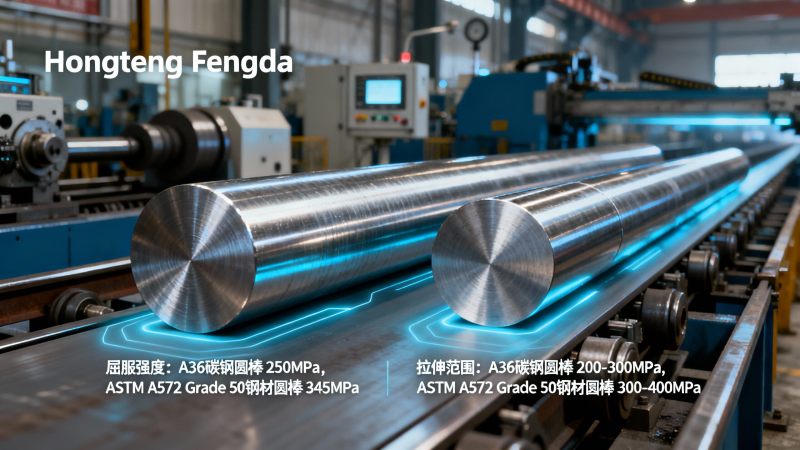
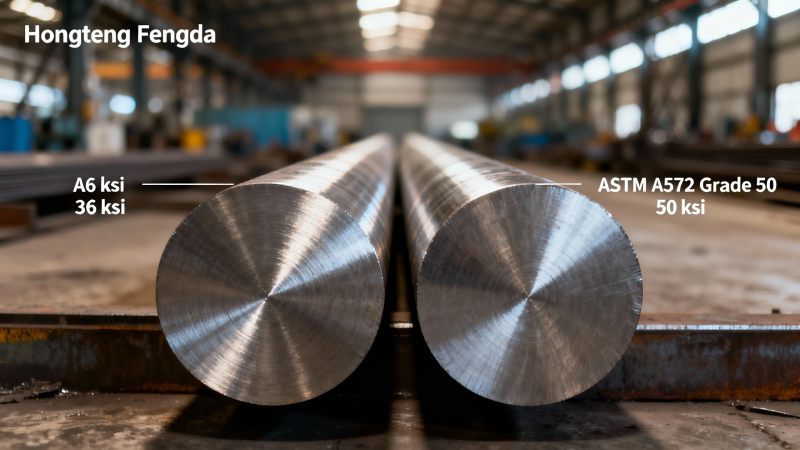
When evaluating material suitability for load-bearing frameworks, bridges, transmission towers, or heavy machinery components, mechanical properties serve as the foundational benchmark. A36 Carbon Steel Round Bar specifications define a minimum yield strength of 36 ksi (250 MPa) and a tensile strength range of 58–80 ksi (400–550 MPa), with elongation at break typically exceeding 20% in 200 mm gauge length. In contrast, ASTM A572 Grade 50 delivers a significantly higher minimum yield strength of 50 ksi (345 MPa), while maintaining comparable tensile strength (65–80 ksi / 450–550 MPa) and slightly reduced ductility—around 18% elongation. This difference directly influences design safety margins: A572 Grade 50 allows for slimmer cross-sections under equivalent loads, reducing dead weight and transportation costs in large-scale infrastructure projects. However, A36 remains widely preferred for non-critical secondary framing, anchor rods, and base plates where predictable plastic deformation and ease of field fabrication are prioritized over ultimate strength density. Both grades meet ASTM A6/A6M dimensional tolerances and undergo rigorous mill testing per ASTM A606 for surface quality and straightness. For A36 Carbon Steel Round Bar for industrial use—such as conveyor shafts, hydraulic cylinder rods, or pulley axles—the balanced combination of formability and moderate strength ensures reliable service life without excessive machining complexity.
Weldability, Machinability, and Fabrication Performance
Fabrication efficiency often determines project timelines and labor budgets more than raw material cost alone. A36 Carbon Steel Round Bar for structural applications excels in this domain due to its low carbon content (max 0.26%) and absence of intentional microalloying elements. Its carbon equivalent (CE) typically falls below 0.40%, enabling full-penetration welding using SMAW, GMAW, or FCAW processes without preheating in most thicknesses up to 1 inch (25 mm). Post-weld stress relief is rarely required unless cyclic loading or extreme environmental exposure is anticipated. ASTM A572 Grade 50, while still considered readily weldable, carries a higher CE (up to 0.45%) due to controlled additions of columbium and vanadium. This necessitates stricter adherence to preheat protocols—especially for sections over 19 mm thick—to avoid hydrogen-induced cracking. From a machining standpoint, A36 offers superior chip control during turning and threading operations, resulting in tighter dimensional repeatability and extended tool life. Its homogeneous ferrite-pearlite microstructure responds consistently to cold bending, punching, and shearing—critical for high-volume fabrication shops serving prefabricated building systems. For A36 Carbon Steel Round Bar for heavy duty use in mining equipment frames or crane booms, this predictability translates into fewer rework incidents and faster shop-floor throughput.
Cost Structure, Supply Chain Reliability, and Global Compliance
Material selection must be evaluated not only on technical merit but also on total landed cost—including unit price, logistics, customs clearance, and supply continuity. A36 Carbon Steel Round Bar specifications align with ASTM A276 and ASTM A484, ensuring seamless acceptance across North American, Middle Eastern, and Southeast Asian regulatory frameworks. As one of the most produced carbon steels globally, A36 benefits from economies of scale, stable billet sourcing, and minimal premium over hot-rolled bar stock. ASTM A572 Grade 50, though standardized, commands a 12–18% price premium due to tighter chemistry controls, enhanced rolling practices, and lower production volumes. For international buyers, this differential compounds with longer lead times—often 8–12 weeks versus 4–6 weeks for A36—particularly when ordering custom diameters or cut-to-length pieces. At Hongteng Fengda, our integrated production line enables just-in-time scheduling for both grades, backed by ISO 9001-certified QA/QC protocols, third-party SGS mill test reports, and EN 10204 3.1 documentation. We maintain strategic inventory of common A36 round bar sizes (from 1/2" to 8") to support urgent project needs, while offering OEM-specific heat traceability and packaging tailored to maritime export requirements. When evaluating A36 Carbon Steel Round Bar for industrial use across diverse geographies, consistency in documentation, labeling, and dimensional conformity reduces inspection delays and avoids costly demurrage charges at destination ports.
Application Mapping: Where Each Grade Delivers Optimal Value
Real-world project success hinges on matching material behavior to functional demands—not theoretical superiority. A36 Carbon Steel Round Bar for structural applications dominates in applications requiring high formability, robust weld integrity, and proven long-term performance under static or low-cycle fatigue conditions: foundation anchor bolts, stair stringers, guardrail posts, and light-duty crane rails. Its predictable thermal expansion coefficient (6.5 × 10⁻⁶ in/in·°F) ensures dimensional stability across seasonal temperature swings in exposed environments. ASTM A572 Grade 50 shines where weight reduction, fatigue resistance, and high-stress concentration tolerance are paramount—such as tension members in long-span trusses, seismic bracing systems, and offshore platform leg connections. Notably, neither grade is recommended for direct exposure to chloride-rich atmospheres or acidic chemical media without protective coating; in such cases, corrosion-resistant alternatives like 316 Stainless Steel Plate become technically necessary—offering molybdenum-enhanced pitting resistance and stable performance up to 870°C in aggressive process environments. Project managers must weigh lifecycle cost against initial investment: while A572 may reduce structural steel tonnage by 15–20%, A36’s broader availability and simpler qualification path often deliver faster ROI on mid-size commercial builds.
Why Partner with Hongteng Fengda for Your Structural Steel Needs?
Hongteng Fengda combines deep metallurgical expertise with agile manufacturing infrastructure to deliver structural steel solutions that balance performance, compliance, and commercial viability. Our A36 Carbon Steel Round Bar specifications are validated through daily spectrometric analysis, ultrasonic testing, and mechanical sampling per ASTM E8/E8M. With production facilities certified to GB/T 19001, ISO 14001, and OHSAS 18001, we ensure every shipment meets exacting dimensional, surface finish, and marking requirements—including optional laser etching of heat numbers and ASTM designation. For clients managing multi-site projects across North America and the EU, we provide consolidated logistics planning, bilingual technical documentation, and real-time production tracking via secure portal access. Whether you require A36 Carbon Steel Round Bar for industrial use in automotive assembly lines or customized A572 Grade 50 rounds for wind turbine tower flanges, our engineering team collaborates early in the design phase to validate specifications, recommend optimal heat treatments, and mitigate potential fabrication bottlenecks. As your long-term structural steel partner, we don’t just supply materials—we co-develop sourcing strategies that strengthen project resilience, reduce total cost of ownership, and uphold your reputation for quality execution.
In summary, A36 Carbon Steel Round Bar for structural applications offers unmatched versatility, cost-efficiency, and fabrication ease—making it the default choice for the majority of general construction and industrial applications. ASTM A572 Grade 50 provides targeted advantages in high-strength, weight-sensitive scenarios—but requires greater attention to welding procedures and procurement planning. There is no universal “better” grade—only the right specification aligned with your project’s technical, logistical, and financial parameters. To receive a detailed comparative datasheet, request a free sample pack, or consult with our structural steel application engineers, contact Hongteng Fengda today.
- ASTM A572
- structural steel
- Structural Steel
- stainless steel plate
- 316 stainless steel plate
- ss steel plate
- steel plate
- A36 Carbon Steel Round Bar
- carbon steel
- steel round bar
- A36 Carbon Steel Round Bar for industrial use
- A36 Carbon Steel Round Bar specifications
- A36 Carbon Steel Round Bar for structural applications
- A36 Carbon Steel Round Bar for heavy duty use
Related recommendations
 How much does 2 inch ss pipe price increase when upgrading from Schedule 40 to Schedule 80 for high-pressure systems?2 inch ss pipe price increases 18–35% when upgrading from Sch 40 to Sch 80—discover why, when it’s truly needed, and how to avoid overpaying.
 Which 304 stainless steel coil suppliers meet ISO 9001 and EN 10088-2 for food-grade fabrication?Discover verified 304 stainless steel coil suppliers meeting ISO 9001 & EN 10088-2 for food-grade fabrication—traceable, audited, and ready for regulatory validation.
 How does 2 inch ss pipe price compare between 304 and 316 grades for marine environments?2 inch ss pipe price varies significantly between 304 and 316 — but in marine environments, choosing 304 risks costly failures. Discover why 316 is the true value choice.
 Is 20 feet square pipe price affected more by raw material volatility or regional logistics costs?20 feet square pipe price is driven primarily by raw material volatility—not logistics. Discover why billet costs dominate pricing & how to forecast smarter with Hongteng Fengda.
Please give us a message


Please enter what you want to find