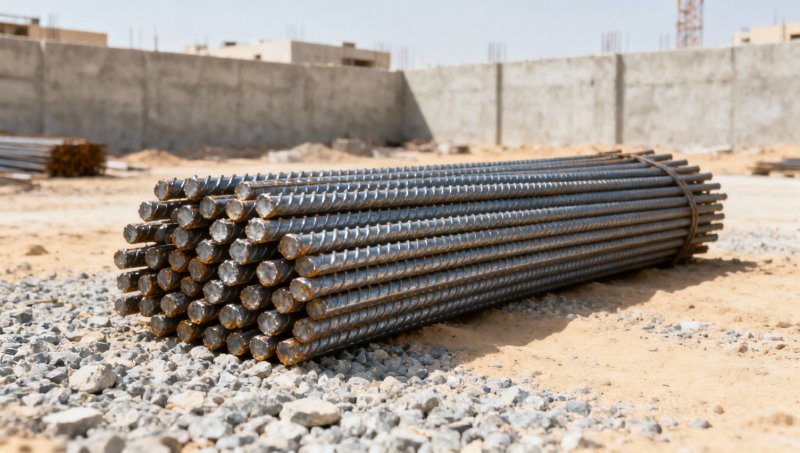
When rebar for construction arrives on a GCC job site without mill test certificates (MTCs), the delay isn’t just bureaucratic—it’s structural, contractual, and often irreversible. This isn’t a paperwork hiccup. It’s a compliance failure that halts pouring, triggers third-party lab testing, invalidates insurance coverage, and in some cases, forces full rebar replacement—even after concrete has been placed.
Why “No MTC” Means “No Go” in Saudi Arabia, UAE, and Qatar
In the GCC, rebar compliance isn’t governed by one standard—it’s enforced through overlapping layers: national building codes (like UAE’s DMCC or Saudi’s SBC 304), mandatory GSO certification (GSO 1596 for deformed steel bars), and project-specific specifications requiring ASTM A615/A706 (US) or EN 10080 (EU). Crucially, these aren’t optional add-ons. They’re embedded into tender documents, contract clauses, and municipal inspection protocols.
Here’s what actually happens when uncertified rebar shows up:
- Immediate hold at site gate: Most major contractors (e.g., Arabtec, Al-Futtaim, Nesma) now require MTCs before unloading—verified against batch numbers, heat IDs, and physical bar markings. No certificate = no offloading.
- Third-party testing cascade: If accepted conditionally, the contractor must arrange independent testing per ASTM A615 Section 8 or EN 10080 Clause 7.3. That adds 5–12 working days—and costs USD 800–2,200 per test batch. One failed tensile or bend test? All rebar from that heat is rejected.
- Concrete pour stoppage: Once rebar is installed but not certified, inspectors won’t sign off on formwork or reinforcement inspection reports (RIRs). No RIR = no concrete pour approval. In high-rise projects, this stalls critical path activities for weeks—not days.
- Contractual liability exposure: Under FIDIC Red Book Clause 2.1 and GCC civil codes, using uncertified materials voids warranty periods and may invalidate professional indemnity insurance. If a structural issue arises later—even unrelated—the absence of traceable MTCs becomes prima facie evidence of due diligence failure.
This isn’t theoretical. In three separate infrastructure projects across Riyadh and Doha over the past 18 months, uncertified rebar shipments triggered formal non-conformance reports (NCRs) that delayed handover by 6–14 weeks—each costing the employer an estimated USD 1.2–3.7 million in liquidated damages and extended supervision fees.
What’s Really Inside That MTC—And Why “Copy-Paste” Certificates Fail
An MTC isn’t a generic quality statement. It’s a legally binding, heat-specific record linking raw material chemistry, rolling parameters, mechanical test results, and dimensional verification to a unique production batch. A valid MTC must include:
- Heat number (not just batch or lot number)
- Chemical composition (C, Mn, Si, S, P, V, Nb, etc.)—verified against ASTM A615 Table 1 or EN 10080 Annex A
- Tensile strength, yield strength, elongation, and bend test results—with actual measured values, not “meets spec” statements
- Date of testing, lab accreditation number (e.g., SASO-accredited labs in KSA), and signature of authorized metallurgist
- Traceability to the original billet cast (for full audit trail)
Certificates missing any of these—or worse, bearing mismatched heat numbers between document and bar stamp—are treated as fraudulent. GCC authorities increasingly cross-check MTCs against manufacturer databases and lab accreditation registers. Duplicate or recycled MTCs are now flagged automatically in digital submission portals like Dubai’s e-Permit system.
The China Sourcing Trap: When “Certified” Isn’t Enough
Many project managers assume sourcing rebar for construction from China means choosing between low cost and compliance. That’s outdated—and dangerous. The real risk isn’t price; it’s *traceability*. Some Chinese mills issue MTCs that meet ASTM/EN *on paper*, but lack integration with production systems. Their heat numbers don’t map to furnace logs. Their test data isn’t archived beyond 90 days. Their labs aren’t accredited to ISO/IEC 17025 for reinforcing steel testing.
That creates a false sense of security. You get the certificate—but when the Doha Municipality requests furnace log verification or the Saudi Aramco QA team audits your supplier’s lab records, the chain breaks. And the delay shifts from “waiting for test results” to “replacing all rebar in the foundation slab.”
Reliable suppliers don’t just issue MTCs—they embed certification into their manufacturing DNA: real-time heat tracking, integrated LIMS (Laboratory Information Management Systems), and dual-signature release protocols where both the mill QA manager and an independent third-party inspector sign off before dispatch.
How to Prevent This—Before the First Shipment Leaves Port
Prevention starts at procurement—not inspection. Here’s what works on the ground:
- Require pre-shipment MTC validation: Don’t wait for arrival. Ask your supplier to submit MTCs + heat-stamped photos + mill production logs *before* loading. Verify heat numbers match across all three documents.
- Confirm lab accreditation scope: Check that the issuing lab’s ISO/IEC 17025 certificate explicitly lists ASTM A615/A706 or EN 10080 testing—not just general metal testing.
- Specify GSO alignment upfront: For GCC-bound shipments, require MTCs formatted per GSO 1596 Annex B, with Arabic/English bilingual headers and GSO-compliant chemical limits (e.g., max 0.045% S for Grade 60).
- Assign internal traceability ownership: Designate one person—ideally the site QA engineer—to own MTC verification from PO to pour. Track every heat number in a live register linked to bar marking photos and delivery notes.
For structural steel components beyond rebar—like beams, columns, or truss members—certification rigor doesn’t relax. It intensifies. That’s why manufacturers serving GCC markets increasingly align broader product lines with the same traceability standards. For instance, Cold Rolled Steel Coil used in factory-built steel frameworks or curtain wall support components follows parallel documentation protocols: heat-specific MTCs, EN 10025-2 compliance, and third-party witnessed testing—ensuring the entire structural envelope remains audit-ready from foundation to façade.
When Delay Is Already Happening—What to Do Next
If uncertified rebar is already on site:
- Do not install it. Even partial installation triggers full NCR escalation.
- Segregate immediately. Tag and isolate all bundles by heat number. Photograph bar stamps and packaging labels.
- Contact your supplier—now. Request original furnace logs, test raw data files (not PDFs), and lab accreditation proof. If they hesitate, assume the MTC is invalid.
- Engage a GSO-recognized lab for urgent testing. Prioritize tensile and bend tests first—these determine immediate usability. Chemical analysis can follow.
- Update your client and consultant—transparently. Delay mitigation begins with early disclosure. Hiding the issue guarantees worse penalties.
Ultimately, MTCs aren’t about passing inspections. They’re about proving you know—exactly—what went into the structure holding up people’s lives. In the GCC, where megaprojects define national ambition, that proof isn’t optional. It’s the baseline.
Please give us a message


Please enter what you want to find