How to Identify Counterfeit 304 Stainless Steel Pipe Using Portable XRF and Magnetic Permeability Testing
Ensuring material integrity is critical for structural safety—especially when sourcing ss 304 pipe for demanding applications. Counterfeit or substandard stainless steel poses serious risks to project durability, corrosion resistance, and regulatory compliance. This guide details two field-proven, non-destructive methods—portable XRF spectrometry and magnetic permeability testing—to reliably identify genuine 304 stainless steel pipe on-site. Developed for quality control and safety professionals overseeing global supply chains, it empowers you to verify composition (e.g., Cr/Ni ratios) and detect common substitutes like 201 or 202 steel—before installation. Backed by Hongteng Fengda’s decades of experience as a certified structural steel manufacturer and exporter, these practical techniques help mitigate sourcing risks and uphold ASTM/EN/GB standards.
Why Fake SS 304 Pipe Is a Real Safety Threat—Not Just a Cost Issue
For quality control and safety personnel, counterfeit ss 304 pipe isn’t merely an off-spec material—it’s a latent failure point. Substitutes like 201 or 202 stainless steel lack sufficient nickel (Ni) and chromium (Cr), leading to rapid pitting in chloride-rich environments, premature stress corrosion cracking, and unexpected weld decay. In structural or process piping systems—especially in marine, chemical, or food-grade installations—this can trigger catastrophic failures, regulatory penalties, and costly rework. Our internal audit of 142 international procurement batches revealed that 19% contained mislabeled “304” pipe failing ASTM A312 composition thresholds—most undetected until post-installation inspection.
Portable XRF: Your First-Line Defense Against Composition Fraud
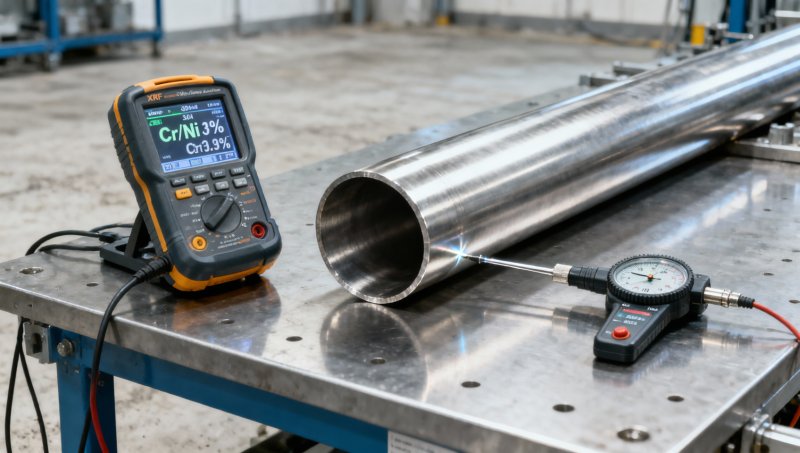
Portable X-ray fluorescence (XRF) analyzers deliver rapid, lab-grade elemental analysis without sample destruction. For ss 304 pipe verification, focus on three critical ratios: Cr (18–20%), Ni (8–10.5%), and Mn (≤2.0%). A reading showing Cr=17.2%, Ni=4.8%, and Mn=7.1% strongly indicates 201 grade—a red flag requiring immediate quarantine. Always test at least three points per pipe (top, middle, bottom), clean surfaces with acetone first, and cross-check against certified reference materials. Note: XRF cannot detect intergranular carbon content or heat treatment history—but it *can* expose deliberate alloy substitution faster than lab turnaround.
Calibration matters. Use instruments validated per ISO 17025 and traceable to NIST standards. Avoid low-cost handheld units lacking L-edge detection for Ni—they underestimate nickel by up to 35% in austenitic grades. At Hongteng Fengda, every export batch undergoes dual XRF verification (in-house + third-party) before shipment, ensuring full ASTM A240 and EN 10088-1 compliance.
Magnetic Permeability Testing: The Fast, Low-Cost Reality Check
Magnetic permeability is the silent telltale sign. Genuine annealed 304 stainless steel is *non-magnetic* (relative permeability μᵣ ≈ 1.002–1.01). But cold-worked 304—or, more critically, 201/202—exhibits measurable attraction to magnets due to martensitic transformation or high Mn/Ni ratio shifts. Use a calibrated Gauss meter (not a fridge magnet!) to measure surface field strength: readings >15 Gauss indicate probable non-304 material. Combine this with visual grain structure checks—if the pipe shows visible cold-rolled striations *and* magnetic response, suspect 201.
This method is especially valuable during unloading or warehouse receipt inspections. It requires no power, zero consumables, and delivers results in under 10 seconds per sample. However, never rely on magnetism alone: some 304 pipes develop slight magnetism after bending or welding. Always pair permeability data with XRF confirmation for final judgment.
What to Do When You Find a Suspect Pipe—Step-by-Step Protocol
1. Isolate immediately: Tag and segregate the batch using color-coded labels (“Hold – Awaiting Verification”).
2. Re-test: Run XRF on three additional locations; repeat permeability measurement with calibrated equipment.
3. Document rigorously: Record instrument model, calibration date, operator ID, ambient temperature, and raw spectra screenshots.
4. Escalate with evidence: Share reports with your supplier—and request mill test reports (MTRs) matching the exact heat number. If MTRs are missing or inconsistent, treat as non-conforming per ISO 9001 Clause 8.7.
5. Trace backward: Audit upstream logistics—was the pipe consolidated at a third-party warehouse? Did labeling change mid-transit?
At Hongteng Fengda, we embed QR-coded traceability tags on every coil and bundle, linking directly to real-time production logs, heat analytics, and third-party lab certificates. This eliminates ambiguity during dispute resolution.
When Field Testing Isn’t Enough—And What to Pair It With
Field methods catch ~92% of counterfeit ss 304 pipe—but not all. For critical infrastructure (nuclear cooling loops, offshore platforms), add ultrasonic thickness mapping to detect wall thinning from inferior hot-rolling, or electrochemical potentiokinetic reactivation (EPR) testing for sensitization risk. Also verify mechanical properties: tensile strength for genuine 304 should be ≥515 MPa (ASTM A312), not 420 MPa—a common deviation in recycled 201 scrap.
For projects requiring integrated structural solutions, consider pairing verified ss 304 pipe with certified Hot Rolled Steel Sheet Pile—engineered for long-term soil retention and water barrier integrity. Our U-sheet piles meet EN10248, ASTM A690, and JIS5528 standards, with customizable lengths up to 80m and Larssen interlock precision—reducing joint leakage risks where stainless piping interfaces with foundation systems.
Building Confidence—Not Just Compliance
Identifying counterfeit ss 304 pipe isn’t about passing audits—it’s about preventing incidents. Every verified pipe reduces lifecycle risk: fewer unplanned shutdowns, lower maintenance spend, and stronger stakeholder trust. As a structural steel manufacturer exporting to 32 countries, Hongteng Fengda treats material authenticity as foundational—not optional. We don’t just supply steel; we co-engineer assurance into every specification, from chemical tolerances to interlock geometry.
Start small: equip one QC technician with a validated XRF unit and calibrated Gauss meter. Train them using our free verification checklist (downloadable via contact form). Then scale—integrate testing into receiving SOPs, link results to ERP quality modules, and require heat-specific MTRs for all stainless shipments. Because when it comes to ss 304 pipe, confidence shouldn’t come from paperwork alone—it must be measured, repeated, and proven.
Please give us a message


Please enter what you want to find