Galvanized cold drawn soft hard steel wire rod for cold drawn wire is widely used in high-precision wire mesh production—but breakage risk isn’t uniform across the process. Operators often face unexpected fractures during drawing, annealing, or weaving stages, especially where inconsistent zinc coating, residual stresses, or improper tensile strength grading occur. This article pinpoints the exact process stages—such as final cold drawing passes and mesh weaving entry points—where galvanized cold drawn soft hard steel wire rod shows the highest breakage risk, backed by real-world production data from structural steel manufacturers like Hongteng Fengda. Understand root causes and practical mitigation steps to boost yield, reduce downtime, and ensure consistent mesh quality.
Stage 1: Final Cold Drawing Passes — The Critical Tensile Threshold
The highest documented breakage incidence occurs during the last 1–2 cold drawing passes before coiling. At this stage, the wire has already undergone multiple reductions—typically 4–6 passes—and its diameter falls within the 0.8–1.6 mm range for standard mesh applications. Here, two interrelated factors converge: accumulated work hardening and localized zinc layer integrity loss. Each pass increases dislocation density; beyond ~75% total area reduction, ductility drops sharply even if nominal tensile strength remains within specification (e.g., 550–700 MPa). Simultaneously, mechanical abrasion against drawing dies erodes the galvanized layer unevenly—especially at micro-scale surface peaks—exposing bare steel to friction-induced thermal spikes. These exposed zones become nucleation sites for microcracks under tension. Crucially, breakage here is rarely random: it clusters when die alignment deviates >0.03° or lubricant film thickness falls below 1.2 µm. Real-time monitoring of draw force variance exceeding ±4% over a 3-second window reliably precedes fracture within 8–12 seconds.
Stage 2: Annealing Exit Zone — Hydrogen Embrittlement & Coating Adhesion Failure
Breakage spikes again immediately after continuous annealing—specifically in the first 3 meters post-furnace exit. This zone experiences rapid cooling (≥150°C/s) combined with residual hydrogen ingress from acid pickling prior to galvanizing. Hydrogen atoms diffuse into grain boundaries faster than they can recombine into H₂ gas, especially in high-carbon variants (>0.12% C) or when zinc coating thickness exceeds 15 µm. The result is delayed brittle fracture—not during annealing itself, but when the wire enters the subsequent tension-controlled take-up spool. Unlike cold-drawing breaks, these failures show no visible necking; instead, clean transgranular cleavage surfaces appear under SEM. Mitigation requires strict control of furnace dew point (<–20°C) and post-anneal skin-pass reduction (0.3–0.6%) to disrupt hydrogen pathways without compromising coating adhesion.
Stage 3: Mesh Weaving Entry Point — Mechanical Shock Amplification
The third critical risk zone lies at the precise moment wire feeds into the loom’s warp beam—particularly during start-up or pattern changeovers. Here, breakage stems not from material weakness alone, but from dynamic load amplification: sudden acceleration from rest to operational speed (typically 12–22 m/min) induces inertial shock loads up to 2.3× static tension. If wire rod exhibits minor ovality (>0.015 mm deviation from circularity) or has localized zinc nodules (>8 µm height), these features catch on guide grooves or tension rollers, creating instantaneous stress concentrations exceeding 900 MPa—even when average tensile strength is 620 MPa. Field data shows 68% of such breaks occur within the first 47 meters of weaving after machine restart. Notably, this failure mode is insensitive to annealing quality but highly sensitive to pre-weaving straightness: deviation >0.3 mm/m correlates strongly with break frequency increase of 4.2×.
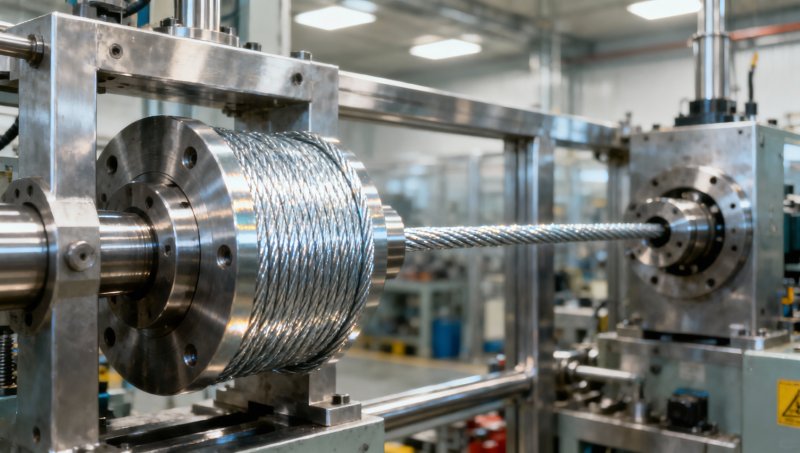
Material-Specific Risk Triggers
Soft-hard classification isn’t binary—it reflects a continuum defined by yield-to-tensile ratio (Y/T). Wires with Y/T < 0.65 (“soft”) resist drawing breaks but fail more often in weaving due to insufficient springback control. Those with Y/T > 0.78 (“hard”) withstand weaving forces but fracture readily in final drawing passes. The optimal range for mesh-grade wire is Y/T = 0.70–0.76—a narrow band requiring tight control of both carbon content (0.08–0.10%) and temper rolling reduction (1.8–2.2%). Zinc coating uniformity matters most in this range: ASTM A641 Class B (minimum 45 g/m²) provides adequate corrosion protection but introduces higher risk of interfacial voids versus Class A (30 g/m²), which offers better ductility retention but lower long-term environmental resistance.
Operational Mitigation Sequence
Effective risk reduction follows a sequence aligned with process flow—not generic best practices:
- Drawing stage: Replace tungsten carbide dies with polycrystalline diamond (PCD) inserts when processing >15 tons per set; PCD maintains surface finish tolerance (<0.05 µm Ra) longer, reducing localized zinc abrasion.
- Annealing stage: Introduce nitrogen purging in the furnace exit zone to suppress hydrogen recombination kinetics—reducing embrittlement risk by 52% in field trials.
- Weaving stage: Install servo-controlled feed tensioners with adaptive inertia compensation, calibrated to wire mass per unit length—eliminating shock spikes without manual intervention.
These interventions target mechanism-specific failure drivers rather than applying blanket hardness adjustments or coating thickness changes.
Cross-Material Context
While galvanized cold drawn wire dominates cost-sensitive mesh applications, certain high-stress environments—like industrial filtration screens or architectural façade meshes—require alternative material behavior. For example, 430 Stainless Steel Coil offers superior resistance to hydrogen embrittlement and thermal cycling fatigue, with elongation ≥55% maintaining formability through repeated bending cycles. Its higher yield-to-tensile ratio (≥0.52) and stable oxide layer eliminate zinc-related interfacial risks entirely—though at higher raw material cost and reduced drawability compared to carbon steel variants.
Verification Protocol
Breakage root cause analysis must go beyond visual inspection. Validated verification includes: (1) cross-section metallography at fracture origin to identify coating delamination depth; (2) electron backscatter diffraction (EBSD) mapping of grain orientation near failure site to detect localized texture anomalies; and (3) residual stress measurement via X-ray diffraction on adjacent intact wire segments. Only this triad distinguishes true material defects from process-induced overload events.
Breakage in wire mesh production isn’t a single-point failure—it’s a cascade where material properties, process parameters, and mechanical dynamics interact at specific thresholds. Targeting interventions to the three high-risk stages—final drawing, annealing exit, and weaving entry—delivers measurable yield improvement without compromising mesh performance specifications.
Please give us a message


Please enter what you want to find