Galvanized electrical conduit—often specified alongside ASTM A106 Gr.B pipe, mild steel plate, and angle stainless steel for industrial integration—frequently fails prematurely in humid industrial sites. This unexpected degradation undermines safety, increases maintenance costs, and raises red flags for project managers, procurement teams, and safety personnel. While I beam vs H beam selection impacts structural integrity, conduit performance hinges on galvanizing quality, steel wire galvanized consistency, and material compliance (ASTM, EN, GB). As a trusted structural steel manufacturer and exporter, Hongteng Fengda investigates root causes—from zinc coating thickness to substrate preparation—and delivers durable, standards-compliant solutions that extend service life in demanding environments.
Why Humidity Accelerates Galvanized Conduit Failure
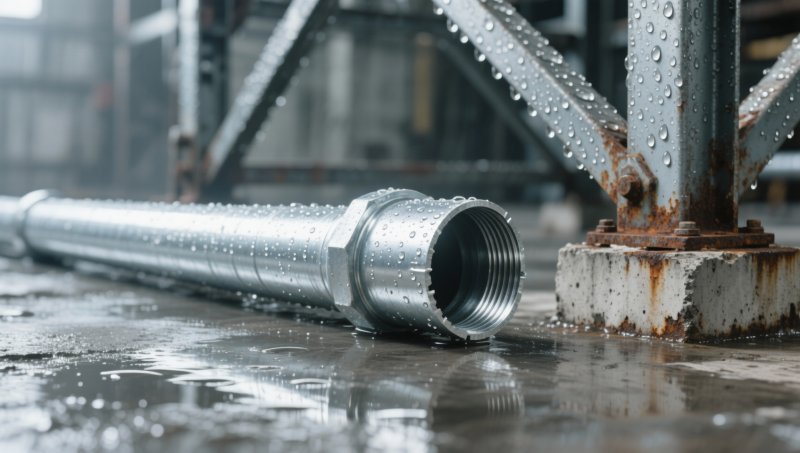
Humid industrial environments—especially those with salt-laden air (coastal refineries), condensation cycles (cold storage plants), or chemical vapors (chemical processing lines)—create ideal conditions for localized corrosion beneath the zinc layer. When relative humidity exceeds 70% for prolonged periods and surface temperature drops below dew point, micro-condensation forms at coating defects, initiating electrochemical reactions.
The failure sequence is rarely uniform: first, white rust (zinc hydroxide) appears within 3–6 months; then, red rust emerges at scratches or cut ends by month 9–12; finally, perforation occurs in high-stress zones like bends or clamped sections after 18–24 months—well before the expected 25-year service life under ISO 1461 specifications.
Critical factors include inconsistent hot-dip galvanizing bath chemistry (zinc purity <99.995%), insufficient immersion time (<3 minutes), and poor pre-treatment—particularly inadequate acid pickling or flux residue. These flaws reduce effective coating thickness from the nominal 85 µm (ASTM A123 Class C) to as low as 42 µm at vulnerable points.
How Galvanizing Quality Impacts Real-World Durability
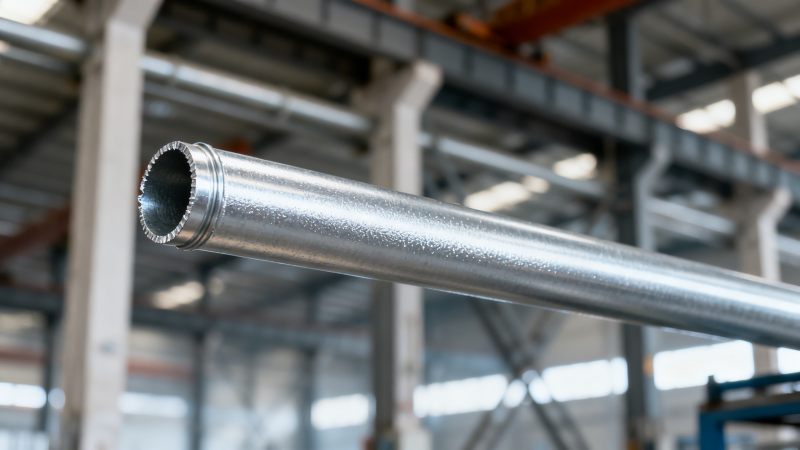
Zinc coating performance isn’t just about thickness—it’s about metallurgical bond integrity and uniformity. Poorly prepared steel substrates (e.g., mill scale not fully removed or silicon content >0.04%) cause “sandwich” layers where zinc peels off instead of alloying. In humid sites, such weak interfaces allow moisture ingress within hours—not weeks.
Hongteng Fengda applies triple-stage surface prep: alkaline degreasing → hydrochloric acid pickling (with inhibitor) → ammonium chloride fluxing. Each batch undergoes spectrometric verification of zinc bath composition and thermal profiling to maintain ±2°C control during dip. This ensures coating adhesion strength ≥7.0 MPa (per ASTM B571) and hardness ≥170 HV.
For applications like substation ancillary facilities or marine components—where ambient salinity exceeds 50 mg/m³—our Galvanized Round Steel achieves 120 µm minimum thickness per EN ISO 1461 Annex B, validated via magnetic induction testing at 5 points per meter.
Coating Performance Comparison Across Production Methods
This table confirms why electrogalvanized conduit fails rapidly in humid zones: thin coatings lack sacrificial capacity. Even standard hot-dip suffers from batch variability. Hongteng Fengda’s process eliminates both issues through controlled bath dynamics and mandatory post-galvanizing inspection.
Procurement Checklist: 5 Non-Negotiables for Humid-Site Projects
When specifying conduit for humid industrial sites, procurement and technical evaluation teams must verify these five criteria—before PO issuance:
- Zinc coating thickness measured per ASTM E376 (minimum 95 µm on all surfaces, including threads and bends)
- Certificate of Conformance showing full compliance with ASTM A123 / EN ISO 1461, including batch-specific test reports
- Surface roughness Ra ≤ 3.2 µm (critical for paint-over compatibility in hybrid protection systems)
- Cut-end treatment protocol: centrifuged spin-off + post-dip sealing (not brush-applied zinc-rich paint)
- Traceability: laser-etched batch ID on every 3-meter section for field verification
Skipping any item risks premature failure. For example, unsealed cut ends corrode 4× faster than intact surfaces—accelerating system-wide degradation even if main body meets spec.
Why Structural Steel Manufacturers Are Better Partners Than Commodity Suppliers
Conduit isn’t a standalone component—it integrates with structural steel frameworks, grounding systems, and support infrastructure. A dedicated structural steel manufacturer like Hongteng Fengda brings cross-system expertise that commodity galvanizers lack:
We co-engineer conduit mounting solutions with our angle steel and channel steel systems—ensuring mechanical compatibility, thermal expansion matching (CTE ≤12 × 10⁻⁶/K), and unified corrosion resistance. Our cold-formed steel profiles use identical galvanizing parameters as conduit, eliminating galvanic couples at junctions.
Global buyers across North America, Europe, and Southeast Asia rely on us for consolidated sourcing: one supplier, one QC protocol, one delivery schedule. Typical lead time is 25–35 days from confirmed specs—including dimensional validation, salt spray certification, and packaging for maritime transport.
Get Project-Ready Support Today
If your next industrial project faces high humidity, chemical exposure, or coastal conditions—we help you eliminate conduit failure risk at source. Our engineering team provides free technical review of conduit specifications, including coating thickness mapping, bend radius analysis, and integration checks against your structural steel framework.
You’ll receive: (1) ASTM/EN-compliant test reports for your exact order; (2) custom-cut lengths with sealed ends; (3) OEM labeling and documentation for audit readiness; and (4) 24-month warranty covering coating integrity and dimensional stability.
Contact Hongteng Fengda now for: conduit diameter & length confirmation, zinc thickness specification alignment, delivery timeline validation, or sample submission for third-party lab testing. We respond to technical inquiries within 4 business hours.
Please give us a message


Please enter what you want to find