When comparing an I beam weight calculator with mill data, many buyers, engineers, and project teams notice small but important differences. These gaps can affect material estimates, cost control, and specification checks for structural steel beams for construction. Understanding how an I beam weight chart or steel beam weight calculator is built helps you make better sourcing and technical decisions, especially when accuracy matters across design, procurement, and fabrication.
In steel procurement, even a small variance such as 1.5% to 3% in theoretical versus actual beam weight can influence freight planning, quotation review, cutting schedules, and project budgeting. For technical evaluators, the issue is not whether a calculator is useful, but when it is sufficient and when mill certificates, standards, or inspection records should take priority.
This topic matters to a wide group of decision-makers: fabricators comparing section sizes, purchasing teams checking supplier offers, quality personnel verifying tolerances, and project managers balancing load requirements with delivery targets. In structural steel supply, accurate weight data is tied directly to compliance, cost, and execution speed.
Why calculator results and mill data are not always identical
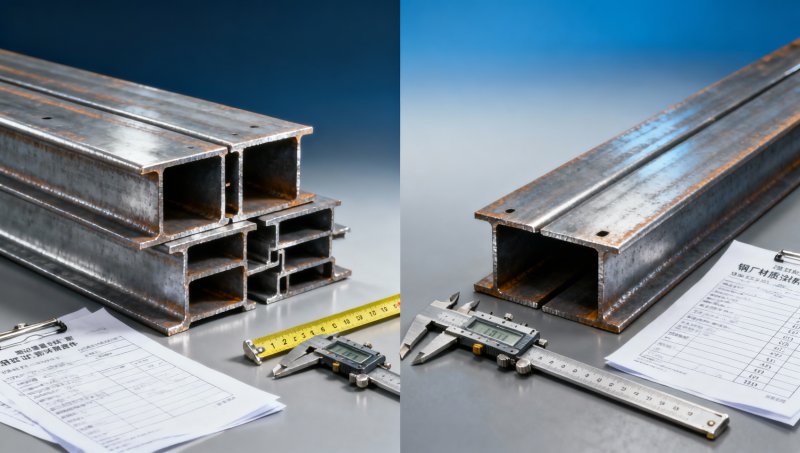
An I beam weight calculator usually works from nominal dimensions and theoretical steel density. In many cases, the formula multiplies sectional area by length and then applies a density value close to 7.85 g/cm³, or 7850 kg/m³. That gives a practical estimate, but it does not automatically include rolling tolerances, corner radii, or mill-specific dimensional variations.
Mill data, by contrast, is based on actual production standards and measured section properties. A beam marked under ASTM, EN, JIS, or GB may have the same general profile category, yet the flange thickness, web thickness, root radius, and section geometry can vary slightly. Over 6 m, 9 m, or 12 m lengths, those differences can produce a noticeable total weight gap per bundle or per truckload.
Another reason is naming confusion. In the market, buyers may search for I beam, H beam, universal beam, wide flange beam, or steel beam calculator, assuming they are interchangeable. They are not always identical. A calculator may use one reference profile family, while the mill data sheet follows another. This is especially common when comparing Chinese GB sections with EN or ASTM sections.
The difference also grows when coatings or special materials are involved. Galvanized layers, stainless grades such as 304 or 316, or special alloy compositions can change unit weight assumptions. While the geometry remains the main driver, material density and surface treatment may add enough mass to matter in cost-sensitive orders.
Common sources of weight variance
- Nominal dimensions used by the calculator instead of measured production dimensions.
- Different standards for profile geometry, such as ASTM A992 versus EN10025-related sections.
- Tolerance ranges in flange thickness and web thickness, often within mill-permitted limits.
- Length variation in cut-to-length supply, for example 5.95 m versus 6.00 m.
- Density assumptions for carbon steel, galvanized steel, or stainless steel sections.
For most early-stage planning, calculator results are acceptable within a narrow range. But when a project moves into final procurement, customs declaration, or detailed fabrication, relying only on a generic weight chart can create mismatches. That is why experienced buyers compare the calculator with the supplier’s mill list, inspection data, and standard reference table before issuing a purchase order.
Typical comparison points
The table below shows where a steel beam weight calculator is useful and where mill data gives stronger control for structural steel purchasing and project execution.
Please give us a message


Please enter what you want to find