When rebar for concrete slab fails at the edges, the cause is rarely random. Poor detailing, inadequate cover, weak compaction, and incorrect use of deformed rebar for concrete often create early cracking and load-transfer problems. For engineers, buyers, and project teams, understanding these edge failures is essential to improving durability, controlling repair costs, and selecting reliable structural steel solutions.
Edge zones in slabs behave differently from the center. They face higher moisture exposure, more temperature variation, weaker confinement, and frequent point loading from wheels, pallets, machinery, or wall lines. In many projects, failure starts within the first 6 to 24 months at corners, free edges, construction joints, or penetrations, even when the slab body appears stable.
For contractors, steel buyers, quality teams, and decision-makers, the issue is not only structural performance. Edge damage affects maintenance budgets, safety risk, downtime, and long-term asset value. A better understanding of reinforcement detailing, cover control, steel quality, and corrosion resistance helps reduce lifecycle cost and supports more reliable project delivery.
Why slab edges are the most vulnerable part of reinforced concrete
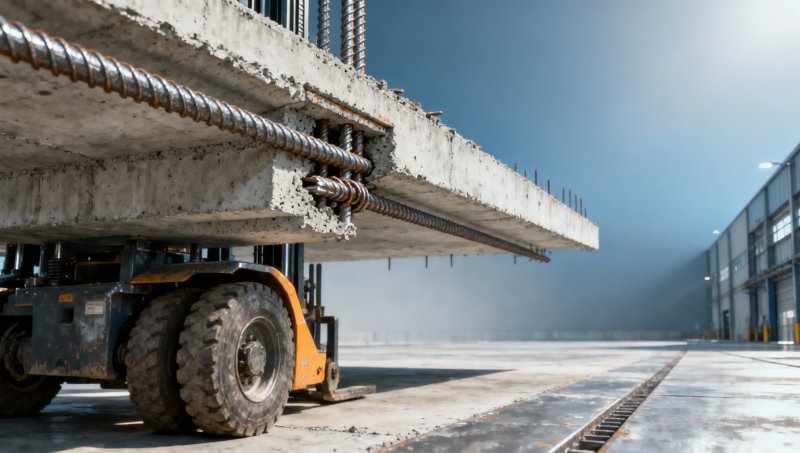
A concrete slab edge is a stress concentration zone. Unlike interior areas, edges have one side exposed and less surrounding concrete to distribute loads. When a forklift wheel, storage rack leg, or impact load is applied within 150 to 300 mm of the edge, bending stress rises sharply. If rebar placement is shallow, discontinuous, or poorly anchored, microcracks can develop early and widen over time.
Another common problem is insufficient concrete cover. In many floor and pavement applications, edge cover below the specified level can expose reinforcement to moisture, carbonation, chlorides, or freeze-thaw action. Once corrosion begins, the steel expands, internal pressure builds, and the edge starts spalling. This is especially important in coastal, industrial, or deicing-salt environments.
Compaction quality is also critical. Edge forms, corners, and congested reinforcement zones are harder to vibrate properly. Honeycombing, voids, and weak mortar pockets reduce bond strength between concrete and steel. Even a 5 to 10 mm void near the cover zone can become a path for water ingress and accelerate damage under repeated loading cycles.
In practical construction, detailing mistakes often occur at transitions. Slab edges may intersect with control joints, dowels, openings, walls, or embedded items. If the reinforcement layout ignores these interruptions, load transfer becomes uneven. The result may be corner cracking, edge curling, or differential settlement, particularly in slabs-on-grade with subbase variation greater than 10 to 15 mm.
Typical failure mechanisms at the edge
- Insufficient development length, causing bars to lose anchorage before the peak tensile zone is reached.
- Cover that is too thin or inconsistent, increasing corrosion risk and spalling probability.
- Weak concrete consolidation around bars, reducing bond and allowing early crack propagation.
- Improper bar diameter or spacing for edge loads, especially under repeated vehicle traffic.
- Subgrade support loss near perimeter lines, causing punching or edge settlement.
The table below summarizes how common edge conditions influence slab performance and what project teams should watch during design review and site inspection.
The key takeaway is that edge failure is usually a combined issue, not a single defect. Reinforcement design, concrete execution, and support conditions must be controlled together. If one of these three elements falls outside acceptable tolerance, the slab edge becomes the first visible weak point.
Rebar detailing mistakes that trigger edge cracking
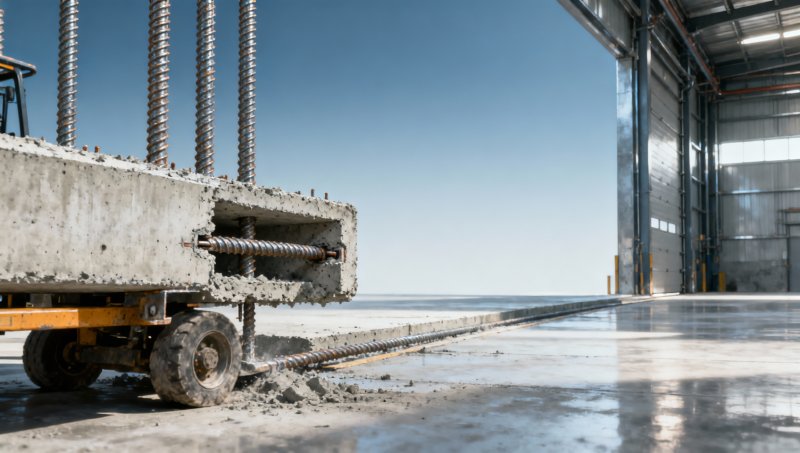
In slab construction, rebar is often selected correctly on paper but installed incorrectly on site. One of the most frequent issues is misplacement of the top and bottom reinforcement near free edges. A bar shifted by 15 to 25 mm may seem minor, but at the slab edge that difference can materially reduce crack control and moment capacity, especially in thinner slabs such as 120 to 180 mm floor systems.
Spacing errors also matter. If bars are spread too far apart near corners or openings, the concrete between them becomes less restrained and more likely to crack under shrinkage or thermal movement. In external slabs, day-night temperature cycles and seasonal movement can repeatedly open and close these cracks, allowing water penetration and corrosion to advance.
A further mistake is assuming that standard deformed rebar alone solves edge behavior. Deformation improves bond, but it does not compensate for missing continuity, poor bend radius, inadequate lap splice, or insufficient support chairs. In procurement and quality control, teams should review not only grade and diameter, but also fabrication accuracy, cut length, bend consistency, and field placement tolerance.
For projects with exposed edges, marine air, industrial humidity, or long service-life requirements, corrosion-resistant supporting steel components can improve durability around the slab system. Mid-project teams often evaluate accessory bars, anchoring rods, and perimeter steel items with coated or galvanized surfaces to reduce maintenance frequency and improve environmental resistance.
Selection points for supporting steel around vulnerable slab edges
When the project calls for corrosion-resistant steel elements in adjacent structural or ancillary applications, one practical option is Galvanized Round Steel. It is available in DC01 material, with tensile strength in the 570–820 MPa range, and diameter options from 16 to 250 mm or customized lengths. The galvanized surface is suited to environments where moisture, outdoor exposure, or industrial atmosphere would otherwise shorten service life.
This type of steel is used across power towers, communication towers, highway protection systems, street light poles, building steel structure components, marine parts, and precision processing applications. For buyers comparing steel supply partners, important checks include compliance with AiSi, ASTM, BS, GB, JIS, EN, and AS requirements, plus process controls such as straightening, milling, chamfering, ultrasonic inspection, and spectrotest-based anti-mixing verification.
How this relates to slab-edge reliability
- Galvanized steel components used in adjacent support, anchorage, or exposed peripheral structures can reduce corrosion-driven replacement cycles.
- Tighter dimensional tolerance, such as ISO h8 or h9 depending on diameter, supports better fit-up in fabricated assemblies.
- Quality controls like ultrasonic testing and surface inspection help reduce hidden defects before installation.
- Customized sizing allows engineering teams to match real loading and connection needs instead of forcing standard stock where it does not fit.
For B2B buyers, the lesson is clear: slab durability does not depend only on the concrete mix or the rebar tag. It also depends on the reliability of surrounding steel components, fabrication precision, and corrosion protection strategy across the full project environment.
How to evaluate steel, workmanship, and inspection before failure appears
The most cost-effective moment to prevent slab-edge failure is before the concrete pour. Once cracking reaches visible width and spalling begins, repair typically involves cutting, patching, traffic interruption, and repeated sealing. In logistics, factory, and parking structures, even localized edge repair can affect operations for 2 to 7 days depending on slab thickness, curing plan, and access constraints.
Project teams should run a structured pre-pour inspection that covers both materials and placement. For reinforcement, that means checking bar grade, diameter, spacing, lap length, cleanliness, support height, cover blocks, and congestion at corners. For concrete, it means reviewing slump suitability, compaction access, form tightness, and curing sequence. These are basic steps, but they are often rushed when schedule pressure increases.
Buyers and technical evaluators should also assess the manufacturer’s process stability. A steel supplier serving international projects should be able to support common standards such as ASTM, EN, JIS, and GB, maintain consistent production lots, and provide workable lead times. This matters because inconsistent steel dimensions or delayed delivery often create field substitutions, which are a hidden cause of detailing errors.
For global sourcing, Hongteng Fengda supports construction and industrial buyers with structural steel products, OEM solutions, and manufacturing controls suited to standard and custom requirements. For procurement teams balancing cost and reliability, the value lies in stable capacity, consistent quality control, and clear communication on specifications, tolerances, and export delivery schedules.
Pre-pour control checklist
- Confirm rebar position against drawings, especially within the outer 300 mm of the slab perimeter.
- Measure cover and chair stability at a minimum of 3 to 5 sample points per edge segment.
- Verify lap splice and development length at corners, joints, and opening returns.
- Check edge form sealing to reduce grout loss and surface voids during vibration.
- Inspect subbase level tolerance and drainage path before concrete placement.
- Document material heat numbers, delivery condition, and relevant standard references.
The following table can be used by engineering, purchasing, and QA teams to align decision criteria before ordering or approving reinforcement-related steel products.
A disciplined inspection routine usually prevents the most expensive failures. In many cases, a 30-minute edge review before pouring can avoid months of repair coordination later. For project managers and financial approvers, that is a strong argument for better upstream control rather than reactive maintenance.
Procurement and design strategies to reduce repair cost over the service life
Low initial price is not the same as low total cost. Slab-edge failures create direct and indirect expenses: repair material, labor, equipment downtime, safety barriers, traffic redirection, and potential claims. In busy industrial facilities, edge deterioration near loading bays or aisle lines can affect operational efficiency long before structural capacity is fully compromised.
A smarter procurement strategy starts with risk classification. Indoor dry slabs may prioritize dimensional consistency and schedule reliability. Outdoor, marine, or industrial environments usually justify stronger corrosion protection and tighter inspection control. For decision-makers comparing suppliers, three practical questions are useful: can the supplier meet the required standard, can they deliver consistent quality at scale, and can they support customization without destabilizing lead time?
Design teams should also match steel selection to actual service conditions. If an edge is exposed to impact, salt, standing water, or repeated dynamic loading, the detailing and material package should reflect that reality. A difference of one specification decision at tender stage can significantly change the maintenance profile over 5 to 15 years.
For exporters and distributors, supplier capability is especially important because project requirements vary by region. A manufacturer with experience serving North America, Europe, the Middle East, and Southeast Asia is generally better positioned to align documentation, packaging, standard references, and delivery expectations with international buyers’ needs.
Common procurement mistakes
- Buying based only on unit price without checking tolerance, coating condition, or inspection scope.
- Approving substitutions late in the project, which can change anchorage or placement geometry.
- Ignoring packaging and marking, which increases mixed-batch risk on large multi-zone jobs.
- Underestimating lead time for customized steel components and forcing rushed field adjustments.
Lifecycle-oriented decision framework
A practical approach is to compare options through four lenses: structural suitability, environmental durability, manufacturing control, and delivery reliability. If two products are similar in base price, but one offers tighter tolerances, better corrosion resistance, and clearer inspection traceability, the long-term value is often stronger even before repair avoidance is considered.
This is where an experienced structural steel manufacturer adds value beyond supply alone. Consistent quality control, OEM support, and stable export coordination help project teams reduce sourcing risk, avoid rework, and maintain construction rhythm across multiple phases.
FAQ: practical questions from engineers, buyers, and project teams
Because slab-edge failure often results from a combination of design, steel selection, and site execution, the most common questions are practical rather than theoretical. The answers below address real concerns from technical reviewers, purchasing departments, and maintenance teams.
How much concrete cover is usually needed at slab edges?
The exact value depends on code, exposure, and member type, but in practice the edge cover must be controlled tightly because even small reductions can accelerate corrosion risk. What matters most is not only the nominal cover value, but whether the installed cover remains within project tolerance across the full perimeter, especially at corners and near openings.
Is deformed rebar always enough to prevent edge cracking?
No. Deformed rebar improves bond performance, but it cannot compensate for poor detailing, bad compaction, short lap lengths, weak subbase support, or curing problems. Edge durability depends on the full system. Rebar type is only one variable among several that must be coordinated.
When should galvanized or corrosion-resistant steel be considered?
It should be considered whenever the surrounding steel system faces outdoor exposure, humidity, industrial atmosphere, coastal air, or a long maintenance cycle. In these conditions, galvanized supporting or ancillary steel can help reduce corrosion-driven replacement frequency and improve service reliability over multi-year operation.
What should procurement teams ask a steel supplier before ordering?
At minimum, ask about applicable standards, dimensional tolerance, inspection methods, coating process, customization capability, packaging and marking control, and expected lead time. For export projects, also confirm documentation alignment and whether the supplier can support repeated orders with stable quality.
How quickly should early edge damage be repaired?
If cracking is widening, moisture is entering, or spalling has started, early intervention is recommended. Small repairs completed within a planned maintenance window are usually less disruptive than delayed repairs after corrosion expands and concrete breaks away further. Waiting often multiplies both repair scope and operational impact.
Rebar for concrete slab fails more often at the edges because the edge is where detailing tolerance, environmental exposure, load concentration, and workmanship defects meet first. Better reinforcement placement, stronger pre-pour inspection, appropriate corrosion protection, and dependable steel sourcing can significantly reduce early cracking and repair cost.
For contractors, distributors, engineers, and procurement teams looking for reliable structural steel support, Hongteng Fengda provides standard and customized solutions backed by modern manufacturing, international standard compliance, and stable export service. If you need help comparing specifications, confirming suitable steel products, or planning a customized supply solution, contact us today to discuss your project in detail and get the right recommendation faster.
Please give us a message


Please enter what you want to find