Knowing when to use Hot dipped Galvanized Steel Wire Rope is essential for operators who work in demanding outdoor, marine, or high-humidity environments. Its corrosion resistance, durability, and reliable performance make it a practical choice for lifting, securing, and structural support applications. Understanding the right usage scenarios can help improve safety, extend service life, and reduce maintenance costs.
Where does Hot dipped Galvanized Steel Wire Rope make the most sense?
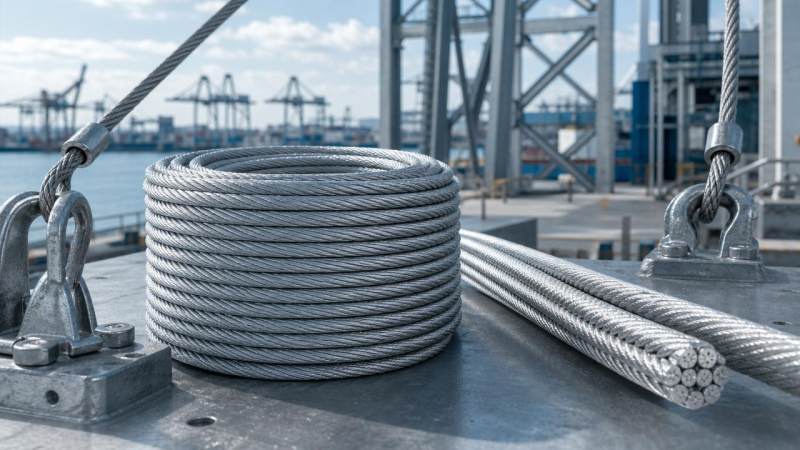
In steel-related operations, wire rope is rarely chosen on price alone. Operators must consider exposure, load cycles, safety margins, inspection difficulty, and downtime risk. Hot dipped Galvanized Steel Wire Rope is most useful when the working environment accelerates rust on ordinary carbon steel rope.
The hot-dip galvanizing process forms a zinc coating around the steel wires. That coating protects the base metal against moisture, salt, and weathering. For field crews, this means slower surface corrosion, fewer seizure problems, and more stable service performance in exposed applications.
This does not mean galvanized rope is the right choice for every job. It is best evaluated by environment, contact conditions, expected service life, and replacement cost. In many structural steel, transport, and outdoor rigging tasks, the added corrosion protection makes operational and economic sense.
Typical conditions that justify galvanized wire rope
- Outdoor lifting areas where rain, condensation, or daily temperature shifts cause repeated wet-dry cycles.
- Marine and coastal zones where salt exposure quickly damages uncoated rope.
- Agricultural, port, and industrial yards where mud, dust, and humidity combine with irregular maintenance.
- Temporary structural support or bracing systems installed in open air for extended periods.
- Utility, tower, and suspended support applications where visual inspection is possible but frequent replacement is costly.
Operators often choose galvanized rope when they need a practical balance between corrosion resistance and cost. Stainless wire rope may offer stronger resistance in some environments, but it is not always necessary for general outdoor or construction use.
Which application scenarios are most suitable?
The decision becomes easier when the worksite is divided into real operating scenarios. The table below helps users compare where Hot dipped Galvanized Steel Wire Rope fits best and where additional material review may be needed.
For operators, the main value lies in reducing corrosion-related failure points. In exposed job sites, rust often starts at the outer wires, then progresses toward reduced flexibility and visible wear. Galvanized rope delays that process and gives maintenance teams a more manageable inspection cycle.
Common steel industry uses
Within the steel and construction supply chain, galvanized wire rope is often used around lifting frames, temporary bracing, suspended lines, material securing, cable support, and transport restraint systems. It is also relevant in projects that combine steel structures with outdoor mechanical systems.
In many structural assemblies, wire rope works together with shaped steel products that provide connection points, support frames, or anchor geometry. For example, in building structures, engineering structures, transmission towers, container racks, or warehouse shelves, angle sections often help distribute force and stabilize the installation.
When operators need support members for such systems, Q195 angle steel can be considered for applications such as beams, bridges, cable trench supports, busbar support installation, lifting and transportation machinery, and ships. Available in equal and unequal specifications, with thickness from 3-24mm, width from 20mm-200mm, and lengths such as 3-9m, 4-12m, 4-19m, 6-19, and 6-15m or customer requirements, it supports flexible structural layouts under ASTM, AISI, EN, DIN, JIS, and GB standards.
For buyers managing combined procurement, integrating wire rope selection with support components such as angle steel can reduce sourcing gaps. Hongteng Fengda supports this type of planning by supplying structural steel products and customized solutions for global construction and industrial projects, helping customers align materials, standards, and delivery schedules.
Hot dipped galvanized vs other wire rope options: how should operators compare?
Selection errors often happen when teams compare only the initial purchase price. A more practical method is to compare corrosion behavior, maintenance burden, environment, and expected replacement frequency. The following table gives a simple decision reference.
For many users, Hot dipped Galvanized Steel Wire Rope becomes the preferred middle-ground solution. It offers stronger durability than bright rope in wet conditions, while usually remaining more cost-manageable than stainless alternatives for routine industrial and structural tasks.
When it may not be the ideal choice
- If the rope runs continuously over sheaves at high speed, the exact rope construction and lubrication system may matter more than galvanizing alone.
- If the environment is strongly chemical rather than simply humid, a deeper material review is necessary.
- If appearance, cleanliness, or food-grade surroundings are critical, another material option may be more suitable.
What should operators check before selecting Hot dipped Galvanized Steel Wire Rope?
Correct selection starts with operating data, not with assumptions. Many failures come from using the right material in the wrong construction, diameter, or end-fitting arrangement. Before ordering, users should confirm both application requirements and installation conditions.
Basic selection checklist
- Define the load type: static holding, lifting, pulling, guying, or repeated dynamic cycling.
- Record environmental factors: rain, salt spray, humidity, dust, heat, or standing water.
- Confirm rope diameter, construction, and compatibility with drums, pulleys, clips, sockets, or terminations.
- Review relevant standards or client specifications, especially for exported projects under ASTM, EN, JIS, or GB-related requirements.
- Plan maintenance access, because even corrosion-resistant rope still needs inspection, lubrication review, and replacement criteria.
The table below can be used during procurement or site review to decide whether a galvanized rope specification is likely to match the working condition.
This kind of pre-check is especially important for contractors and operators who must coordinate steel structures, lifting accessories, and project deadlines at the same time. A dependable supplier helps by clarifying dimensions, applicable standards, and delivery timing before the material reaches the site.
How do cost, service life, and sourcing risk affect the decision?
A lower upfront price can become expensive if rope replacement interrupts lifting plans, tower work, port handling, or temporary support systems. In exposed conditions, lifecycle cost usually matters more than the cheapest unit price.
Hot dipped Galvanized Steel Wire Rope often reduces hidden costs in three ways: less frequent corrosion-related replacement, fewer urgent procurement events, and lower risk of performance decline during storage or field use. This is valuable when projects operate across long lead times or remote job sites.
For international buyers, sourcing risk also includes documentation, dimensional consistency, packaging condition, and standard compliance. Hongteng Fengda supports global customers with stable production capacity, quality control, and customized structural steel supply, helping reduce delays and mismatch between ordered material and actual project needs.
Practical cost judgment for buyers
- Choose galvanized rope if corrosion exposure is frequent and replacement access is difficult.
- Choose bright rope only when the environment is dry, protected, and easy to maintain.
- Consider stainless options only when exposure severity justifies the price difference.
Common mistakes and FAQs operators should not ignore
Does galvanized mean maintenance-free?
No. Hot dipped Galvanized Steel Wire Rope resists corrosion better, but it still requires routine inspection for broken wires, deformation, abrasion, diameter loss, and end-connection issues. Galvanizing slows rust damage; it does not eliminate mechanical wear or overload risk.
Is it always better than bright steel wire rope?
Not always. In dry indoor use, bright rope may be sufficient and more economical. The right answer depends on actual exposure, safety requirements, and maintenance conditions. The best material is the one that fits the task, not the one with the broadest claim.
Can operators use it in marine environments?
Yes, in many marine-adjacent or coastal applications it is a practical choice. However, salt exposure increases the need for regular inspection, proper storage, and suitable lubrication. If the environment is extremely aggressive, a higher-grade material review may be necessary.
What do buyers often overlook during procurement?
They may focus only on rope diameter and price while ignoring rope construction, end-use load pattern, compatibility with fittings, or applicable standards. They may also forget to align rope procurement with related structural steel components, causing delivery gaps during installation.
Why choose us for structural steel coordination and project support?
When operators, contractors, or procurement teams need more than a simple material list, coordinated supply becomes important. Hongteng Fengda is a professional structural steel manufacturer and exporter from China, serving global construction, industrial, and manufacturing projects with angle steel, channel steel, steel beams, cold formed steel profiles, and customized structural steel components.
Our value is practical: stable production capacity, strict quality control, support for ASTM, EN, JIS, and GB-related requirements, and the ability to help buyers reduce sourcing risks. If your project involves exposed steel structures, support frames, lifting-related installations, or multi-item export procurement, we can help coordinate materials more efficiently.
You can contact us to discuss parameter confirmation, structural product selection, delivery schedules, OEM or customized solutions, certification-related requirements, sample support, and quotation details. If you are comparing Hot dipped Galvanized Steel Wire Rope usage scenarios with structural support materials, we can also help you review the matching steel components for your project environment and installation plan.
Please give us a message


Please enter what you want to find