Welding galvanised plate steel is not simply a matter of using the same settings and habits applied to bare carbon steel. The zinc coating changes the job in ways that affect operator health, weld appearance, joint integrity, and the corrosion resistance of the finished component. A plate may look clean and ready to weld, yet the coating around the arc can produce hazardous fumes, cause porosity, and leave the completed joint vulnerable to early rusting if it is not restored correctly.
For operators, the key is to treat galvanised work as a controlled process rather than an ordinary weld. Safe preparation, effective ventilation, sensible welding parameters, and proper post-weld repair all matter. These precautions are especially important in structural fabrication, industrial platforms, brackets, frames, cold-formed assemblies, and site modifications where galvanised plate steel is selected for long-term corrosion protection.
Why the zinc coating needs special attention
Galvanised plate steel is carbon steel protected by a zinc coating, usually applied through hot-dip galvanising or, in some products, electro-galvanising. Zinc provides sacrificial corrosion protection: it reacts preferentially when exposed to moisture and helps protect the underlying steel. That benefit is valuable outdoors and in humid or industrial environments, but zinc does not behave like plain steel under welding heat.
When the arc or flame reaches the coated surface, zinc near the weld zone rapidly vaporises. As that vapour cools, it forms zinc oxide fume. The fume can be irritating and harmful when inhaled, particularly in confined or poorly ventilated work areas. The coating may also enter the molten weld pool, contributing to spatter, undercut, porosity, cracking risk in some joint conditions, and an uneven weld bead.
The practical consequence is clear: the coating must be managed before welding, the fumes must be controlled during welding, and the damaged protective layer must be repaired afterward. Skipping one of these stages often creates problems that only become visible after installation.
Start with a job assessment, not the welding torch
Before any work begins, confirm what material is being welded and where the work will take place. “Galvanised” is not enough information by itself. The operator or supervisor should identify the plate thickness, coating type if known, joint design, welding position, access around the joint, and whether the work is indoors, outdoors, elevated, or inside a restricted space.
A pre-weld review should also consider coatings beyond zinc. Galvanised plate steel may have paint, primer, oil, marking compounds, sealant, or contamination from storage and fabrication. These materials can create additional fumes or weld defects. If the steel is being welded as part of an existing structure, check whether there are enclosed cavities, combustible materials nearby, or coatings on the reverse side of the plate.
For fabricated structural components, clear drawings and material traceability make this process easier. Suppliers of angle steel, channel sections, beams, cold-formed profiles, and customised structural parts can help buyers specify whether parts are intended to be welded before galvanising or field-welded after galvanising. That decision affects both fabrication planning and corrosion protection strategy.
Remove zinc from the immediate weld zone
The most reliable way to improve weld quality and reduce zinc fume at the arc is to remove the galvanised coating from the area directly adjacent to the joint. Mechanical cleaning is commonly used. Depending on the job, this may involve grinding, sanding, wire brushing, or other approved abrasion methods. The goal is to expose clean base steel where the weld will be deposited, while avoiding unnecessary damage across a large surrounding area.
Cleaning should cover the weld path and enough material on both sides to prevent zinc from being drawn into the molten pool. The exact width depends on the joint type, plate thickness, welding process, and procedure being followed. Operators should work to the approved welding procedure specification rather than relying on a fixed rule of thumb for every plate and joint.
Do not assume that a wire brush alone always removes a hot-dip galvanised coating adequately. It may clean loose surface contamination without fully exposing bare steel. Visual inspection is useful, but the surface should also be checked for remaining bright zinc, white corrosion products, grease, and grinding debris.
Grinding galvanised coatings creates dust, so respiratory protection and housekeeping are still necessary during preparation. Collect dust where practical, avoid blowing it around with compressed air, and keep debris away from other trades or open work areas.
Ventilation is a primary control, not an afterthought
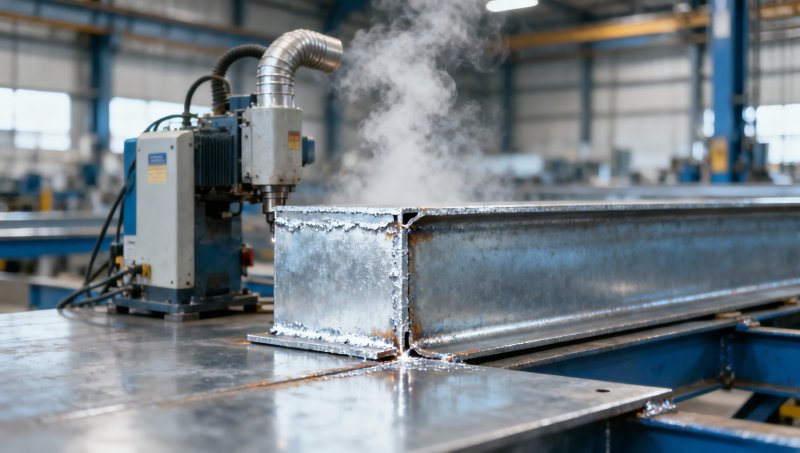
Good air movement is essential when welding galvanised plate steel. Natural outdoor airflow may help, but it should not be treated as a guaranteed protection method. Wind direction can change, and a worker leaning over a joint can place their breathing zone directly in the rising fume plume.
Local exhaust ventilation is often the preferred control because it captures fume close to its source. Position extraction so that it draws the fume away from the welder without disturbing shielding gas coverage or pulling fumes past the operator’s face. General workshop ventilation can supplement local extraction, but it is rarely a complete substitute for it during repeated galvanised welding tasks.
Confined spaces require a higher level of planning. Welding inside tanks, ducts, pits, enclosed frames, containers, or poorly ventilated rooms can allow fumes to build up quickly. Such work should be controlled under the site’s confined-space procedures, including atmosphere assessment, mechanical ventilation, communication arrangements, fire precautions, and standby or rescue provisions where required by local regulations.
Never weld galvanised plate steel in an enclosed area merely because the task is short. A brief weld can still create a concentrated fume exposure when airflow is poor.
Use suitable respiratory and personal protective equipment
Ventilation comes first because it controls exposure at the source, but personal protective equipment remains important. Select respiratory protection according to the workplace risk assessment, the welding process, fume level, ventilation performance, and applicable occupational health requirements. A properly selected and fitted welding respirator or powered air-purifying respirator may be appropriate in situations where engineering controls do not adequately reduce exposure.
Respiratory equipment only works when it fits and is maintained correctly. Facial hair can interfere with the seal of many tight-fitting respirators. Filters have service limits, and damaged masks, blocked filters, or poorly fitted equipment can create a false sense of security. Operators should be trained in inspection, fit testing where required, use limitations, storage, and replacement schedules.
Standard welding PPE is also necessary: a suitable welding helmet with the correct lens shade, flame-resistant clothing, gloves, safety footwear, and eye protection for grinding and chipping. Zinc-related fume is an important concern, but it does not replace the usual controls for arc flash, sparks, hot metal, burns, and fire.
Choose the welding process and parameters with the coating in mind
Galvanised plate steel can be welded using common processes such as shielded metal arc welding, gas metal arc welding, flux-cored arc welding, and gas tungsten arc welding, provided the process is qualified for the material and joint. The best choice depends on plate thickness, position, production volume, joint access, required appearance, and project specification.
Because residual zinc can interfere with arc stability and weld pool behaviour, settings should be established through a qualified procedure or test weld. Excessively high heat input can burn back more coating than necessary, enlarge the heat-affected area, increase distortion, and produce more fume. Heat that is too low, however, may result in lack of fusion or a poorly shaped bead. The objective is controlled penetration and sound fusion, not simply “burning through” the coating.
Keep consumables clean and dry, and use shielding gas arrangements appropriate to the selected process. In gas-shielded welding, poor gas coverage combined with zinc contamination can make porosity especially troublesome. If pinholes or excessive spatter appear, stop and investigate rather than repeatedly welding over the defect. The cause may be remaining zinc, surface contamination, unsuitable parameters, inadequate gas protection, or joint fit-up problems.
Watch for defects that are more common on galvanised material
A visually acceptable bead is not always a sound weld. Zinc vapour can become trapped in the solidifying weld metal, creating porosity. This may appear as surface pinholes, but some voids may not be obvious without appropriate inspection. Overlapping plates and lap joints deserve particular care because zinc on hidden faying surfaces can generate gas that escapes through the weld area.
Other concerns include incomplete fusion, excessive spatter, undercut, slag inclusions, and cracking associated with poor joint preparation or restraint. Where the joint is structural, load-bearing, pressure-related, or governed by a project code, use the specified inspection and acceptance methods. Visual examination may be sufficient for minor fabrications, while more critical work may require additional non-destructive testing in accordance with the governing standard or engineering requirement.
Do not weld over a defect simply to improve appearance. Remove the defective area, clean it thoroughly, and repair it using the approved method. Covering porosity with another pass can leave an unreliable joint beneath a smoother surface.
Pay attention to the reverse side and enclosed spaces in the assembly
Operators often focus on the visible face of the plate, but the zinc coating on the opposite side is still affected by heat. On thin galvanised plate steel, the reverse coating may discolour, burn away, or release fumes through gaps and openings. Check both sides when access permits.
Fabrications with closed sections, overlapping plates, or sealed cavities require additional thought. Heating can create pressure from trapped air, moisture, or zinc vapour. Where a component is designed for hot-dip galvanising after fabrication, venting and drainage holes are normally part of the design. For welding already galvanised assemblies, never assume a closed cavity is harmless. Follow the fabrication drawing, safety procedure, and engineering instructions before applying heat.
Restore corrosion protection after welding
The weld and surrounding heat-affected zone no longer have their original zinc protection. Leaving bare or heat-damaged steel exposed can lead to local corrosion, even when the rest of the galvanised plate steel remains in good condition. Post-weld coating repair is therefore part of the welding operation, not a cosmetic extra.
After the weld has cooled and been inspected, remove slag, spatter, oxides, and loose coating. The repair system should be compatible with the project’s corrosion protection requirements. Common approaches include zinc-rich repair coatings, zinc metal spray, or other approved zinc repair methods. Product selection and surface preparation should follow the coating manufacturer’s instructions and the relevant project standard.
Apply the repair material not only to the weld bead but also to areas where grinding or heat has damaged the galvanised layer. The repaired zone should have continuous coverage, sound adhesion, and sufficient thickness for the intended environment. In marine, chemical, coastal, or heavily industrial settings, the corrosion protection specification may be more demanding than for a sheltered indoor structure.
Symptoms of zinc fume exposure should never be ignored
Inhaling welding fumes from zinc-coated steel may cause flu-like symptoms sometimes described as metal fume fever. Symptoms can include throat irritation, coughing, headache, feverishness, chills, fatigue, nausea, or a metallic taste. They may be delayed, which can lead workers to underestimate the connection with the welding task.
If an operator feels unwell after welding galvanised material, they should leave the exposure area, report the condition promptly, and follow workplace medical procedures. Severe symptoms, breathing difficulty, or any emergency condition requires immediate medical attention. Do not encourage workers to “push through” symptoms or treat repeated exposure as normal. It is a sign that controls need to be reviewed.
A practical final check before releasing the job
Before the component moves to the next stage, take a moment to confirm that the work is complete in both safety and quality terms. Is the weld clean, continuous, and acceptable for its intended service? Have visible defects been addressed? Has damaged galvanising been repaired? Has grinding dust, used consumables, and welding debris been removed from the area? These small checks prevent many avoidable site issues.
Welding galvanised plate steel safely is ultimately about respecting the coating’s purpose while controlling the hazards created when heat is applied. Clean the joint, capture the fume, wear the right protection, use a suitable qualified procedure, inspect the weld, and restore the zinc barrier. With those precautions built into the workflow, operators can produce dependable welded connections without sacrificing the corrosion resistance that made galvanised steel the right material choice in the first place.
Please give us a message


Please enter what you want to find