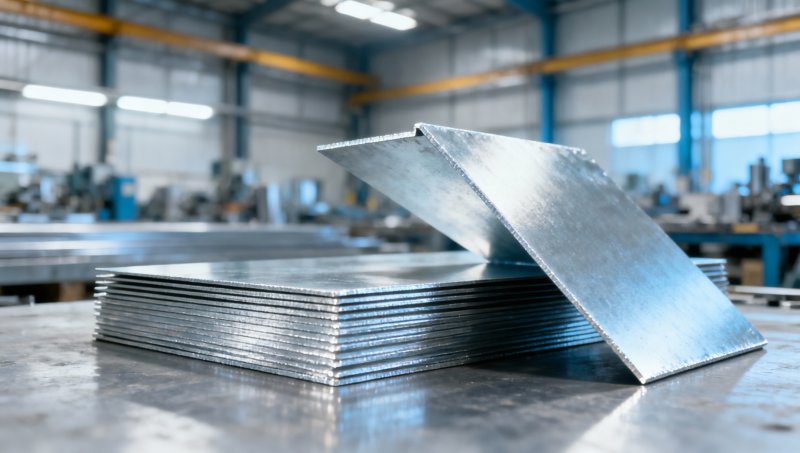
In steel product specifications, “sheet galvanized” usually means a steel sheet that has been coated with zinc to improve corrosion resistance. The phrase appears simple, but it is incomplete as a purchasing description. It tells a buyer that zinc protection is present; it does not tell them how the zinc was applied, how much zinc is on the surface, what steel substrate is underneath, whether the product is suitable for forming, or how long it will perform in a particular environment.
That distinction matters because galvanized sheet is used across roofing, cladding, ductwork, appliance panels, light-gauge framing, fencing, agricultural equipment, cable trays, fabricated brackets, and many industrial components. In each application, the real question is rarely “Is it galvanized?” It is more often: “Will this coating, thickness, grade, finish, and processing route work for the exposure conditions and fabrication process we have?”
For researchers and first-time buyers, understanding what sits behind the term helps prevent a common sourcing problem: comparing offers that look identical in a quotation but describe materially different products.
“Galvanized” describes protection, not the whole product
Steel corrodes when moisture, oxygen, salts, pollutants, or chemicals attack the exposed surface. Zinc coating delays that process in two ways. First, it acts as a physical barrier between the steel and the surrounding environment. Second, zinc offers sacrificial protection: when small areas of steel become exposed at scratches or cut edges, zinc can corrode preferentially and help protect nearby steel.
That is why galvanized sheet is widely chosen where ordinary carbon steel would rust too quickly. But zinc is not a universal answer to corrosion. Its performance depends on the amount of coating, the nature of exposure, drainage, ventilation, edge treatment, contact with other metals, and whether the sheet is later painted, bent, welded, or cut.
In a specification, “sheet galvanized” should therefore be treated as the starting point of a technical conversation, not the final requirement. A supplier may understand it as hot-dip galvanized steel sheet, while another may quote electro-galvanized material. Both are zinc-coated products, but their coating characteristics, appearance, available thicknesses, and intended uses can differ substantially.
The first distinction: hot-dip galvanized versus electro-galvanized
Most commercially available galvanized sheet falls into one of two broad categories.
Hot-dip galvanized sheet is produced by passing prepared steel strip or sheet through a bath of molten zinc. The result is typically a relatively robust zinc coating, often specified by coating mass. This material is common in construction-related uses, general fabrication, roofing products, cold-formed sections, guard components, agricultural equipment, and applications where corrosion resistance is a primary concern.
Electro-galvanized sheet receives zinc through an electroplating process. It commonly provides a smoother, more uniform surface and can be useful where appearance, paintability, precision forming, or controlled coating thickness is important. It may be used in certain automotive, appliance, office equipment, and indoor manufactured-product applications. However, it should not automatically be considered interchangeable with hot-dip galvanized sheet for outdoor or heavily corrosive service.
The wording in a purchase request should identify the required coating process when the application depends on it. Asking only for “galvanized sheet” leaves room for a supplier to quote the product that best fits its own production range rather than the buyer’s actual use case.
Coating designation is often more important than the word “galvanized”
One of the most important items in a galvanized sheet specification is the coating designation. Depending on the governing standard, this may be expressed as coating mass per unit area, coating weight, or coating thickness. Common market descriptions may include labels such as Z100, Z180, Z275, G30, G60, or G90. These terms cannot be compared safely without checking the standard behind them.
For example, a designation using “Z” is often associated with zinc coating mass in grams per square meter under certain EN, JIS, or GB-based conventions. Designations beginning with “G” may be used in ASTM-related purchasing language and can refer to coating weight classifications. The exact method of measurement, total coating allocation, and nominal requirements are determined by the applicable standard. A buyer should never assume that two labels from different standards indicate identical zinc protection merely because the numbers appear similar.
Higher coating mass generally means more zinc is available to resist corrosion, but “more” is not always automatically “better.” A heavier coating may affect surface appearance, forming behavior, weldability, paint preparation, cost, and availability. For parts that require tight bending radii or smooth cosmetic surfaces, the best choice may differ from the best choice for roof sheets exposed to rain, condensation, and airborne contaminants.
The right question is: what coating level is appropriate for the expected environment and service-life target? A dry indoor panel, a warehouse roof in a coastal area, and a welded outdoor support bracket should not be specified in the same way.
What the specification should say beyond “sheet galvanized”
A useful galvanized sheet requirement normally combines material, dimensions, coating, standard, and processing expectations. The more demanding the application, the less acceptable it is to rely on a short commercial description.
- Base steel grade: The sheet’s mechanical properties determine whether it can be bent, stamped, roll formed, welded, or used structurally. A corrosion-resistant coating does not make a low-strength substrate suitable for a load-bearing application.
- Thickness: State whether the required thickness is the base metal thickness or the total coated thickness. This is especially relevant for thinner sheet, where coating can affect the final measurement.
- Width, length, and coil/slit format: Sheet dimensions influence yield, handling, transport, and downstream fabrication cost. Coil sourcing may suit continuous roll forming, while cut sheets may reduce internal processing for smaller batches.
- Coating type and designation: Specify hot-dip or electro-galvanized where relevant, together with the required coating class under the chosen standard.
- Surface condition: Spangle, minimized spangle, skin-passed surface, oiled, dry, phosphated, or passivated conditions may matter for appearance, storage, paint adhesion, and forming.
- Applicable standard: ASTM, EN, JIS, GB, or another project standard should be identified clearly. It should also be confirmed whether the stated edition is required.
- Testing and documentation: Material test certificates, coating test records, chemical composition, mechanical-property results, and dimensional inspection requirements should match the project risk.
For structural or fabricated products, the sheet may only be one input material in a larger assembly. In that case, the buyer should also define whether galvanizing is required before fabrication, after fabrication, or only on selected surfaces. Pre-galvanized sheet is not equivalent to a completed fabricated component that has been hot-dip galvanized after welding and drilling.
Pre-galvanized sheet and post-fabrication galvanizing solve different problems
This is one of the more consequential distinctions in steel procurement. Pre-galvanized sheet is coated before it is cut, punched, bent, roll formed, or welded. It is efficient for continuous production of profiles, panels, ducts, and light-gauge components. The zinc coating protects the broad surface from the start, and the process is well suited to standardized high-volume manufacturing.
However, fabrication creates cut edges, holes, and sometimes heat-affected areas. Zinc’s sacrificial behavior can provide a degree of local protection around small exposed edges, but this should not be interpreted as unlimited protection in severe environments. Repeated cutting, deep damage, aggressive forming, or corrosive exposure may require additional edge protection, paint systems, sealing, or a different galvanizing route.
Post-fabrication hot-dip galvanizing is performed after an item has been welded and assembled. It can provide coating coverage over complex shapes, weld zones, and edges, which is valuable for outdoor structural steel, handrails, supports, frames, and industrial assemblies. Yet it introduces its own design and quality considerations: venting and drainage holes, distortion risk, weld cleanliness, enclosed volumes, coating build-up, and dimensional tolerance all need attention before fabrication begins.
Neither option is inherently superior. The choice depends on product geometry, corrosion exposure, production volume, required appearance, fabrication method, and project budget.
Where galvanized sheet works well, and where caution is needed
Galvanized sheet is often a practical choice for general building and manufacturing use because it combines the formability and availability of steel with a measure of corrosion protection. It is commonly suitable for dry or moderately exposed environments where the coating level and design details are matched to the conditions.
It deserves more scrutiny in coastal locations, chemical plants, livestock facilities, fertilizer storage areas, wastewater environments, and sites with persistent condensation. Chlorides, ammonia, acidic pollutants, wet deposits, and poor drainage can all accelerate zinc consumption. A specification that performs satisfactorily in an inland commercial building may have a much shorter life in a coastal processing facility.
Contact corrosion is another overlooked issue. When galvanized steel is placed against certain dissimilar metals in the presence of moisture, galvanic effects may accelerate corrosion. The details depend on the metal combination, exposed surface areas, water path, and local environment. Separators, compatible fasteners, coatings, and drainage design may be necessary. This is particularly relevant for roof systems, facade assemblies, cable support systems, and mixed-metal fabricated equipment.
Buyers should also avoid assuming that galvanized sheet is maintenance-free. Dirt accumulation, standing water, damaged paint systems, trapped moisture, and inaccessible joints can all reduce real-world performance. Good design often matters as much as coating selection: water must be allowed to drain, surfaces should dry between wetting cycles, and crevices that retain contaminants should be minimized.
Fabrication can change the result
A galvanized sheet may arrive with compliant coating weight and acceptable surface quality, then lose value during fabrication if handling and processing are poorly controlled. Roll forming, press braking, punching, laser cutting, welding, grinding, and transport each create possible damage points.
For formed products, coating adhesion and bend performance should be considered early. A heavily coated sheet may behave differently at sharp bends than a thinner-coated or differently processed material. For welded assemblies, zinc fumes require appropriate workplace controls, and welding can damage adjacent coating. The extent of repair needed after welding depends on the governing specification, corrosion category, customer requirements, and the size and location of affected areas.
For painted galvanized products, surface preparation is not optional. Fresh zinc surfaces, oils used for corrosion protection during storage, passivation treatments, and surface contaminants can influence paint adhesion. A paint system should be selected and tested for the specific galvanized surface condition rather than assumed to work across all zinc-coated products.
How to compare supplier quotations without creating false equivalence
When several suppliers quote galvanized sheet, the lowest unit price may reflect a different coating designation, thinner base metal, different standard, broader dimensional tolerance, lower-grade substrate, or a surface condition that creates extra work later. The quotation should be normalized before comparison.
A practical comparison begins by checking whether every offer states the same base steel grade, nominal thickness, coating class, standard, surface treatment, dimensional tolerance, and inspection documents. If one supplier lists “galvanized sheet, 1.0 mm” while another lists a complete designation including coating weight and standard, those are not yet comparable offers.
Lead time and packaging also matter. Zinc-coated sheet can be vulnerable to storage-related surface staining, often called white rust, when moisture is trapped between tightly packed surfaces or coils. This does not always mean the coating has failed, but severe cases can affect appearance and service performance. Export shipments should use packaging appropriate to the transport route, expected transit time, humidity exposure, and destination handling conditions.
For international procurement, buyers should also confirm unit conventions, tolerances, certificate language, marking requirements, and destination-market compliance expectations. A manufacturer experienced with ASTM, EN, JIS, and GB specifications can be useful, but the buyer should still state the project requirement rather than relying only on a supplier’s general standards list.
The questions worth asking before placing an order
The most useful pre-purchase questions are usually specific and operational. What environment will the sheet face? Is the required corrosion resistance based on a defined standard, an existing approved sample, or an estimated service life? Will the material be welded, deeply drawn, roll formed, painted, or used with other metals? Are cut edges exposed? Is the stated thickness measured before or after coating? Which documents must accompany the shipment?
For a routine indoor fabricated part, the answer may support a standard zinc-coated sheet with ordinary commercial tolerances. For exterior cladding, industrial enclosures, or structural components, the decision may require a more detailed review of coating designation, substrate grade, fabrication route, drainage design, and post-fabrication protection.
The phrase “sheet galvanized” is worth paying attention to because it signals a corrosion-protection decision, not just a material description. Once the application, coating system, steel grade, and fabrication method are aligned, it becomes much easier to compare suppliers on a like-for-like basis and to avoid paying for protection that is either insufficient for the environment or unnecessarily specified for the job.
Please give us a message


Please enter what you want to find