Before accepting a stainless steel pipe shipment, inspection standards are becoming stricter across global steel projects.
Quantity checks alone are no longer enough for a stainless steel pipe delivery.
Material traceability, dimensional accuracy, surface quality, and document compliance now shape project risk more directly.
A disciplined review process helps prevent delays, welding issues, corrosion failures, and rejection costs after unloading.
In steel supply chains, acceptance has become a control point, not a routine warehouse step.
Why stainless steel pipe acceptance standards are rising
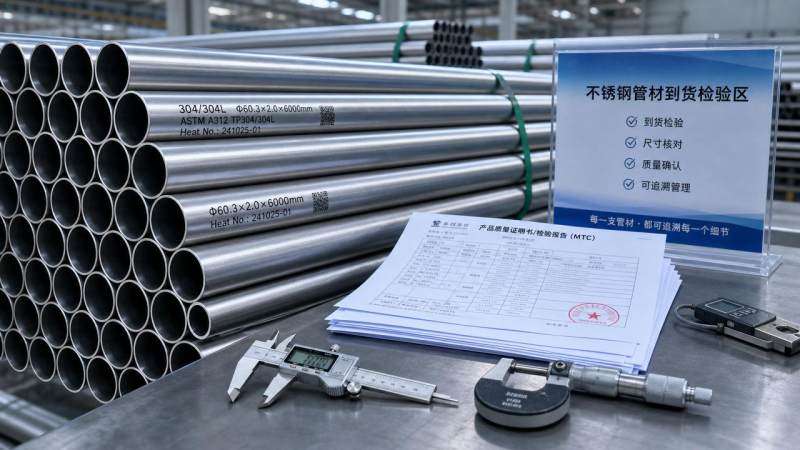
Recent project demands show a clear shift toward tighter incoming inspection for every stainless steel pipe shipment.
More projects now involve aggressive environments, higher pressure systems, and stricter code compliance.
At the same time, international sourcing has increased variation in markings, packaging, and mill documentation.
This means a stainless steel pipe that looks acceptable may still fail specification review.
For structural and industrial steel supply, control at receipt protects downstream fabrication and installation efficiency.
Hongteng Fengda supports this approach through reliable steel supply, international standard compliance, and stable export execution.
The strongest trend signals appear in traceability and verification
The biggest change is not visual inspection alone.
The real shift is toward evidence-based acceptance for stainless steel pipe and related steel materials.
Buyers increasingly compare physical goods against certificates, heat numbers, standards, and ordered tolerances.
This trend is driven by several factors:
These signals matter beyond pipe alone.
Across the steel sector, receiving inspection is becoming a strategic quality gate.
What to check first when a stainless steel pipe shipment arrives
Initial acceptance should move from outer packaging to technical confirmation.
A practical sequence reduces missed issues and supports faster disposition decisions.
1. Confirm shipment identity
Check purchase order numbers, packing list, bundle count, and piece quantity.
Verify that each stainless steel pipe lot matches the ordered specification.
2. Review grade and standard
Compare ordered grade with markings and mill test certificates.
Common checks include ASTM, EN, JIS, and GB references.
A mismatch here can invalidate the entire stainless steel pipe shipment.
3. Measure dimensions and tolerances
Confirm outside diameter, wall thickness, length, and straightness using calibrated tools.
Even small deviations may affect fit-up, pressure rating, or welding preparation.
4. Inspect surface condition
Look for dents, gouges, scale, rust stains, oil, and chloride contamination.
A clean stainless steel pipe surface supports corrosion resistance and fabrication quality.
5. Check markings and traceability
Heat number, size, grade, and manufacturer identification should remain legible.
Missing traceability creates risk during audits and future maintenance work.
Document control now influences steel acceptance more than before
Physical inspection alone cannot confirm full compliance.
Documentation has become equally important in stainless steel pipe acceptance.
Key documents often include:
- Mill test certificate with chemical and mechanical data
- Packing list and invoice consistency records
- Heat number mapping by bundle or piece
- Third-party inspection report when required
- Country of origin and compliance declarations
If the shipment supports a wider construction package, document discipline should cover adjacent materials too.
For example, reinforcement steel often follows similar verification logic.
A related option is HPB300 Rebar, used in load-bearing and structural concrete applications.
It offers yield strength not less than 300 MPa, common sizes from 6mm to 50mm, and shapes like spiral, herringbone, and crescent patterns.
Certified references such as API, ISO9001-2008, SGS, and BV show how steel buyers increasingly value verified standards across product categories.
How these checks affect fabrication, installation, and project timing
The impact of poor acceptance extends beyond the receiving area.
A nonconforming stainless steel pipe can disrupt several business stages at once.
This is why stainless steel pipe inspection should connect quality, logistics, and engineering teams through one acceptance standard.
The most important points to watch in the next inspection cycle
Future acceptance procedures will likely become even more standardized.
Several priorities deserve close attention:
- Build a receiving checklist specific to each stainless steel pipe grade and application
- Use calibrated thickness and diameter tools for every sampled lot
- Require complete MTC review before releasing material to production
- Separate suspect bundles immediately to protect traceability
- Record photo evidence for packaging, markings, and visible damage
- Align pipe acceptance criteria with welding procedure and end-use conditions
These actions reduce sourcing risk and support more predictable steel project execution.
A practical way to strengthen stainless steel pipe acceptance decisions
A strong process starts before the truck or container arrives.
Predefine acceptance criteria in the purchase order, inspection plan, and technical annex.
When the stainless steel pipe shipment reaches site, inspect identity, dimensions, surface, and documents in one controlled flow.
Release only conforming lots, isolate questionable material, and document every deviation clearly.
For global steel sourcing, stable suppliers with strict quality control and international compliance experience make this work easier.
Hongteng Fengda supports construction and industrial projects with dependable steel products, customized solutions, and export-ready quality systems.
The next step is simple: review your current incoming checklist and update it for today’s stainless steel pipe risks, tolerances, and traceability demands.
Please give us a message


Please enter what you want to find