Before any beam, channel, or custom component is approved for use, structural steel testing verifies whether it can truly meet safety, strength, and compliance requirements. For quality control and safety decisions, understanding what these checks cover helps reduce project risk, prevent costly failures, and confirm that steel will perform reliably under real service conditions.
Why structural steel testing matters before approval
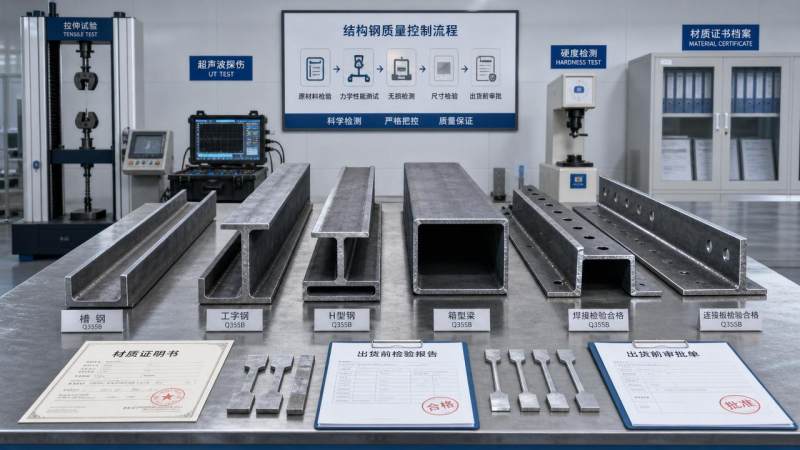
Structural steel testing is not just a paperwork step. It confirms whether the supplied steel matches the ordered grade, meets code requirements, and can carry design loads without unexpected deformation or failure.
In steel projects, approval depends on more than appearance. Test results must support strength, ductility, weldability, chemistry, dimensional accuracy, and surface quality. If one area fails, the whole component may become a safety risk.
For global projects, structural steel testing also helps verify compliance with ASTM, EN, JIS, or GB standards. This is especially important when steel is exported across regions with different acceptance rules and documentation expectations.
Core structural steel testing checklist before approval
Use this checklist to judge whether the material has been properly evaluated before release, shipment, fabrication, or site installation.
- Confirm chemical composition against the specified steel grade. Check carbon, manganese, sulfur, phosphorus, and alloying elements to ensure the material matches the required standard and intended structural use.
- Verify tensile properties through tensile testing. Review yield strength, tensile strength, and elongation values to confirm the steel can resist applied loads and still provide necessary ductility.
- Check impact toughness where low temperatures or dynamic loading apply. Charpy impact testing helps show whether the steel can absorb energy without brittle fracture.
- Measure hardness when wear resistance or fabrication response matters. Hardness values can indicate heat treatment condition, strength consistency, and possible welding or machining concerns.
- Inspect dimensions and straightness carefully. Confirm flange width, web thickness, wall thickness, length, squareness, camber, and twist remain within specified tolerances.
- Examine surface condition for cracks, laminations, scaling, rust, pits, and edge damage. Surface defects may reduce fatigue life, corrosion performance, or downstream fabrication quality.
- Use non-destructive testing where hidden discontinuities are possible. Ultrasonic, magnetic particle, or dye penetrant methods help detect internal flaws without damaging the part.
- Review weldability factors before fabrication approval. Carbon equivalent, chemistry balance, and mill condition affect preheat needs, cracking risk, and welding procedure qualification.
- Check coating or surface preparation if corrosion protection is specified. Blasting cleanliness, galvanizing quality, and paint adhesion can affect long-term structural durability.
- Match mill test certificates to physical material identification. Heat numbers, batch records, and traceability marks must align with the delivered steel and test report set.
What each test result really tells you
Mechanical performance
The most recognized part of structural steel testing is mechanical testing. Tensile testing shows how much load the steel can carry before yielding and before breaking. Elongation indicates whether the material can deform instead of failing suddenly.
Impact testing becomes critical for bridges, offshore structures, cold regions, and seismic applications. A steel grade may look acceptable on paper, yet poor toughness can still create brittle fracture risk in service.
Chemical and metallurgical control
Chemistry testing verifies whether the steel grade is genuine. Excess sulfur or phosphorus can reduce toughness. High carbon may improve strength, yet it can also make welding more difficult and increase cracking sensitivity.
Microstructure review is sometimes added for critical components. Grain size, segregation, or improper heat treatment can explain unexpected test failures and help identify processing issues at the mill.
Dimensional and visual acceptance
Approval often fails because of shape or tolerance problems rather than strength. A beam with incorrect flange dimensions or a cold formed profile with excessive twist may create fit-up problems, misalignment, or added field rework.
Visual inspection also matters because some defects are obvious before any instrument is used. Lamination at cut edges, heavy corrosion, or severe denting should trigger further review rather than simple acceptance.
In some projects, material reviews cover more than carbon steel sections. When corrosion resistance is part of the design, products such as 304L Stainless Steel Pipe may be selected for related process lines or exposed systems. Its ultra-low-carbon chemistry, strong toughness, and compliance with ASTM, EN, JIS, GB, AISI, and DIN standards help address intergranular corrosion concerns while keeping good machinability.
How structural steel testing changes by application
Building frames and commercial structures
For building frames, structural steel testing usually centers on yield strength, tensile strength, dimensions, and weldability. Reliable fit-up and certified traceability are essential because fabricated connections depend on consistent section geometry.
Fire protection systems, coatings, and connection zones may need additional checks. If the steel will be galvanized or painted, surface condition becomes part of approval, not just a finishing concern.
Industrial plants and heavy equipment
Industrial projects often involve repeated loads, vibration, heat, or corrosive environments. Here, structural steel testing should go beyond basic tensile results and include toughness, hardness, and non-destructive examination where fatigue is possible.
Mixed-material systems are common in these settings. For example, stainless process piping and carbon steel supports may be reviewed together. In that case, corrosion compatibility and standard matching become part of the wider approval logic.
Infrastructure and export projects
Bridges, transmission structures, ports, and export packages usually require stricter documentation. Structural steel testing must support local code acceptance, shipment traceability, and third-party inspection records.
When steel is sourced internationally, stable quality systems matter as much as individual test values. Manufacturers with modern production control and experience across ASTM, EN, JIS, and GB requirements can reduce approval delays and sourcing risk.
Common gaps that delay approval or create hidden risk
Relying only on mill certificates is a common mistake. Documentation is necessary, but it does not replace receiving inspection, dimensional verification, or additional testing for critical applications.
Ignoring toughness requirements can be costly. Steel may pass tensile criteria yet still perform poorly in cold weather, seismic zones, or impact-prone conditions.
Overlooking traceability can break compliance. If heat numbers are missing after cutting or fabrication starts, proving material origin later becomes difficult or impossible.
Skipping non-destructive testing on thicker sections creates blind spots. Internal laminations or weld-related discontinuities may remain undetected until service failure or assembly trouble appears.
Treating surface defects as cosmetic can also lead to rejection later. Coating adhesion, fatigue resistance, and corrosion life often depend on surface condition at the approval stage.
Practical steps to execute structural steel testing effectively
- Define the required standard, grade, and application conditions before production begins.
- Set a testing plan covering chemistry, mechanics, dimensions, surface quality, and NDT where needed.
- Verify that sample locations, test frequency, and acceptance limits match the governing specification.
- Keep traceability from raw material to finished component using heat numbers and batch records.
- Review reports alongside physical inspection instead of treating documents as the only approval basis.
- Use qualified producers with stable capacity, strict quality control, and export standard familiarity.
Final takeaway
Structural steel testing checks far more than simple strength. Before approval, it verifies chemistry, mechanical behavior, toughness, dimensions, surface condition, internal soundness, and traceable compliance with project standards.
A disciplined review process helps avoid rejection, rework, and in-service failure. For global steel supply, choosing a source with dependable manufacturing, customized capability, and standard-based quality control makes structural steel testing more meaningful and easier to trust.
The next step is simple: build an approval checklist around the actual service environment, confirm every required test before shipment, and tie each result back to the intended structural function of the steel.
Please give us a message


Please enter what you want to find